My list of 100 best novels: A lifetime’s treasure trove

In one of the classrooms in the Inst W block, soon to be demolished, there was a small fiction library.  One day in the late 1960s, as I was examining the books on loan, I discovered a flyer announcing a competition to decide on the best novels published by Penguin. A list of 50 titles was proposed. I didn’t enter the competition but kept the flyer and decided to make it my aim to read each of those 50 books.

My Irish bookcase

Recently the Guardian came up with another list, this time of the 100 best novels of all time, chosen by a panel of contemporary authors. I had read half of them, many also included in the 1960s Penguin list. However times and tastes have changed and some titles from the 1960s were missing. T. E Lawrence’s Seven Pillars of Wisdom, a book I never got round to reading, was not included. Surprisingly neither was Huckleberry Finn by Mark Twain. Perhaps the Guardian no longer considers some authors to be politically correct.  Woman authors take up a large part of today’s Guardian list, whereas they accounted for only a quarter of titles in the 1960s. I find that I am reading more woman authors these days, but I don’t think that four novels by Virginia Woolf should be included in the top 100.  

So I’ve been working on my own list of 100 best novels. It’s drawn from the Penguin list of the 1960s, the Guardian list of 2026, with additions of my own. Unlike the Guardian I decided to choose only one title per author. This gave scope to include many more novelists. The titles have not been put in order of merit, although books that are widely recognized as among the best ever written tend to be near the beginning. The novels are named in the language in which I read them. Over the last sixty years I have read every page of all these books, with the exception of Proust, where I have only read the first two volumes. Does he merit the time and effort to read all 4,000 pages?

Of course all lists like this are subjective: there is no such thing as the perfect list of best novels. Each year new novels are written and old ones are forgotten.  I’m not the same reader I was when I was a schoolboy. Books that moved me then, may today leave me cold. My list is unbalanced, prejudiced even, including a disproportionate number of Irish writers. Many amendments have been made to the list since I started it, and no doubt it will change again until I press the publish button on this post. Whatever the final choice, I find something intriguing, magical even, in a list of best novels. It’s like a lifetime’s treasure trove.

Please send me your comments and suggestions. Do you think that I have neglected any first-class authors? If so, who and why?  Have I chosen the best book by each author?  Is there an author or book here that you find poor, pretentious, boring or unreadable?  What’s your favourite?  What about a top ten?

Here goes:

  My best hundred novels

  1. George Eliot: Middle-march
  2. James Joyce: Ulysses
  3. Jane Austen: Persuasion 
  4. Marcel Proust:  A la recherche du temps perdu 
  5. Joseph Conrad: Nostromo
  6. Muriel Spark: The Prime of Miss Jean Brodie
  7. Italian Calvino: If On A Winter’s Night 
  8. Miguel Cervantes: Don Quixote
  9. Charlotte Brontë: Jane Eyre
  10. Charles Dickens: A Tale of Two Cities
  11. Graham Greene: The Heart of the Matter
  12. Gabriel Garcia Marquez: Love in the Time of Cholera
  13. Flann O’Brien: The Third Policeman
  14. Edna O’Brien: The Country Girls
  15. Leo Tolstoy: War and Peace
  16. Ernest Hemingway: For Whom The Bell Tolls
  17. Eugene Mc Cabe: Death and Nightingales 
  18. Kipling: Kim
  19. Virginia Woolf: Mrs Dalloway
  20. Gustave Flaubert: Madame Bovary
  21. Emile Zola: Germinal
  22. Stendhal: Le Rouge et le Noir
  23. Oscar Wilde: The Picture of Dorian Gray
  24. Nabokov: Lolita
  25. Kurt Vonnegut: Slaughterhouse 5
  26. Heller: Catch 22
  27. Thomas Mann: The Magic Mountain
  28. Henry James: Portrait of a Lady
  29. Thomas Hardy: Tess of the d’Urbervilles
  30. Emily Brontë: Wuthering Heights
  31. Ian McEwan: Atonement 
  32. Kazuo Ishiguro: The Remains of the Day 
  33. Murakami: The Wind-up Bird
  34. Brian Moore: Lies of Silence
  35. George Orwell: 1984
  36. Herman Melville: Moby Dick 
  37. Laurence Sterne: The Life and Times of Tristram Shandy 
  38. Arundhati Roy: The God of Small Things  
  39. Margaret Atwood: The Handmaid’s Tale  
  40. William Thackeray: Vanity Fair
  41. Rohinton Mistry: A Fine Balance
  42. Amitav Ghosh: The Hungry Tide
  43. J.M. Coetzee: Disgrace
  44. E.M. Forster: Howard’s End
  45. Albert Camus: La Peste
  46. Chimananda Ngozi Adichie: Half of a Yellow Sun 
  47. Daphne du Maurier: Rebecca 
  48. Iris Murdoch: The Sea, the Sea
  49. John Banville: The Sea
  50. Irving Welsh: Trainspotting 
  51. Elisabeth Bowen: The Last September 
  52. Molly Keane: Good Behaviour
  53. Anna Burns: Milkman
  54. Isabelle Allende: The House of the Spirits
  55. Robert Louis Stevenson: Treasure Island
  56. Walter Scott: Old Mortality
  57. Dostoyevsky: Crime and Punishment
  58. Herman Hesse: The Glass Bead Game 
  59. D.H Lawrence: Sons and Lovers
  60. J.G Farrell: The Siege of Krishnapur 
  61. Henry Fielding: Tom Jones
  62. Igor Turgenev: Fathers and Sons
  63. Jean Rhys: Wide Sargasso sea 
  64. Doris Lessing: The Grass is Singing
  65. Steinbeck: The Grapes of Wrath
  66. Jack Kerouac: On the Road 
  67. V.S. Naipaul: A House for Mr Biswas 
  68. Jonathan Swift: Gulliver’s Travels 
  69. Alain Fournier: Le Grand Meaulnes
  70. Milan Kundera: The Unbearable Lightness of Being
  71. Leila Slimani: Chanson Douce
  72. Anthony Trollope: Phineas Finn
  73. Honoré de Balzac : Père Goriot
  74. Harper Lee: To Kill a Mockingbird
  75. Aldous Huxley: Brave New World
  76. Chinua Achebe: Things Fall Apart
  77. Robertson Davies: What’s Bred in the Bone
  78. John Steinbeck: The Grapes of Wrath 
  79. Daniel Defoe: Moll Flanders 
  80. Evelyn Waugh: Scoop 
  81. Mark Twain: Huckleberry Finn
  82. Vikram Seth: A Suitable Boy 
  83. Alexandre Dumas: Vingt an après
  84. Mario Vargas Llosa: The Bad Girl 
  85. Alan Paton: Cry the Beloved Country
  86. Jose Saramago: Blindness
  87. Umberto Eco: The Name of the Rose 
  88. Italo Svevo: Zeno’s Conscience 
  89. Homer: The Odyssey
  90. Pat Barker: Regeneration Trilogy 
  91. Nadine Gordimer: The Handgun
  92. Michael Ondaatje: The English Patient
  93. Jan Carson: The Raptures
  94. Carlo Levi: Christ stopped at Eboli
  95. William Boyd: The Ice-Cream War
  96. Claire Keegan: Foster
  97. Lewis Carroll: Alice in Wonderland
  98. Saul Bellow: Herzog 
  99. Bernard McLaverty: Grace Notes 
  100. Malcolm Lowry: Under the Volcano

Since first publication I’ve amended this list to take account of a number of suggestions. Several readers quickly pointed out spelling mistakes and doubles. This proves that my list was not a copy/paste effort or one generated by AI. AI has become so all pervasive these days that I think that writers prone to human errors and misspelling (sp ?) will soon make a comeback. Mark Twain and W.B.Yeats spring to mind. The most controversial choice was Dickens’ Tale of Two Cities, considered by two readers as one of his weakest books. But I loved it when I first read it, aged 15, and there is no other book whose first and last lines I can remember.

Reading about pirates

In defence of the 21st President of the United States of America

When I was a boy my father told me that our family was closely related to Chester Alan Arthur, the 21st President of the United States. Chester’s father, like mine, was a preacher who grew up on a small farm in North Antrim. 

Until recently I had met few people who had heard of Chester Alan Arthur, the Vice-President who took office in 1881 when President Garfield was assassinated. However, Chester’s obscurity did not prevent me from celebrating my relationship with the holder, from 1881-1885, of the most powerful office in the world.

In honour of my cousin, I named this blog “Closely related to Chester”. According to a recent biography entitled the “Unexpected President”, Chester Arthur turned out to be good at his job, rising above his  previous association with corrupt elements of the Republican party, and introducing an important reform of the civil service when he reached the White House. He was also an elegant man, “dignified, tall and handsome” who was known by his many admirers as the “dude President”.

Last week I learnt that NETFLIX had put out a new mini-series, “Death by Lightning”, about the assassination of US President Garfield. I wondered if Chester Arthur would feature in it and was eager to see how he would be portrayed.

A travesty ! Oh, how my eyes burned to see how the truth can be sacrificed on the binge altar, and how a good man’s reputation can be tarnished in the name of entertainment. What an injustice has been dealt out to my undeserving kinsman! 

Things start badly and then get worse. Chester is shown progressively as a thug, a drunkard, a lecher and a buffoon!  He was none of those things. The mini-series may be accurate in its portrayal of the physical assassination of President Garfield, but there is no historical evidence for the character assassination of his Vice-President.

The actor Matthew Macfadyen, of Succession fame, turns in a fine performance as the mad assassin, Guiteau, and many people will watch the show to see him. However, there is little to say about James Garfield, either before or after his three-month Presidency: not enough of a story here.

Question: How do you spin a one-off historical episode into a mini-series?

Answer: introduce a pantomime clown/villain. Boo! Hiss!

Poor cousin Chester, I sympathize with you. Unfortunately, when unscrupulous film producers decide to portray someone badly, viewers believe the images they see, however distorted and inaccurate. 

The reviewer in the Guardian fell for the trap, but I won’t repeat all the unfair words he used about “Stovepipe” Arthur.

It is some consolation to read a review of “Death by Lightning” by Destry Edwards who fact checks the string of falsehoods about Chester Arthur (viz: no clown, no drunkard, no thug and no lecher). I look forward to the film of Edwards’ true-life story of how Chester rose to the job of US President, not after a slap in the face by President Garfield’s wife, but after reading encouraging letters from one of his strongest supporters.

In the meantime, I proudly maintain the title of my blog, and refer readers to the chapter about Chester in my book “The Corncrake’s Welcome” in which I gave new meaning to the acronym MAGA – Make Arthur Great Again!

https://cei.org/opeds_articles/death-by-lightning-fact-vs-fiction/

https://troubador.co.uk/bookshop/autobiography/the-corncrakes-welcome

Bob Dylan at Bozar: no phones home

Palais des Beaux Arts, Brussels

The first time I saw Bob Dylan was in Belgium in the 1980s, at Anderlecht football ground. His band occupied a stage at one end of the pitch while we stood at the other. We could scarcely see him nor make out the songs he was singing, so distant was the band and so successfully did Dylan disguise his well-known words and tunes. 

The second time was at a concert was in Uruguay in 2006, at the Conrad Hotel in Punta del Este. The audience was made up of rich young Argentinians on holiday, calling their friends by mobile phone and then waving to one another across the stadium. I strained to listen Dylan singing “Like a Rolling Stone”, one of the anthems of my youth, but the Argentinians paid little attention. They were a different generation. For them it was all about being seen in the right place, and they spoiled my experience.

When I learnt that Dylan was playing once more in Brussels, this time in the intimate and beautiful Palais des Beaux Arts, I didn’t think twice. He is now 84 years old – no spring rooster crowing at the break of dawn. We bought tickets and travelled from Italy to Brussels for the concert.

What attracted me most to this concert was that it was without phones. Dylan had decided to disarm philistines and hangers-on, people addicted to capturing images that they will look at once and then discard. He seemed to be caring for genuine fans like me.  At last, I might hear the world’s finest song-writer close-up and without distractions. In his heyday Dylan was a mighty poet, not read in school-books but listened to on the radio, on TV, a troubadour singing for the poor and dispossessed, for freedom, for the whole world. There were other great singer song-writers – Leonard Cohen, Joni Mitchell and Van Morrison, but Dylan soared above them all.  And maybe, in 2025, with his new-found concern for the quality of the audience’s experience, he might even reward us with recognizable versions of his greatest hits.

We arrived at the Bozar an hour early, before the Art Deco entrance doors were unlocked. Our phones were locked away in pouches resembling church money collection bags, except that we allowed to carry them with us. We now had an hour to wait, time to sip a glass of wine and watch as people of all ages walked into the concert hall and stood around. Hundreds of people were happily talking to one other. No heads were buried, fixed on screens, communicating with people elsewhere. We were all together, fully present in the same public space.

With fifteen minutes to go, we took our seats in the “baignoires” – boxes like old-fashioned baths, just twenty yards from the stage. This was the closest I had ever been at a Dylan concert. The hall was packed, buzzing with anticipation, the bells ringing for ten minutes to go and then five, until, right on time, a group of ancient musicians, dressed in black, appeared on stage.  I was reminded of when we used to wait on the Lisburn Road in Belfast for the bands to arrive on 12th July: all of us looking down the road waiting and listening for the music to begin.

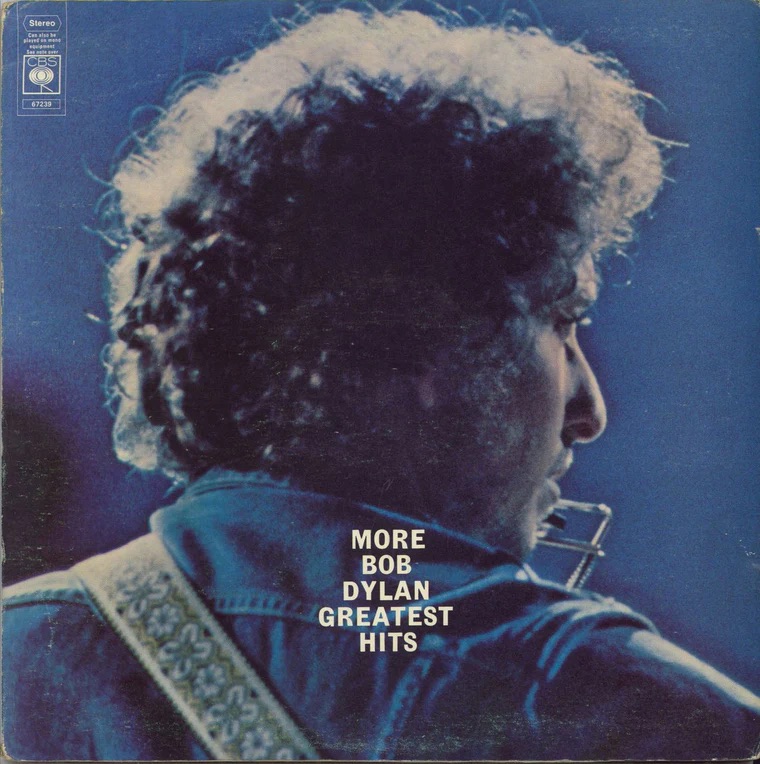
The lights were yellow and low. Dylan, surrounded tightly by his band, started with his back to the audience. The first song brought tears to my eyes. “I’ll be your baby tonight” was on the double LP Greatest Hits 2 which my brother John and I bought for Christmas in 1973. We listened and danced to this music in John’s room until the record player needle broke. It was harder to recognize “It ain’t me babe”, the only one of his early songs that Dylan played. A protest song of sorts, both a personal and public one. He was once more reminding us that he is only the poet, not the leader, not the messiah.

After that it got harder to make out the words in Dylan’s octogenarian guttural growl. I refused to believe Paola when she whispered to me he was singing “When I paint my masterpiece”, perhaps my favourite Dylan song. The tune was different, the rhythm was samba, but she was right. We made out the words “I left Rome and landed in Brussels” and a cheer broke out across the Belgian audience.

Most of the other songs were new – well, new to us. We have not kept up with the 50 plus albums Dylan has brought out in his lifetime. Dylan still seems to enjoy singing the songs he chooses on the night, not the songs the audience wants to hear. He and his band played without a break for eighty minutes. Chapeau ! From time to time he stood up for a few seconds and then sat down. He left the stage with no goodbye, thanks or encore, but we felt that he had given us good value.  

In 1964, at the height of his fame as a folk singer of protest songs, Dylan closed the album “The Times They Are A-Changin’” by taking “The Parting Glass”, a traditional song that he got from the Clancy brothers, and transforming it into “Restless Farewell”. It was a rebuke to critics of magazines like Newsweek who sought to tie him down, to know who had influenced him, and what cereal he ate for breakfast. The song ends with the lines: 

‘So I’ll make my stand

And remain as I am

And bid farewell and not give a damn’

Robert Zimmerman did not disappoint us this time. His idea to lock up our phones made all the difference. And I found it reassuring that he still presents his audiences with an enigma: A complete unknown/With no direction home/like a rolling stone.

Under observation by Jane Goodall

I once met Jane Goodall, the renowned environmentalist, who died last week. 

It was in 2003 and I was Head of Delegation and EU Ambassador to Tanzania. We had a massive programme of cooperation with the country, focusing on infrastructure and agriculture. We were also funding projects to protect the environment in many of Tanzania’s wildlife parks and reserves. These included the small park of Gombe, on the shores of Lake Tanganyika, where for many years Jane Goodall had been observing chimpanzees. There she made the astonishing discovery that our closest relatives in the animal world use tools, a skill that was previously thought to be reserved to our primate species. She also found out that, in certain circumstances, chimpanzees will kill one another and even wage war.

In Gombe, Jane’s organisation, Roots and Shoots, was involving local people in productive activities in order to protect the park, and the EU had funded some of this work. My environment expert in the Delegation briefed me that the funds had not always been used exactly for the intended activities.  He advised me to insist that all previous funds be properly accounted for before agreeing to advance any new money.

So when Jane Goodall arrived for our meeting at the new EU Delegation, I was in cautious mode, eager to listen to this famous person making her pitch for new funding, but also prepared to insist on proper accountability. 

However, instead of asking for new EU funding, Jane Goodall sat in a chair, not opposite but beside me, and said nothing. The slim woman, her blonde hair tied back in a bow, simply looked at me, smiling. This made me feel uneasy, and the more she saw this, the more she kept observing me. I found myself talking, not very coherently, about EU support for the environment. She just sat still without saying a word. It felt as though she were trying to assess what sort of an alpha male primate she was sitting beside. 

After a few minutes of this disturbing silence Jane took out of her handbag a fluffy toy baby chimpanzee and handed it to me.

What was I to do with a fluffy toy ? Of course I held it, but how should I hold it? On my lap? Against my heart? At arm’s length ? This was my first post as a Head of Delegation and EU Ambassador and I had a certain idea of the dignity of my position. There were a dozen people in the room, including my own staff, and it felt ridiculous to be holding a toy chimpanzee in front of them. 

When Jane Goodall finally spoke she said that she had placed the same chimpanzee in the hands of world leaders including Mikael Gorbatchev and Kofi Annan, and she found that the meetings with them had gone very well.

I don’t recall the rest of our meeting at the EU Delegation in Dar es salaam, but I know that from the beginning to the end Jane Goodall had me in the palm of her hand, and the EU did help fund later Roots and Shoots projects. 

As Jane Goodall left Umoja House we posed for a photo in front of the flags of the EU Member States which are flown inside EU Delegations the world over. Her wide green eyes fix the camera confidently, while I am still left holding the chimpanzee. Over the next twenty years she became one of the foremost spokespersons for nature, protecting the environment and combating climate change, someone who inspired millions of people, young and old, all over the world.

Through her many years of observing primates Jane Goodall discovered how closely we are connected to one another and to the natural world. She shared her unique understanding with us. She believed that ‘each of us makes a difference and that we have to decide what sort of difference we will make. She gave us all ‘reason for hope’.

Ancient and Modern in Greece 

 As I close one decade and enter a new one, I ask myself whether it is better to revisit familiar places or to explore new horizons. Is it more rewarding to travel back, and learn what has changed and what remains, or to set out on a fresh adventure and be surprised by the new? One way to enjoy both old and new worlds is to visit places you know about but have never properly visited. So I have come to Greece for my 70th birthday celebrations.

I find Greece a wonderfully hospitable country. Each of our friendly guides asks us the same three questions: What’s your name? Where do you come from? Have you been here before? Well, I have been here, but my previous visits have been two and far between: a stifling night in a hotel in Piraeus in 1978, returning from my wedding in Tanzania, and a week on the island of Corfu in the 1990s, when we exited the Club Med once for a half day tour. 

If academic studies were an accurate guide to destiny, I would have spent more time in Greece. Ancient Greek is my third foreign language, after French and Latin. My investment in the first two languages has already paid off well. I spent much of my working life in francophone countries, and now, in retirement, I’ve enjoyed almost six months in Italy, where they speak a modern version of Latin. So why haven’t I spent more time in Greece? 

Greece in early spring is as beautiful as it is supposed to be. The birds are singing, and wildflowers explode under the olive trees. The poppies are a deeper more blood-red colour than those showing their first growth in my Edinburgh garden. A few days ago, in the blue and white seaside village of Galaxidi, I listened to the water lapping on the shore and watched as “rosy-fingered dawn” appear over Mt. Parnassus. My thoughts turned to the Odyssey, taught to us by the late Michael Longley, to Odysseus and Telemachus, and then to my son David running at the same moment across England from West to East. We too also crossed mountains, the snow-covered Pindus range, not on foot but in a jeep. For a few hours, in that remote part of Greece, close to Albania, we were well away from the madding crowd of other tourists.

Before this visit I already knew much about this country’s history, culture, and religion. For two years in the mid-1960s I was one of a small band of pupils who chose to study Ancient Greek, and obtained two O-levels—one in the language and one in the Greek New Testament. The Good Book was first written in Greek, as I was reminded when we visited Corinth, and saw where St. Paul faced his accusers. When I was fifteen I was able to translate the entire Gospel according to St. Mark into English. It helped that I was well-versed in the English text.

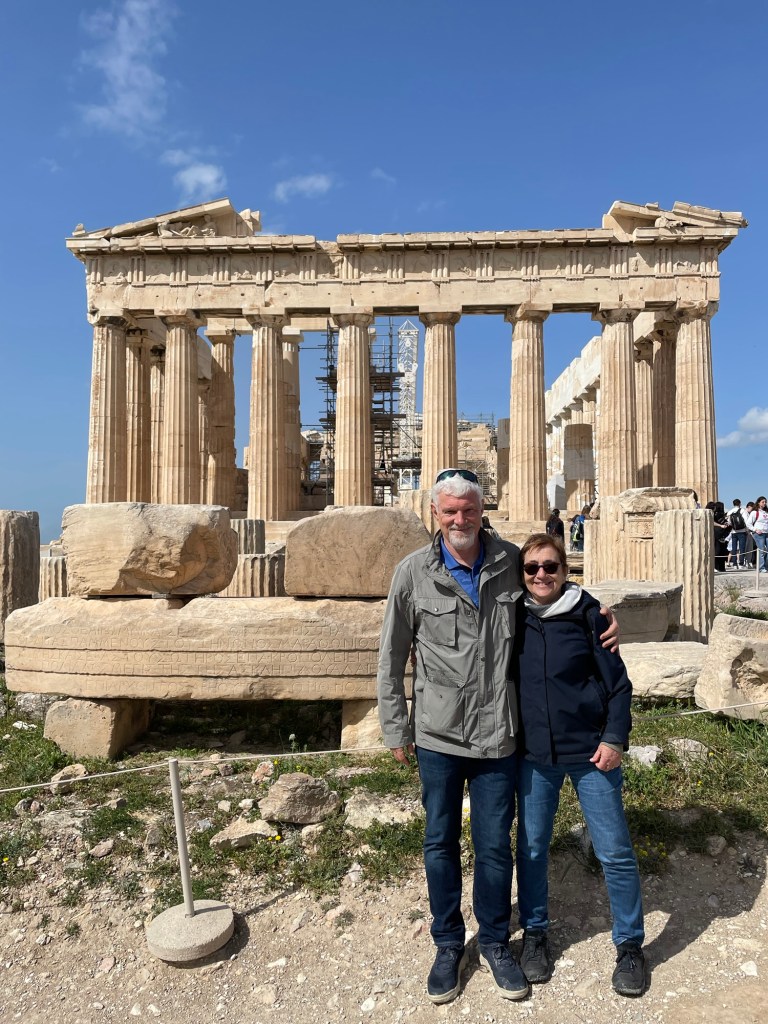
When we visited the Acropolis on my birthday, and posted a picture to prove it, one of my Facebook friends remarked that this was a ‘confluence of ancient ruins’. Ha ha, Dave. I had a similar thought, but kept it to myself. Good word ‘confluence’, but of Latin origin. I would prefer ‘synchronization’ from the Greek, meaning ‘in time with’.  

The Temple at Delphi

From that vantage point, high above the city of Athens, we looked down at the theatre where Sophocles’ tragedy Antigone was first performed. I thought of our teachers, Old Rothers and Charlie Fay. It is the only play I have ever performed in —in both Greek and English—hiding my nerves behind a giant mask of the Chorus.  

The Agora and temple of Hephaestus

Of course, today there is the slight problem of updating my knowledge of Ancient Greek to Modern Greek. Judging by their puzzled reactions, today’s Greeks have difficulty understanding their own archaic tongue, particularly when spoken with a Belfast accent. Over the last two millennia some vowels have shifted, and some consonants have clustered in confusing ways. 

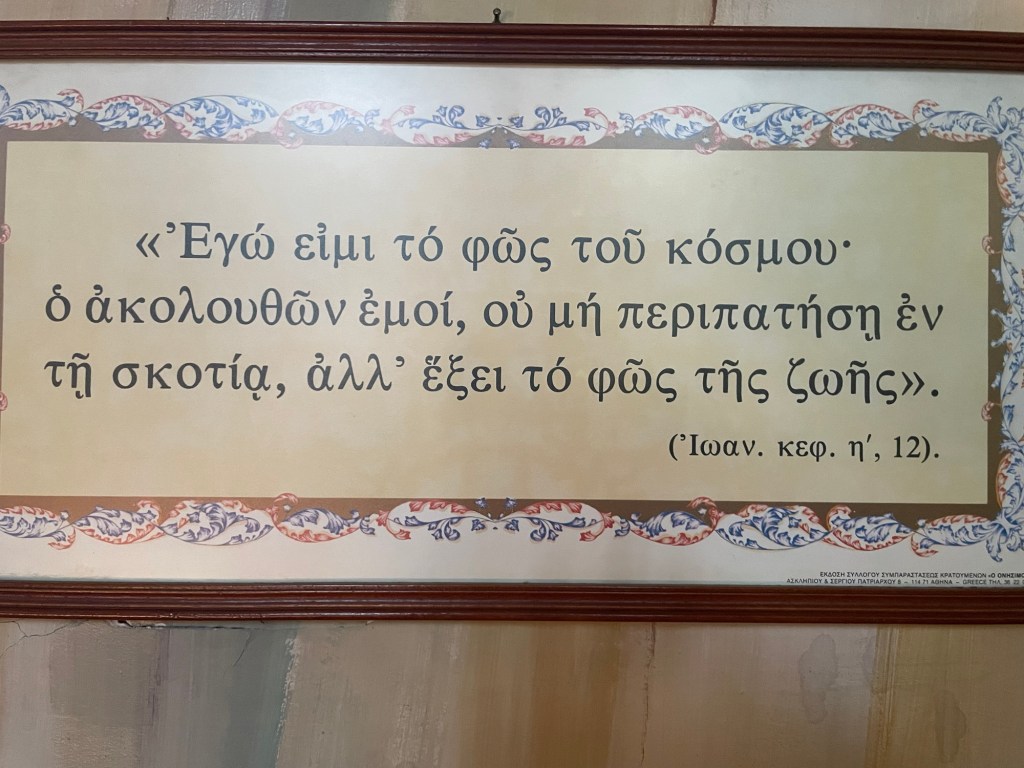
Notwithstanding these impediments, as I travel through this country I feel that the Greek language insurance policy I took out fifty years ago has finally matured. It is satisfying to be able to decipher and make sense of the characters of the 24-letter Greek alphabet. In a restaurant, this reveals the simplest words for potatoes and tomatoes. Along the highway, I discovered the place name Thermopylae, just in time to ask the driver to stop at the battlefield where the ancient Spartans made their last stand. And in the amazing monasteries of Meteora I was able to decipher the biblical texts on the walls. Each small success — with menus, the names of streets, or scripture— gives me the simple joy of connecting with ancient and modern people through a shared language.

‘I am the light of the World.’ St John’s gospel

Michael Longley

The poet Michael Longley, previously mentioned in this blog, died last week at the age of 85. I had the good fortune to have Michael Longley as my English teacher at Inst from 1967 to 1969. He was an inspirational young schoolmaster, introducing  us to Homer, to Stravinsky, and, in person, to his friend Seamus Heaney, who read some of his first poems to us. Fifty years later I had the privilege to meet Michael again, when I interviewed him, during lockdown, for the Wigtown Book Festival.

With no experience of this sort of interview, I was a wee bit nervous at first, but Michael soon put me at ease, and I greatly enjoyed our conversation. I asked him about the different themes of his poetry and he read some of his favourite pieces. Towards the end of the interview, in answer to questions from viewers, he gave some fascinating insights into the art of writing poetry.

Over the years I carried the slim volumes of Michael Longley’s poetry with me all over the world. I recall asking his permission to read ‘Ceasefire’ at BRAC University in Bangladesh. Michael kindly allowed me to quote from two of his poems as epigraphs in my books of memoirs. My favourite poem of his used to be ‘Detour’, in which he imagines his own funeral meandering along the main street of an Irish market town, never reaching a conclusion. No doubt it will be read this week. I now think that my favourite poem is ‘Laertes’ which he chose, explained and read at the Wigtown Festival. Here is the link to the U tube video of our interview, called the Candlelight Master. The conversation starts at minute 6.20.

The Maria Raffo

Nonna Maria, centre right, with grand-daughter Paola, standing in front.

On one of my first visits to Italy, in the late 1970s, Paola introduced me to her grandmother. Nonna Maria spoke no English and I had learnt just a few phrases of Italian, but we smiled at each other and I learned afterwards that the matriarch had pronounced that I was a ‘ragazzo per bene’ – a suitable boy.

Nonna Maria died a few years later. Paola and I were married in 1978 and spent the following forty years living and working around the world. A couple of years after retiring we decided to look for somewhere warm to spend the winter months. We focussed on Liguria, the Italian riviera, which extends on either side of Genoa, from Ventimiglia at the French border, to Cinque Terre in the South. Paola’s brother and several cousins lived here, and her nonna Maria had originally come from Genoa, or so I thought.

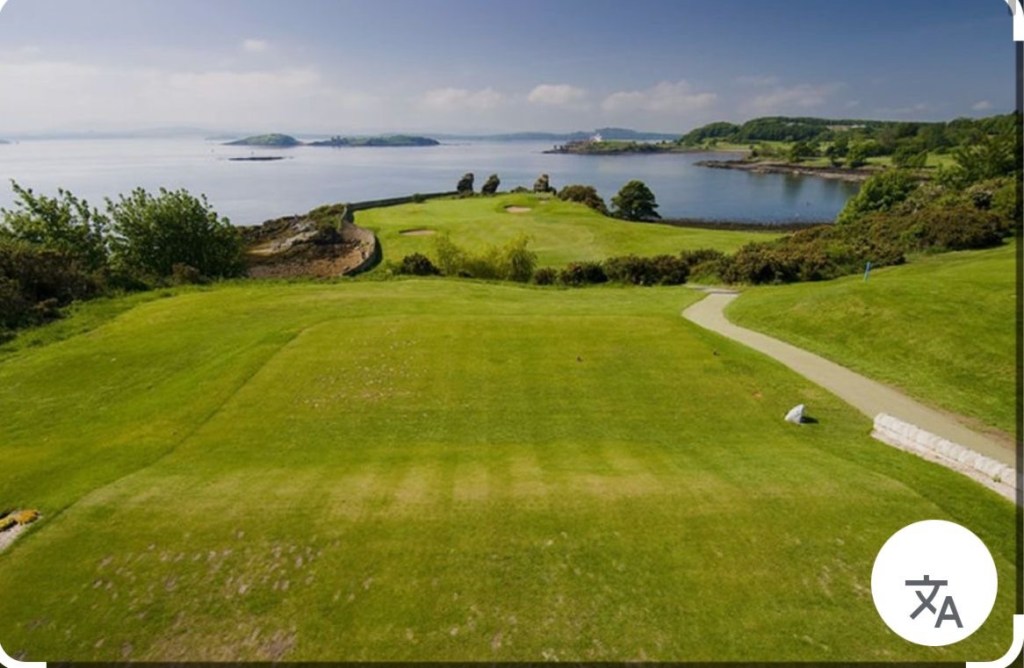
In autumn 2022 we drove from Belgium through Switzerland to Italy and began our search for a suitable winter home. I had only one condition: that there should be a golf course nearby. I am addicted to the game, and sport is a great way to make friends in a new country. We found an excellent course in Garlenda, but it was not particularly welcoming. Golf is still an elite sport in Italy, with the associated golf snobbery. We travelled from the Ponente (sunset) side of Liguria to the Levante (sunrise) side and spent a week in Lerici, on the beautiful Bay of Poets, which Shelley and Byron visited in the 19th century. The sunsets were spectacular, but there was only a miniature golf course.

However we found a more promising 18 hole golf course in Rapallo, a town which was also once frequented by poets – W.B.Yeats and Ezra Pound held court there in the 1920s. I made up a three ball with two club members who had recently retired from Turin and Milan. These gentlemen were good company, not over fussy about the golf, but, like most Italians, obsessed with food. After the 14th hole they enquired if I was not hungry and suggested that we adjourn for lunch, as the kitchen was closing soon. Over a tasty dish of spaghetti, and a good bottle of wine, we chatted about the essential criteria for a winter home. They recommended that I avoid small touristy places which would be dead in December. Instead they suggested I should consider nearby Chiavari, a town with a large local population. Many people from Chiavari emigrated to South America, in the 19th and early 20th centuries, where they made their fortune. On their return to Chiavari, in the 1930s, they constructed palazzi on wide avenues with names such as Corso Buenos Aires or Corso Montevideo. In Chiavari I might find an apartment in one of the palazzi from that era to renovate.

When I told Paola about my conversation with the golfers, and suggested that we try Chiavari, she consulted her relatives. They pointed out that Chiavari was in fact Nonna Maria’s birthplace. She had lived in the city until, aged seventeen, she eloped with Paola’s grandfather. (He was already married, with several children, but that is another story.) So Paola was happy for us to explore Chiavari, where she had family roots.

We found a friendly B & B and liked the feel of the city. There was a marina,with sailing boats, and a wide seaside promenade which offered regular saffron sunsets. In the town ancient narrow streets, bordered by colonnades, were packed with little shops. Even in December Chiavari was full of people walking up and down the Carrugio, chatting in groups or having coffee.

We viewed a few apartments, but found nothing exceptional, until I came across an agency specializing in renovations. They took us to visit a palazzo built in the 1930s. Over the entrance was the figure of a sailing ship, cast in iron. We climbed up marble stairs to a third-floor apartment and were struck by the entrance hall with its Art Deco tiled floor. The house was owned by a family once famous for the manufacture of tiles, and in each room the floor had a different pattern. Part of the apartment was being used as offices and there was little furniture. The main room was bright, facing South. I looked out to palm trees and the marina, and beyond a myriad of little boats sailing on a shimmering blue sea. I could imagine us settling in this place, and so could Paola.

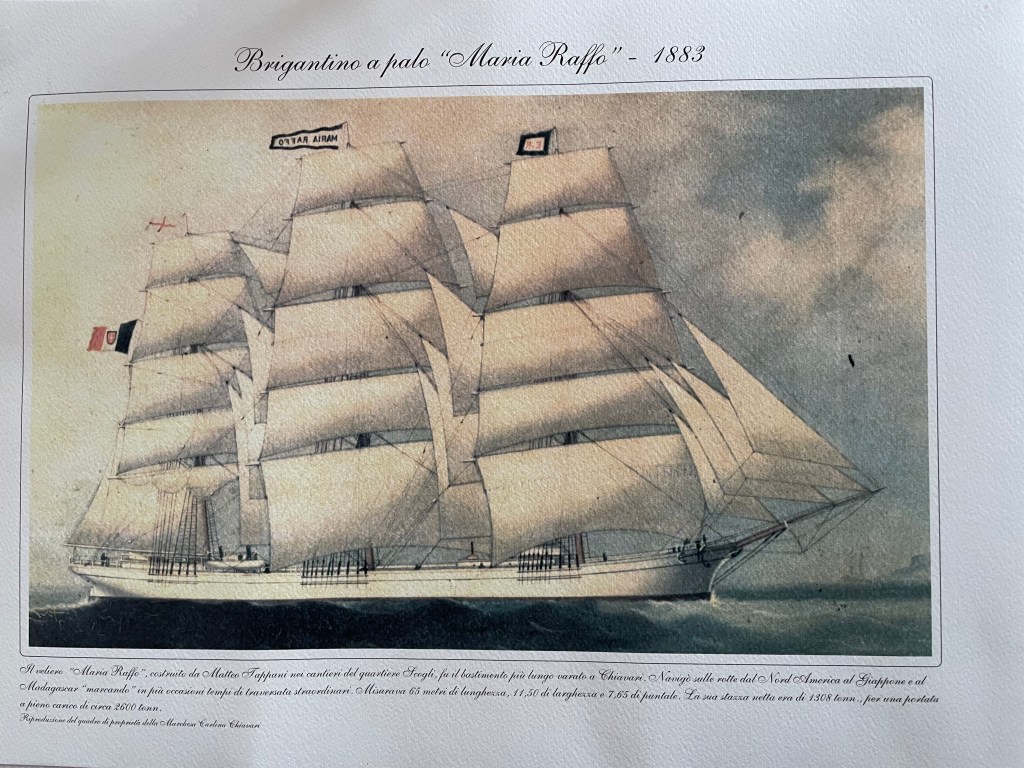
Turning away from the view, my eye was caught by a framed picture lying abandoned in the corner of the room on an old sideboard. I walked up to have a closer look. The picture was a drawing of a three-masted sailing boat, a Brigantine, and written in italics at the top was the boat’s name.

The boat was called the Maria Raffo, which is the full maiden name of Paola’s grandmother, nonna Maria Raffo.

This was a sign, a blessing from nonna Maria. We looked no further. We bought the flat, renovated it, and are living in it two years later.

At Christmas Paola gave me a copy of the Maria Raffo drawing which you can see below. The boat was built in Chiavari in 1883 for the shipowner Ernesto Raffo. It was remarkably fast and resistant in storms. For many years it carried goods across the Pacific Ocean, from the US to Japan, breaking records for speed. We have not yet discovered the link between Paola’s grandmother and the boat. Perhaps Ernesto Raffo named his boat after his wife. Was she a relative of Paola’s grandmother ? Whatever the precise history, these days Paola feels quite at home putting down new roots in Chiavari, the city of her grandmother, where everyday, as she goes to market and gets to know the inhabitants, she is no doubt meeting people to whom she is in some way related.

Exile in Paradise

Sandy Lane, Barbados

In 1685, during the reign of Charles II, the covenanter William Hanna of Wigtown in south west Scotland was banished to Barbados for his refusal to acknowledge the King’s religious authority. Britain had established an important colony on the tiny Caribbean island, with sugar plantations, worked first by indentured labour and later by African slaves. It is not known whether my namesake made it safely across the Atlantic to captivity in Barbados. Many ships were wrecked on the voyage there and he may have drowned on the way.

Three centuries later Barbados, with a population of 250,000, had become an independent country, the proud ‘craftsman of its fate’ and a growing tourist destination. It was a model democracy, with a long established Parliament. It still exported sugar and rum, and produced some of the finest cricketers in the world. Tourists thought of it as paradise.

Barbados was also the location for the Delegation of the European Commission to the Eastern Caribbean. A strange set of circumstances decreed that Barbados would be my first Delegation, and that I should enjoy a more fortunate exile than my courageous Scottish forefather.

Continue reading “Exile in Paradise”

The Best of Irish Presbyterianism

One of the joys of writing is learning the response of readers. Strangers tell you that they have enjoyed your story. Old friends get back in touch, and you learn more about one another. And sometimes people whom you did not know well show that they have understood you through your writing: they “really get you”.

Neil Faris was one such understanding reader. I had known Neil since I was a child, but I am closer in age to his younger brothers, Paul and John. I started school, at the age 4, in the same class as Paul, and I was best man at his wedding. John, who became a clergyman, kindly took the service at my brother’s funeral in 2017.

Neil followed this blog. He enjoyed my first book of memoirs Voyages with my Grandfather and encouraged me to write the seque The Corncrake’s Welcome. I sent some chapters to him and he offered meticulous and pertinent observations.

When I learnt that Neil was suffering from a severe form of cancer, I made a point of meeting up with him in Belfast. He was undergoing treatment and was not well, but we enjoyed coffee and scones at a cafe on the Lisburn Road, on a chilly October day. Six months later, he invited me for tea at his flat on the Malone Road, on a bright May morning. We chatted about our families, who have known each other for three generations, and we found that we viewed the world from similar standpoints. He was the grandson of a Presbyterian Minister, and I was a son of the Manse. We both attended Belfast Inst and both went on to study law. Neil’s years at Trinity College and mine at the Department of Foreign Affairs in Dublin broadened our Northern Irish perspective. I felt both enriched and stimulated after our conversations.

Neil died last month. Tributes from friends and colleagues appeared in The Newsletter and the Belfast Telegraph. Neil had been a leading Northern Irish lawyer who fought for justice, human rights, and the environment, and had made a difference in all these fields. He kept going right to the end.

After his death I realised that Neil left me a gift, in the form of a review of The Corncrake’s Welcome which he wrote earlier this year. He thought that it needed polishing, and wanted to discuss it with me, but we were not given the opportunity to do so. Here it is, unedited, and sorry I am to lose an old/new/good friend and a valued reader.

Review of The Corncrake’s Welcome  – William D Hanna, Troubador Publishing Limited, Market Harborough

William Hanna was  a son of Windsor Presbyterian Church Manse on the Lisburn Road in Belfast, becoming, in a diplomatic career,  an ambassador of the European Union. The Corncrake’s Welcome is his engaging memoir of his and his family’s  life and times in the Belfast of the 1960s and 1970s.  

First of all, William Hanna marries very well elements of  his family history. He was able to persuade his father, Rev William Hanna, to write reminiscences of his childhood in Loughgiel, County Antrim. Rev Mr Hanna records a deep love for the County Antrim countryside, evoking the call of the corncrakes, then common enough in the fields around Loughgiel. The community there was ‘mixed’ between Protestant and Catholic and Rev Mr Hanna developed a lasting friendship with a fellow cleric – who became Cardinal Cathal B Daly and who introduced Rev Mr Hanna to Pope John Paul II on the famous papal visit to Ireland in September 1979.

William Hanna records well how both Rev Mr Hanna and Cardinal Daly were, throughout their years of service in their respective churches, true men of peace in  the long weary decades of sectarian violence that afflicted Northern Ireland (and the island of Ireland and Britain generally). But there is much else of interest in the reminiscences of Rev Mr Hanna: including his origins in the covenanting tradition of the Reformed Presbyterian Church – a tradition that perhaps may be novel to many protestants.

But William Hanna by no means forgets his mother, Honor Hanna. He includes very interesting extracts of 1942 from her World War 2 diary, when as Honor Boyd, she was a nurse in Belfast. As well as recounting the travails of that life and times she records the deep trauma of the loss on active service in Burma of her brother Jack. Truly, as William Hanna writes, 1942 was a fateful year for the family.

The second half of the book is then the  personal story of William Hanna (both growing up in Belfast  & at the start of his career in the Irish Diplomatic Service in Dublin).

Now, the ‘Windsor’ area of South Belfast was by no means immune from the sectarian violence  which intensified across Northern Ireland in the 1960s and 1970s, even though, of course, many other areas suffered far worse. William Hanna  recounts episodes where his father as presbyterian minister stood firm against sectarianism and for peace.

Just one example of this.  Not in any way an incidental point, but William Hanna records a  dreadful sectarian murder at Moore & Oliver’s garage then on the Lisburn Road and almost opposite the presbyterian church. Surely, Rev Mr Hanna was a genuine peacemaker being able to bring not just some comfort to the bereaved family and also, as William Hanna was told,  years later at his father’s  funeral, how in calling on and praying with the bereaved family Rev Mr Hanna had  ‘taken the hate away’. Truly an act of enduring grace.

In summary, there is so much in the book that captures the best of Irish Presbyterianism that it should be appreciated by all those who are presbyterian adherents and also by those who value the contribution that Presbyterianism has made and can make on the island of Ireland and wider afield.

Neil Faris

Dreaming about Bangladesh

Last Sunday night I dreamt about Bangladesh, where I served as EU Ambassador from 2010 to 2014. In my dream I was organizing a diplomatic event, when the Prime Minister, Sheikh Hasina suddenly appeared in the room, totally alone. I had not expected her to attend in person, and I rushed around trying to find a chair for her to sit on, but each one I looked at was broken. Since I was unable to find a suitable chair the PM lay down on the floor. When I awoke I told my wife about the dream. An hour later I learnt on BBC radio news that Sheikh Hasina, who had been in power since 2010, had fled the country, leaving by helicopter before students ransacked her palace.

Although it is ten years since I lived in Bangladesh I still have great affection for the country. People often ask me which of my diplomatic postings I enjoyed the most. I reply that it was Bangladesh. It’s not that the capital, Dhaka, was a comfortable place to live. Far from it: Dhaka usually features as one of the most unlivable capital cities in the world. But the people of Bangladesh captivated me: their language and culture, their courage, resilience and determination to succeed in the face of adversity impressed me profoundly and have stayed with me.

In my book Voyages with my Grandfather ( https://troubador.co.uk/bookshop/travel/voyages-with-my-grandfather) I told the story of my first official meeting with Sheikh Hasina, the then Prime Minister. Soon after my arrival in Bangladesh I learnt of the work of Rabindranath Tagore, the finest poet in Bangla, composer of the national anthems of India and Bangladesh, and winner of the Nobel Prize. I discovered both an Irish and Scottish connection. The Irish connection is W. B. Yeats, who was one of the first westerners to appreciate Tagore’s work. The Scottish connection is Robert Burns. Tagore adapted the words and music of one of Burns’ most beautiful songs to the Bangla language and topography. He transposed ‘Ye Banks and Braes’ into ‘Phule Phule’ which is today one of the most popular folk songs in Bangladesh.

img_1588-1
Bangladesh PM meeting EU Commission President Barroso in 2010

On the day appointed for my first meeting with Sheikh Hasina I was sitting in a large room in her palace, talking nervously to her diplomatic adviser. I told him about Tagore and Burns and started humming the tune of Phule Phule. At that moment the Prime Minister entered the room and sat down on an embroidered settee. Her adviser began the introductions by informing the PM that the new European Ambassador had a song for her. This was not a moment to be bashful. So I started singing ‘Phule Phule, dhole dhole’. And then, for a few moments, Sheikh Hasina joined in and sang the song with me, in a soft and tuneful voice.

I did not mention in my book that I rather spoiled this harmonious start to my new assignment by asking the PM how certain minorities in the country, such as the Rohingya, were being treated. My mandate was to improve relations between the EU and Bangladesh. We promoted trade and business and provided a lot of aid. But our main purpose – the main objective of EU Foreign Policy was, and remains, to strengthen fundamental values such as democracy, the rule of law and human rights. At times this led to a difficult dialogue, particularly in 2014 when we decided not to observe the elections because of the undemocratic actions of the government. This decision displeased the PM. Although I saw the President before I left the country, the PM was unavailable to meet me for a farewell courtesy call.

Over the years since then Sheikh Hasina’s rule became increasingly authoritarian, and student protests grew. I have now retired, and have not been following the events in Bangladesh closely. Last week I had no conscious idea that the protesters were so near to ousting the PM. I suppose my dream must have been a case of my unconscious mind drawing some conclusions.

Speaking to the Press in Bangladesh, 2014

One person who was always prepared to see me, not only when I first arrived in Dhaka, but also when I said farewell, was Nobel prize winner and founder of the Grameen Bank, Muhammad Yunus. I recall his sense of despair ten years ago at the authoritarian direction the country was already taking. Today he has been appointed head of an interim government. I am convinced that Yunus, who is 84, has no political ambitions. He simply wishes to serve his country. He has made some hopeful statements. For my many friends in Bangladesh, and for its millions of people, I sincerely hope that he will be able to ensure an orderly and peaceful transition towards a democratically elected government, in full respect of human rights and democratic principles.