Dr Fay assigned me to the chorus of one of his plays — Antigone — and so I can only make a minor contribution to their history in comparison with those, including the distinguished Irish cleric Rev John Faris, who played the main characters.
I became a classics scholar more by default than design. First form at Inst meant studying foreign languages — French and Latin — for the first time. Our new French teacher was perhaps a better coach of the 1st XV than of 11- year-olds struggling with avoir and être.
However our Latin teacher, Rev. McConnell Auld, was a decent chap, who tolerated our repeated mistakes without pulling our hair. He didn’t seem to notice that we decorated the covers of our New Latin Course textbooks, so that they became so many ‘Newts Eating Courses. The Auld sipped his chocolate, munched his biscuits and exhorted us to soldier on with porto, portas, portat as ‘the girl sits under the tree’ (puella sub
arbore sedet) and as ‘the sailors launch their boats into the sea’,
(nautae scaphas etc). It was because of the more sympathetic teaching of a dead language than a living one that I chose to study Greek in 3rd form, rather than German like most of my friends.
Rothwell was another good chap, though quite eccentric. He seemed to be obsessed with pigs. I wonder if anyone remembers his brilliant Scottish Presbyterian minister’s sermon which included the phrase ‘Where the Wild Haggises Roam’. He was a distinguished classicist who instilled in us a love of the languages. With only five boys in my Greek class, my turn to answer the questions came round so often that learning inevitably took place. Rothers also introduced us to the classical theatre, taking us down to Dublin to see Medea performed at Trinity, and entertaining us to lunch in The Buttery.
So by the time we entered Charlie Fay’s class, we knew classics quite well, and were inoculated to some extent against his infamous wrath. We steered our way through his lessons more or less unscathed, and without being brought to ‘our knees’ too often. Dr Fay may have seemed a monster to pupils who struggled with classics, but he was kind to those who showed any enthusiasm for the subject. We were few and he needed every one of us to take part in his plays.
In my youth I suffered from stage fright. My first and only starring role at school, at the age of seven, was as one of the Pleiades. Fortunately Miss Strahan, the choreographer of this piece of stellar entertainment
for Inchmarlo parents, gave me no words to recite.
A couple of years later my one and only solo performance in the Windsor Church choir also turned out to be a silent one. I had learnt by heart the words of the second verse of The Holly and the Ivy (The Holly bears a berry as red as any blood) but when Alec Mc Neilly gave me my cue to perform in front of the congregation no words came out of my mouth, in spite the organ master’s smiling face, pleading with me to perform.

For a few years after that I succeeded in avoiding any solo stage appearances. When I learnt that my good run had come to an end, and there was no way to avoid conscription into one of Dr Fay’s plays, I was relieved to hide behind a mask, deep in the ranks of the chorus.
The choruses of Antigone were set to music by Geoffrey Trory, or Mr Trog as my Aunt Emily once addressed him, confidently, at a parents’ meeting. I can still remember the rising melody that Trory composed for the first chorus of Antigone:
‘Wonders are many on earth, and the greatest of these
Is Man, who rides the ocean and takes his way
Through the deeps, through wind-swept valleys of perilous seas
That surge and sway.’
Behind my mask I was at last able to perform in public. And I also sang in tune, which is more than can be said for some others, including Fay himself, who belted out the words from the wings when he thought the chorus was not getting its message across to the audience loudly enough.
Looking back today I admire the actors who played the leading roles In Antigone, learning swathes of Greek and English text, while all I had to memorize were a few chorus lines. As John Faris recalls, I also had sympathy for the parents who were condemned to sit through the play twice — first in Greek and then in English. Perhaps some of them sat in the Common Hall on a cold winter’s night, reflecting on ancient lessons about the laws of men and the laws of God. I suspect most were counting the minutes until the final curtain fell and they could drive their offspring safely home, through Belfast’s troubled City Centre streets, back to leafy Malone Road suburbs.
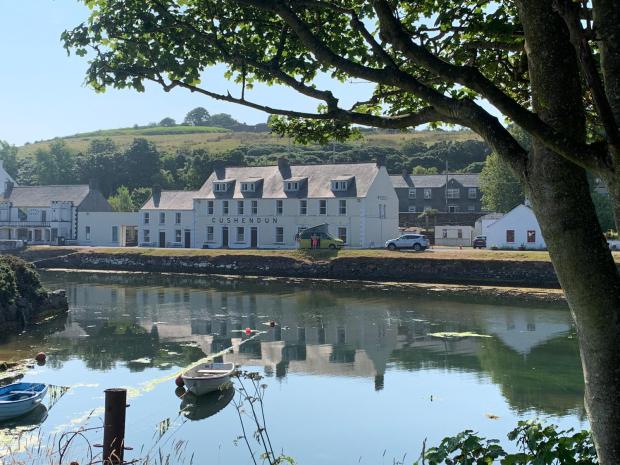
Recently I took my grandchildren to Cushendun and pointed out to them the house where, in 1970, we were summonsed by Charlie Fay to stay for a week with him and his wife and daughter, and study Antigone. That Easter I had been at my uncle’s farm in Loughgiel and had cycled over the mountains, past Slieve na Orra, where in 1583 Sorley Boy MacDonnell won a decisive victory against the MacQuillans, and down through beautiful Glendun to the village. It amazes me today that we were taught next to no Irish history at Inst, and certainly nothing about Sorley Boy MacDonnell, whereas we spent long hours translating Caeser’s Gallic wars and learning of battles between Athenians and Spartans.
At Cushendun Fay gave each of us household tasks. Mine was to sweep the kitchen floor each morning, since then a duty I have always taken seriously. We studied Greek all morning, translating the entire play, and were free after lunch. One afternoon one of the main actors in the play (was he Ismene?) was displaying his skills as a fly fisherman, casting into the river Dun, when a wind arose and he hooked his own ear. He was whisked off to the Cottage Hospital in Cushendall to get the hook removed. Comedy and tragedy are but a breath apart.
Today there is a little statue near the spot. It’s just below the bridge, near where Game of Thrones busses deposit sword-wielding tourists, who march solemnly round to the caves to take selfies, or enact battle scenes from the blood-curdling series, before having coffee at McBride’s. In fact the statue is not in honour of a Game of Thrones hero, Sir Jaime or Eurion, nor of Dr Fay, nor even of our unfortunate fisherman, but of a much-loved local goat, the last animal to be culled in the foot and mouth epidemic. Epi demos — from the Greek — a plague upon the people. We ignore the laws of God at our peril.
Thanks to our talented Classics teachers I did well in Greek and Latin ‘O’ levels. My last memory of Dr Fay is passing him in the N block stairwell, seeing him stop and turn round, with a look of regret. saying, “You should be studying Classics at ‘A’ level”. I did not want to disappoint him, but by that time I had found a good French teacher, outside Inst, and my eyes were fixed on Edinburgh and an M.A. course in Contemporary European Institutions.
Over the years I have sometimes pondered on the tale of tragic destiny that Sophocles presents to us in Antigone. I’ve thought of those old men in the chorus, who we first played when we were adolescents, coming on stage to declare, “Woe is me — the Gods are unhappy — this is not going to turn out well.” I sometimes felt my role as EU Ambassador in different countries, attempting to find common language among 28 national positions, was like leading a Greek chorus. Perhaps now that one of the most out-of-tune Member States has left the stage, the sound will be more EUphonious… perhaps not. As the chorus reminds us towards the end of Antigone “The future is not to be known; our present care is with the present; the rest is in other hands.”

 Closely Related to Chester
That’s a very evocative piece, Willie. Schoolmasters had such an influence and their work resides in our minds forever. My Latin master in first year was a very nice man called Jimmy Geals. He had taught many of the fathers and uncles of those in the form and sometimes muddled the generations but no one minded. I spent two weeks in Lockdown 1 studying Latin again but then the weather made staying indoors impossible and manual labour made staying awake after dinner equally hard.
All the best Malcolm
Sent from my iPhone
>
LikeLike
Thanks for the flattering references, Willie. I learned some hundreds of lines in English and Greek as Creon in Antigone and can only remember the first two of my opening speech.
I think Derek Mahon, also an Instonian, was referencing that chorus in Antigone in this poem
Glengormley
‘Wonders are many and none is more wonderful than man’
Who has tamed the terrier, trimmed the hedge
And grasped the principle of the watering can.
Clothes pegs litter the window ledge
And the long ships lie in clover. Washing lines
Shake out white linen over the chalk thanes.
Now we are safe from monsters, and the giants
Who tore up sods twelve miles by six
And hurled them out to sea to become islands
Can worry us no more. The sticks
And stones that once broke bones will not now harm
A generation of such sense and charm.
Only words hurt us now. No saint or hero,
Landing at night from the conspiring seas,
Brings dangerous tokens to the new era—
Their sad names linger in the histories.
The unreconciled, in their metaphysical pain,
Dangle from lampposts in the dawn rain;
And much dies with them. I should rather praise
A worldly time under this worldly sky—
The terrier-taming, garden-watering days
Those heroes pictured as they struggled through
The quick noose of their finite being. By
Necessity, if not choice, I live here too.
LikeLike
Thanks John. Interesting poem by Derek Mahon. Quite bleak. They have painted one of his last uplifting poems on the outside wall of Mc Bride’s pub in Cushendun. I imagine he may have been regular there. Louis Mc Niece wrote a poem about Cushendun on the eve of the Second World War.
LikeLike
Hi Willy.
Your powers of recollection astound and delight me and cause me to ponder my own school days.
I too was taught Latin at school.
For 5 years I toiled over the language and to this day I don’t know why I chose it over the modern European choices I had.
I think I had romantic visions of Roman legions and gladiators.
Of course being the Christian Brothers Grammar the school had high hopes of the Latin scholars entering the priesthood hence their enthusiasm for the language.
Needless to say they ended up disappointed in me from that standpoint but I can still conjugate a verb here and there so not totally wasted. 😂
Well Done
Adrian
LikeLike
Respond to this comment by replying above this line
Thanks Adrian. I’m glad you enjoyed it. Well done to the men of Tyrone for bringing back the Sam Maguire !
________________________________
LikeLike