Next Sunday morning, 18 February 2024, I will be talking about my new book, “The Corncrake’s Welcome” in the programme Sunday Sequence on BBC Radio Ulster. The interview will go out as a podcast soon after.
The Corncrake’s Welcome is both a personal and family memoir, set in Northern Ireland. Early in the book my father recounts the magical day, some ninety years ago, when their farmhouse was connected to the outside world through the airwaves.
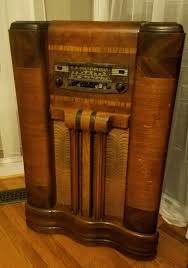
Wireless
It was a Saturday in late winter in the early 1930s. A kinsman had taken the day off to supervise the operation. First he erected a pole, roof high alongside our dwelling. He bored a hole through the timber of a window, produced a wire to be attached to the pole, threaded it through the windows, and finally secured it a strange looking contraption with lots of knobs and dials. And we now owned our first wireless. This was no crystal set but the real thing. It was mid-afternoon and the voice of the rugby commentator from Cardiff was saying, ‘Ross has crossed the Welsh line for his second score. The conversion is now being attempted. Square two.’ A reference to the diagram of the field was then provided for listeners. The player was William McC Ross. His performance that day has been equalled by few Irishmen.
At school some companions talked about ‘the flicks’. But we lived miles away from the nearest picture house. We didn’t have the money or transport, nor would there have been much encouragement from our parents for such waste of time on a Friday evening or a Saturday afternoon matinee. After all, the outside world came right to our own fireside through the wireless.
At first, we listened to music broadcast from England: Jack Payne and his band, Henry Hall and his Orchestra, and Reginald Dixon at the organ of the Blackpool Tower Ballroom.
Religion too had a place on the air. One young Scottish preacher from Govan Old Parish Church, George McCleod, was compelling. This man could talk and what he had to say was important. There was a Thursday evening short service from St Michael’s, Chester Square in London. And also from St Martin in the Fields. We loved the Irish witticisms of Reverend Pat McCormack and later the passionate pleading of his successor, Reverend Dick Sheppard.
Jamie McAleese was the local carpenter and very competent. Our family would call him in to build an extension to the kitchen or to erect a new barn. His wife was a teacher, and their home was a delight to visit. It was so neat and tidy and ordered. To boys accustomed to the daily disarray of a busy farmhouse, this home looked different. Different too was the choice of wireless programmes that always caught the ear on entering. Tuned in twice daily to London, we were used to solid and substantial fare, whereas the McAleese apparatus always seemed to carry the sounds of a Ceilidh. We soon learned to tune in to Radio Athlone. There was always gaiety about the daily output on the Southern waves. When John McCormack was not singing the evocative melodies of Thomas Moore, a Ceilidh band set our feet tapping. To add to the novelty there was a generous quota of programmes in the Gaelic tongue.
Around eleven o’clock each evening, the lady announcer from Athlone signed off in English and in Gaelic with ‘and that Ladies and gentleman is the end of broadcasting for today’. I heard this so often I leant it by heart: ‘agus sin deireadh’. I have often spoken this one phrase in Irish, and it has served me well as a useful variant for the more traditional ‘Goodbye’.
***
Dad became a clergyman and served from 1941-1981 as minister to congregations in Randalstown, Belfast and Co. Donegal. All his life he remained passionate about rugby. He was the founder of the rugby club at Randalstown. In 1967 he took me to Dublin to see my first international match, Ireland v Wales. He died in 1983.
Last year, when I came to write about Dad in my memoirs, I wanted to give an idea of what it was like to listen to him preaching in the pulpit.
I had been struggling with my chapter for a while, just as Dad had often struggled with his sermons. But boy could the old man tell a story. We especially enjoyed his children’s addresses. How could I recapture today the impression Dad’s storytelling made and the lessons he taught us?
It occurred to me that I still had old cassette tapes of Dad’s preaching from services broadcast on the radio. I hadn’t listened to them this century and no longer even owned a tape recorder. I ordered a Walkman-like device, which Amazon delivered the next day, and sat down to listen to a service first broadcast on RTE radio from St Johnston in Donegal on Sunday 24 February 1980.
The cassette had been stopped in the middle of the service. I didn’t press rewind, in case the new machine would eat up the old brown tape. I just pressed Play, and the congregation sprang to life, singing a Psalm. Donegal voices in harmony. Winnie McCracken at the organ. I wondered how many of that congregation are alive today.
A woman read a lesson from the New Testament with great gusto and in a lovely accent — a Laggan lilt. It was the story of the man who built his house on stone and the one who built his house on sand.
The voice that followed was even clearer, and still holds power over me, whether I hear it on tape, or in my head. Dad had an engaging speaking voice, with an unmistakable North Antrim accent and intonation. He pronounced ‘not’ as ‘nought’ an indicator of his origin in the Route district. He also rolled his Rs, a trick he may have acquired from listening to Scots pulpit orators like George McCleod and D.P. Thompson.
He began the Children’s Address, pausing between each phrase;
‘What an exciting picture Jesus gives us in those verses. Two men in two houses and then the rain, floods and gales. One house stands up to it, and the other one comes down with a great crash.
GiRRls and boys, let’s hope the weather is ‘nought’ like that when you go to school tomorrow.
Do you know that in some parts of Scotland when it’s raining hard, and the children cannot get out to play, they sing this little rhyme:
‘Rainy rainy, rattle and stainy
Don’t rain on me,
Rain on John O’Groat’s house,
Far ayont the sea.’
Now that’s funny, because John O’Groats’house is not far beyond the sea. It’s in the north of Scotland, in Caithness, almost in the sea. Maybe you will go there one day and see it for yourselves.
I smiled to myself, as I listened to the radio broadcast. How did you know, Dad, that I’ve recently visited Caithness for the first time?
But who was this man John O’Groats? We are told that many years ago, in the reign of James IV, there came to Scotland a Dutch man called Jan de Groot. He had eight sons, and by and by they all married and had homes of their own, but once a year, on a certain date, they all came back to see their father and to celebrate the day when he arrived in Scotland.
On one of those yearly visits, unfortunately, these eight sons started quarreling among themselves as to which one should be the boss and sit at the top of the table. Not so nice for the old man, was it? Well, they all turned to him to decide and settle the dispute. And all he said was ‘All right, all right, come back all of you next year and I’ll tell you.
The next year, when they all came back for the anniversary dinner, they found that their father had built a room with eight sides to it, and on each side a door, and in the centre of the room a table with eight sides. So, there was nothing to quarrel over. Each son could walk in by a different door and sit at a different side of the table. All eight of them were equal.
Clever old man, John O’Groats. Mind you, we are not told if that ended the quarrel among the brothers. I do hope so. But d’you know, our Lord Jesus had the same trouble with his twelve disciples. One day he found that several of them had started to quarrel because each wanted to be head disciple. And our Lord was much cleverer and wiser than old John O’Groats. This is what he said to them.
‘Whoever wants to be greatest among you must be your servant.’
And to show them what he meant, Jesus took a basin of water and a towel and stood down and washed the sand from his disciples’ feet.
***
I’ve just realized that next Sunday 18 February be the anniversary of Dad’s death. I have a notion that he’ll be listening to the BBC Ulster radio broadcast up in heaven.
(Ireland next play Wales at Lansdowne Road on 24 February).

 Closely Related to Chester