On the radio

Next Sunday morning, 18 February 2024, I will be talking about my new book, “The Corncrake’s Welcome” in the programme Sunday Sequence on BBC Radio Ulster. The interview will go out as a podcast soon after.

The Corncrake’s Welcome is both a personal and family memoir, set in Northern Ireland. Early in the book my father recounts the magical day, some ninety years ago, when their farmhouse was connected to the outside world through the airwaves.
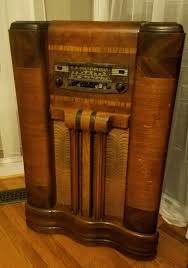
Wireless

It was a Saturday in late winter in the early 1930s. A kinsman had taken the day off to supervise the operation. First he erected a pole, roof high alongside our dwelling. He bored a hole through the timber of a window, produced a wire to be attached to the pole, threaded it through the windows, and finally secured it a strange looking contraption with lots of knobs and dials. And we now owned our first wireless. This was no crystal set but the real thing. It was mid-afternoon and the voice of the rugby commentator from Cardiff was saying, ‘Ross has crossed the Welsh line for his second score. The conversion is now being attempted. Square two.’ A reference to the diagram of the field was then provided for listeners. The player was William McC Ross. His performance that day has been equalled by few Irishmen.

At school some companions talked about ‘the flicks’. But we lived miles away from the nearest picture house. We didn’t have the money or transport, nor would there have been much encouragement from our parents for such waste of time on a Friday evening or a Saturday afternoon matinee. After all, the outside world came right to our own fireside through the wireless.

At first, we listened to music broadcast from England: Jack Payne and his band, Henry Hall and his Orchestra, and Reginald Dixon at the organ of the Blackpool Tower Ballroom.

Religion too had a place on the air. One young Scottish preacher from Govan Old Parish Church, George McCleod, was compelling. This man could talk and what he had to say was important. There was a Thursday evening short service from St Michael’s, Chester Square in London. And also from St Martin in the Fields. We loved the Irish witticisms of Reverend Pat McCormack and later the passionate pleading of his successor, Reverend Dick Sheppard.

Jamie McAleese was the local carpenter and very competent. Our family would call him in to build an extension to the kitchen or to erect a new barn. His wife was a teacher, and their home was a delight to visit. It was so neat and tidy and ordered. To boys accustomed to the daily disarray of a busy farmhouse, this home looked different. Different too was the choice of wireless programmes that always caught the ear on entering. Tuned in twice daily to London, we were used to solid and substantial fare, whereas the McAleese apparatus always seemed to carry the sounds of a Ceilidh. We soon learned to tune in to Radio Athlone. There was always gaiety about the daily output on the Southern waves. When John McCormack was not singing the evocative melodies of Thomas Moore, a Ceilidh band set our feet tapping. To add to the novelty there was a generous quota of programmes in the Gaelic tongue.

Around eleven o’clock each evening, the lady announcer from Athlone signed off in English and in Gaelic with ‘and that Ladies and gentleman is the end of broadcasting for today’. I heard this so often I leant it by heart: ‘agus sin deireadh’. I have often spoken this one phrase in Irish, and it has served me well as a useful variant for the more traditional ‘Goodbye’.

***

Dad became a clergyman and served from 1941-1981 as minister to congregations in Randalstown, Belfast and Co. Donegal. All his life he remained passionate about rugby. He was the founder of the rugby club at Randalstown. In 1967 he took me to Dublin to see my first international match, Ireland v Wales. He died in 1983.

Last year, when I came to write about Dad in my memoirs, I wanted to give an idea of what it was like to listen to him preaching in the pulpit.

I had been struggling with my chapter for a while, just as Dad had often struggled with his sermons. But boy could the old man tell a story. We especially enjoyed his children’s addresses. How could I recapture today the impression Dad’s storytelling made and the lessons he taught us?

It occurred to me that I still had old cassette tapes of Dad’s preaching from services broadcast on the radio. I hadn’t listened to them this century and no longer even owned a tape recorder. I ordered a Walkman-like device, which Amazon delivered the next day, and sat down to listen to a service first broadcast on RTE radio from St Johnston in Donegal on Sunday 24 February 1980.

The cassette had been stopped in the middle of the service. I didn’t press rewind, in case the new machine would eat up the old brown tape. I just pressed Play, and the congregation sprang to life, singing a Psalm. Donegal voices in harmony. Winnie McCracken at the organ. I wondered how many of that congregation are alive today.

A woman read a lesson from the New Testament with great gusto and in a lovely accent — a Laggan lilt. It was the story of the man who built his house on stone and the one who built his house on sand.

The voice that followed was even clearer, and still holds power over me, whether I hear it on tape, or in my head. Dad had an engaging speaking voice, with an unmistakable North Antrim accent and intonation. He pronounced ‘not’ as ‘nought’ an indicator of his origin in the Route district. He also rolled his Rs, a trick he may have acquired from listening to Scots pulpit orators like George McCleod and D.P. Thompson.

He began the Children’s Address, pausing between each phrase;

‘What an exciting picture Jesus gives us in those verses. Two men in two houses and then the rain, floods and gales. One house stands up to it, and the other one comes down with a great crash.

GiRRls and boys, let’s hope the weather is ‘nought’ like that when you go to school tomorrow.

Do you know that in some parts of Scotland when it’s raining hard, and the children cannot get out to play, they sing this little rhyme:

‘Rainy rainy, rattle and stainy

Don’t rain on me,

Rain on John O’Groat’s house,

Far ayont the sea.’

Now that’s funny, because John O’Groats’house is not far beyond the sea. It’s in the north of Scotland, in Caithness, almost in the sea. Maybe you will go there one day and see it for yourselves.

I smiled to myself, as I listened to the radio broadcast. How did you know, Dad, that I’ve recently visited Caithness for the first time?

But who was this man John O’Groats? We are told that many years ago, in the reign of James IV, there came to Scotland a Dutch man called Jan de Groot. He had eight sons, and by and by they all married and had homes of their own, but once a year, on a certain date, they all came back to see their father and to celebrate the day when he arrived in Scotland.

On one of those yearly visits, unfortunately, these eight sons started quarreling among themselves as to which one should be the boss and sit at the top of the table. Not so nice for the old man, was it? Well, they all turned to him to decide and settle the dispute. And all he said was ‘All right, all right, come back all of you next year and I’ll tell you.

The next year, when they all came back for the anniversary dinner, they found that their father had built a room with eight sides to it, and on each side a door, and in the centre of the room a table with eight sides. So, there was nothing to quarrel over. Each son could walk in by a different door and sit at a different side of the table. All eight of them were equal.

Clever old man, John O’Groats. Mind you, we are not told if that ended the quarrel among the brothers. I do hope so. But d’you know, our Lord Jesus had the same trouble with his twelve disciples. One day he found that several of them had started to quarrel because each wanted to be head disciple. And our Lord was much cleverer and wiser than old John O’Groats. This is what he said to them.

‘Whoever wants to be greatest among you must be your servant.’

And to show them what he meant, Jesus took a basin of water and a towel and stood down and washed the sand from his disciples’ feet.

***

I’ve just realized that next Sunday 18 February be the anniversary of Dad’s death. I have a notion that he’ll be listening to the BBC Ulster radio broadcast up in heaven.

(Ireland next play Wales at Lansdowne Road on 24 February).
https://emea01.safelinks.protection.outlook.com/?url=https%3A%2F%2Fwww.troubador.co.uk%2Fbookshop%2Fautobiography%2Fthe-corncrakes-welcome&data=05%7C02%7C%7Cba48d417c0854ca7484808dbfb3230f1%7C84df9e7fe9f640afb435aaaaaaaaaaaa%7C1%7C0%7C638379966747866045%7CUnknown%7CTWFpbGZsb3d8eyJWIjoiMC4wLjAwMDAiLCJQIjoiV2luMzIiLCJBTiI6Ik1haWwiLCJXVCI6Mn0%3D%7C3000%7C%7C%7C&sdata=sdP7XxzZzaCs8KH0w0MCsS3FAc8vWQ6FjXYkUAMk7hk%3D&reserved=0


Still Life

Last year I wrote about returning to Inst for a school reunion, fifty years on. John Faris, who was a couple of years ahead of me at Inst, and who reads this blog, contacted the editor of the Instonians Old Boys magazine, Seahorse, to propose that the piece be included in their Winter 2023 edition.

A fellow called Stephen read the article and noticed the reference to my brother John, who died in 2017. Stephen had been in charge of the sheltered accommodation on the Lisburn Road where John lived for many years.

Last week Stephen sent me an e mail and told me he had something of John’s which he wanted to give me. For the life of me I couldn’t think what it was, but I gave Stephen my number and he phoned me later the same day.

Stephen reminded me that after John died his flat was cleared and there were some personal belongings to be disposed of. At the time I had said that the only item which interested me was a picture that had been my mother’s and had been given to John in 2010 after she died.

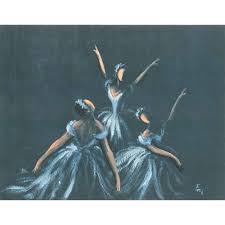
John attached little or no importance to material things and did not hang the picture on his wall. He was also embarrassed to display the painting because its subject was a group of ballerinas. So they lay neglected in a corner of his bed-sit, the glass got broken, and the picture was forgotten until now.

We’ve arranged to have the painting delivered to relatives in Belfast who remember it well. It hung for many years in the drawing room in Windsor Manse, and it was precious to my mother, because it was painted by a woman whom she admired, perhaps more than anyone else in the world, for her incredible courage.

Elizabeth Twistington Higgins and her sister Janet were close friends of my mother when she nursed in London after the War. Elizabeth made my mother’s wedding dress, and sewed part of the hem with my mother’s golden hair. She was a ballet dancer and my mother took her then fiancé, my father, to see Elizabeth dance in a West End show. But Elizabeth contracted polio and had to give up dancing. She was paralyzed from the neck down, and had to spent much of the rest of her life in an iron lung.

However Elizabeth did not give up living. Although she could only move a few muscles she taught ballet and took up painting. Her paintings were often used in Christmas cards. The subjects were flowers or fruit or ballet dancers. She gave my mother two of these paintings, one of daffodils, which my mother may have passed on to a niece, and the one of the three ballerinas which will soon be returned to me.

Elizabeth appeared in ‘This is Your Life’ with Eamonn Andrews. My mother used to tell her story to Presbyterian Women’s Groups, showing as visual aids the wedding dress, also worn by my sister Anne Louise at her wedding, some Christmas cards, the picture of the ballerinas, and Elizabeth’s autobiography.

The title of Elizabeth Twistington Higgins’ autobiography may have been chosen before by other writers, but none could have given it more meaning : Still Life.

The picture of the ballerinas will remind me of family members who are departed from this world, but are still alive in my mind. I tell more stories about them in The Corncrake’s Welcome. https://www.troubador.co.uk/bookshop/autobiography/the-corncrakes-welcome

Back to Inst: Quaerere Verum

Royal Belfast Academical Institution

I travelled back to Belfast last month to attend a school reunion at Inst. It was fifty years since I left the school, and I had never before been minded to attend such an event.

A few hundred old boys turned up, in dinner jackets and bow ties, with heads greyer or more bald towards the front tables of the Common Hall, where once ‘eager and joyous in youth’ we donned uniform black and yellow RBAI blazers and school ties.

As Michael Longley pointed out in a video a few years ago, Inst was founded by William Drennan, also founding member of the Society of United Irishmen, and coiner of the phrase ‘The Emerald Isle’, as a place of education for all, with no religious connotations. Indeed until the Education Act of 1947 there were no prayers at Assembly.

That had changed by my time, and when we attended Morning Assembly in 1966 we had to remember to bring red hymn books with us.

In our first years at Inst there was revolution in the air, at least among the bigger boys. I don’t recall that it was about the impending sectarian conflict in our city. It was more triggered by civil rights marches in the US, and student protest in Paris. Having discovered the similarity between our hymn books and Chairman Mao’s little red book, we waved our books in the air, like so many followers of the revolution. Some books were even thrown and trampled on the ground and burned near the tuck shop.

For this irresponsible and irreligious act a few radical pupils were punished. A gust of protest arose. Word went round that we would not sing the hymn the next day at Assembly. But the Principal somehow got wind of our proposed hymn boycott. At 9 a.m. we all stood to attention, as we were expected to, when Mr Peskett entered the Common Hall. But when he arrived on the stage, and took off his mortar board, instead of announcing the morning’s hymn he curtly told us all to ‘please sit’. He announced no hymn. Radical protestant movement in the centre of Belfast had once more been nipped in the bud.

Last month no hymns were sung at our Old Boys dinner, but a prayer was said, and we drank a loyal toast to the King. And, with the words printed on sheets to remind us, we all sang the school song in unison and with gusto.

The words of Inst ! Inst ! Ancient and Royal are stirring, but the music is borrowed from an old German drinking song, of the oompah oompah variety, and it was hard to tell if the old boys were taking the words seriously enough. A finer Inst school song was written in the 1930s by some of our uncles, but it did not catch on, and they may have taken it with them to their graves.

Ten old boys from my year turned up. That’s about 10% of the final year pupils. Half had stayed in Northern Ireland and half had left. Belfast wasn’t such a great place to hang around in in ‘73. It’s much improved today.

Some of us recalled our first English teacher, an Irish hockey international from Cork, who introduced us to Yeats, and got himself into deep water by an impressive but inaccurate throw of a duster across the classroom. It had been the boy behind who was talking, not the innocent chap who still bears the scar on his head.

Michael Longley, our second year English teacher one day brought a pal to his classroom to read his new poetry to us – poems with titles such as ‘Digging’ ‘Blackberrying’ and ‘Follower’ which were later to earn their author ~ Seamus Heaney ~ the Nobel Prize. We recalled how Longley once played a piece of classical music on his record player and asked us to write down the thoughts that came into our heads as we listened. We learnt afterwards that the piece was Stravinsky’s Rite of Spring. Apparently one cultured fellow knew the title of the work.

I was delighted when the President of the Old Boys Association remembered our 1973 Ulster Schools Cup Rugby Final, even though we lost to Ballyclare, and when one old boy remembered playing rugby with my late brother John. There was a moment’s silence for absent friends.

What had happened to us all in the fifty years since we left Inst ? Some joined the family firm, and a pair of good mathematicians entered the insurance profession. A talented scrum-half became an architect; a fine artist chose to teach English ; a clever fellow turned into an Oxford don; and one boy – perhaps our highest flyer – became a pilot in the Canadian Air Force.

It was he who asked me how I became a diplomat, but, just as I was about to answer we were asked to stand to sing that old school song, and we did as we were told.

After that there were good speeches, and plenty of red wine, and I never did get round to explaining how a son of the Manse and old Instonian, brought up in such a British tradition, later became an Irish and European diplomat.

If you are interested to know more you may read my story, and that of my family, and how we responded to the Troubles, in ‘The Corncrake’s Welcome’ , just published by Troubador, available in paperback and soon in e book. https://www.troubador.co.uk/bookshop/autobiography/the-corncrakes-welcome

P.S. I apologize for any inaccuracies that may have occurred in this post. The school’s motto is Quaerere Verum – Seek the Truth, and my memories may not all be accurate or reliable. I welcome observations or corrections.

What-you-may-call-it

Yesterday I finished writing my second book. It’s a sequel to Voyages with my Grandfather. It starts with my parents’ stories and moves on to how I grew up in Belfast in the 1960s. It also takes me to Scotland, Donegal, France, Dublin, and Belgium.

I’m still looking for a title. The working title has always been, like this blog, Closely related to Chester. I have reworked some of the pieces published here over the last two years, including my tribute to old Chester, the little known 21st President of the United States. But perhaps this title is too obscure, or too presumptuous.

Continue reading “What-you-may-call-it”

Back to Inchmarlo: the Friendship Bench

at Inchmarlo

If you were out and about in South Belfast last week you might have noticed a pair of grey-haired men jogging up the Malone Road and down the Lisburn. Tony was in Northern Ireland for a wedding, and I was there for a funeral. We decided to meet up and revisit old haunts, including Inchmarlo, our preparatory school.

Tony, who is a ski instructor in his retirement, was always a natural sportsman, and still is a competitive runner, placed 150 somethingth in the world in his category. I run in no known categories, local or international, and was relieved that my wonky left knee held up for our 7km circuit, gaining me Strava kudos. 

Upon reaching Cranmore Park I found a pretext to halt a while. Where precisely had been the little woods where Miss Strahan led us on nature walks? There was once a pond, fringed with frogspawn, hidden under sycamores and horse chestnuts, giving masses of conkers in autumn. One day the woods were removed to make way for more rugby pitches. Inst’s insatiable quest to win the Schools’ Cup had triumphed over concern for conservation of the natural environment. Back then the ‘environment’ hadn’t yet been invented.

I showed Tony the place where, as I walked home from school at the end of term, along the chalk-flecked footpath, three or four great raindrops fell out of a clear sky onto the page of my report book, smudging the blue ink. I had opened the book to find out my marks and my place in class. We were not supposed to do this before our parents saw the book. My curiosity was now indelibly recorded for parents and teachers alike to see.

I wondered how reliable our memories would be the following day, when we were to tour the school, for the first time in 60 years. Tony pointed out that in my email to the Headteacher I had got our first year wrong: it was 1959 not 1958. But I recalled all the names of the teachers correctly. He was always good with numbers, and became a nuclear physicist. He also taught me my first words of French — which I won’t repeat here: I became a diplomat.

Next day we were warmly welcomed by the Headteacher and her deputy. But for me the school was still under the steely-eyed sway of our Headmaster, the ubiquitous Edgar Lockett. He was standing there, stiff and soldier-like, on the stairs above the Assembly; he was in shirt-sleeves in the covered way showing us how to play forward and backward defensive shots with the cricket bat; and he was smiling as he challenged us to spell Parliament and Government. A couple of lectures he gave me on the importance of hard work still ring in my ears.

I placed myself against the wall under where the clock used to be. This was where you were made to stand if you were sent out of the classroom for bad behaviour. Did this ever happen to me? It must have, for time now slowed down. I could hear the silence all through the building as I waited for the small impossibly suntanned Headmaster, to descend the creaking wooden stairs and quiz me about the nature of my misdemeanor.

Miss Kilpatrick’s class 1959/60 (thanks to Maurice Cassidy)

We adored Miss Kilpatrick, our first teacher, who one day placed fat black pencils in our hands and told us we could write with them. Unfortunately the blue cupboard with its panelled door in Miss Kilpatrick’s room was gone. But its contents were not forgotten. The headteacher still keeps a stash of sweeties as rewards. Miss Lamont mothered us and encouraged creative writing. I once wrote six pages for her about far off lands that I might travel to. But it is still Miss Strahan, striding the football pitch in her tweeds, with her shrill silver whistle, who is the most remembered teacher of those earliest years. She wrote that I must ‘hitch my wagon to a star’ and kept me in after class one day to write five lines: ‘I must not forget my handkerchief’. Tony remembered her pointing finger at lunchtime: ‘Eat that up ! ”

The floors were most familiar. The upstairs pine floor knotted and warped, the assembly hall criss-crossed by oak parquet, and the terrazzo in the cloakroom grey and white, precisely as I remembered it. We were small boys then, close to the ground.

The Ring, an oval-shaped path where we used to run, is still there. I showed Tony the final bend, where I was tripped up one day, and both my knees were sandpapered by the tarmacadam, turning rapidly from white to pink and then crimson. Ouch !

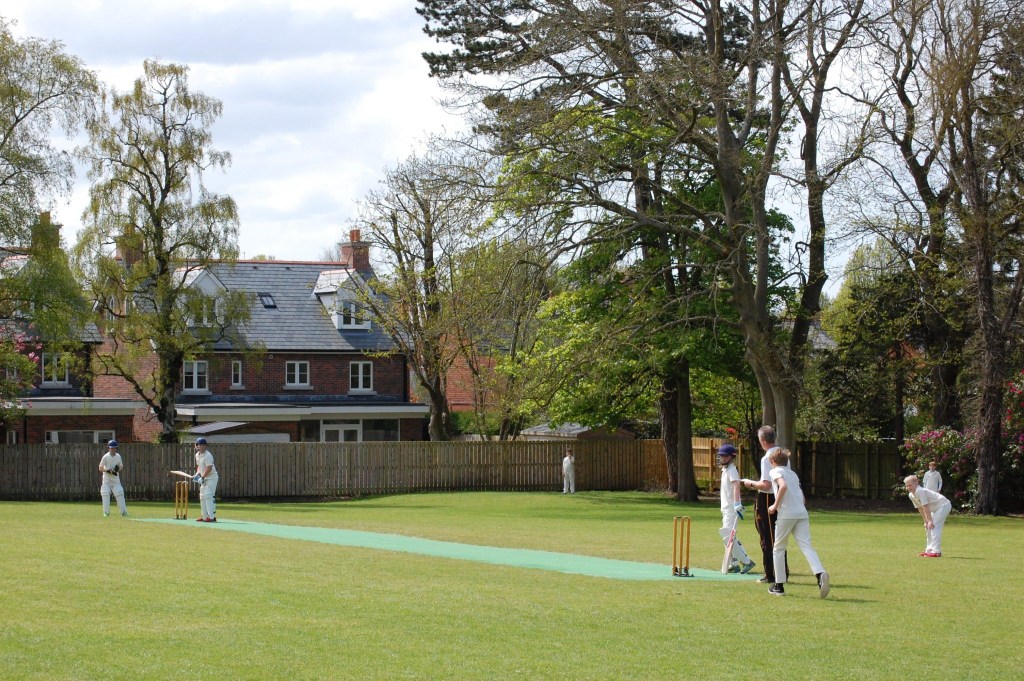
The rounders field now has an all-weather surface, but there is still real grass on the outfield of the main cricket ground. The Fathers v Sons match was due to be held the next day. In my mind Dad’s glorious cover drive rebounded against the red-brick wall. It didn’t matter that he was bowled out next ball. His four runs preserved my prestige.

Cricket at Inchmarlo, (image from school’s website)

Over in the dining hall Miss Weir, with her blue rinse hair, winged spectacles and handbag, was giving us elocution lessons, trying to wean us off Belfast vowels and consonants: “Cruella de Vil’s dinnah pahty took place in a black mahble room … and everything tasted of peppah.”

Next to the dining hall is the bicycle area where one day, when I was ten, I took a mental picture of me and my bike, and said to myself, “This exact moment in my life will never ever return”. I was right and wrong. It has returned many times in my memory, and it did so once more.

Tony and I had our picture taken at the friendship bench. The colourful wooden structure wasn’t there in the 60s, but we were then the best of friends, and remain so today, even though our paths diverged. Tony left when he was 8 years old. We both travelled far from Belfast and heard nothing of each other for over half a century. As I remember it, in our early years there were two gangs. Tony was the leader of one and I was his deputy. As Tony remembers it, he was often accused of being a swot, but I always had his back.

Inchmarlo remains a privileged place. The pupil numbers are small, and teachers have time for them, as well as for old boys. Edgar Lockett told us that the aim of education was to teach us how to think for ourselves. The school motto is Quaerere Verum — Seek the truth. Still a good guide after all these years.

Inchmarlo, Cranmore Park, Belfast (photo from school’s website)

Reflections on the Union Canal

Morning run by the Union Canal in Edinburgh

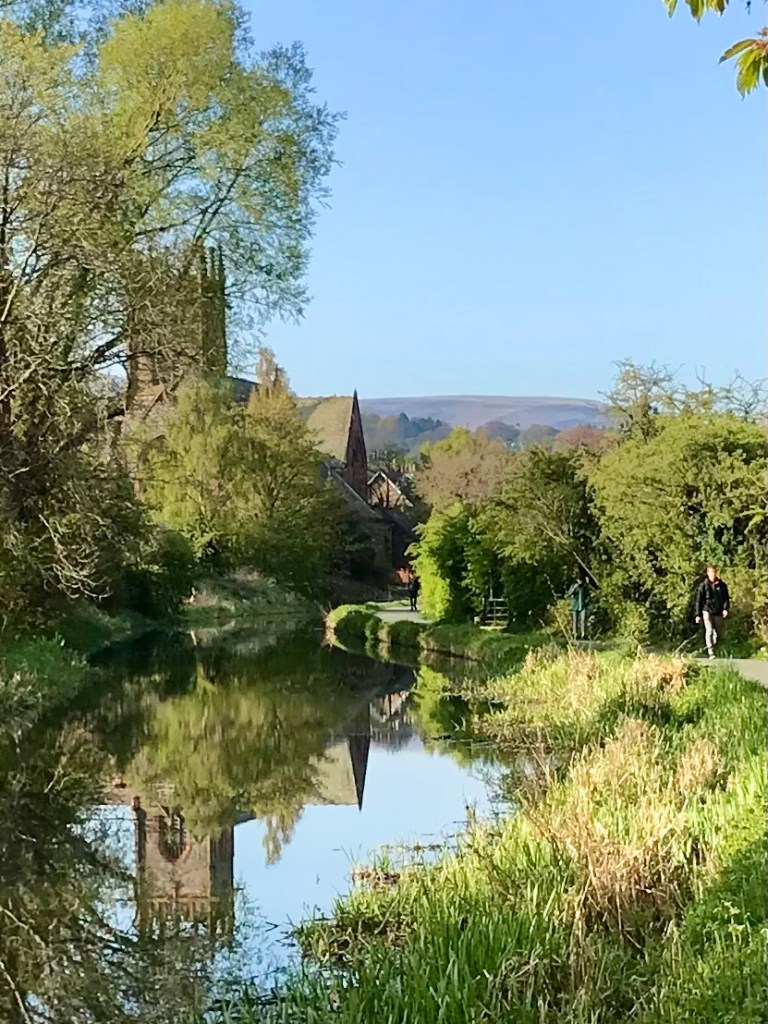
A few days ago I rose early to Ieave my car at a garage a couple of miles away beside the Union Canal. It was a beautiful blue-skied morning, such as Edinburgh occasionally bestows on its inhabitants, and I decided to run back home along the canal. The sun was shining brightly and the trees were just beginning to put on their new leaves. As I came to the stretch of the canal near the church at Polwarth I stopped and took a photo of the scene.

When I examined the photo later I was disappointed that the church tower was partly hidden by the leaves. Nevertheless I put the photo on Facebook where many people liked it. Looking more closely I could see that the tower is in fact fully visible in the reflection. You can see this even better if you turn the photo upside down.

My father might have crafted a sermon or a children’s address out of such a photograph. Perhaps his text would have been “for now we see through a glass darkly, but then face to face. Now I know in part; then I will know fully.”

A few days later, as I crossed the bridge over the canal, on my way to see a rugby match at Murrayfield, another beautiful sight greeted me.

Evening swim on the canal

There are also swans with their cygnets at the nearby Craiglockhart nature reserve. Each year the entire neighbourhood takes an interest in the birds’ nest and bets are placed on when the eggs will hatch. Ornithologists line up with their huge cameras to capture the moment of birth.

Yesterday afternoon I walked along the Union Canal, westwards this time to where it joins the Water of Leith, which winds its way down from the Pentland Hills.

The canal above Slateford

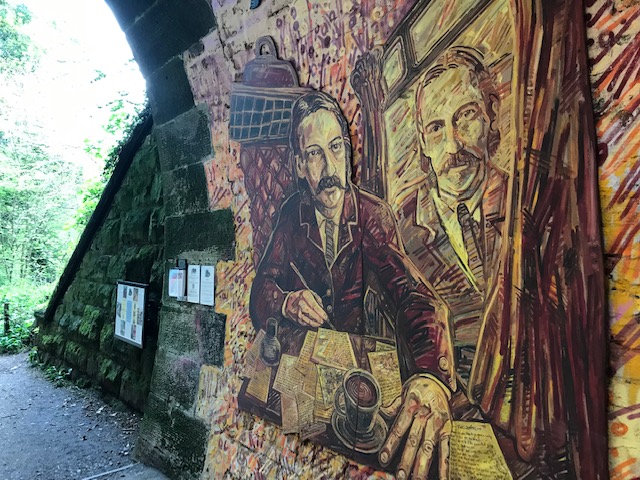
I followed the river up to the village of Colinton. This is territory Robert Louis Stevenson frequented as a boy. Stevenson, author of ‘Treasure Island’ and ‘Kidnapped’ was one of my grandparents’ favourite authors and I brought their copy of his book ‘Edinburgh’ with me when I first came to the University, many years ago. I remember reading it out loud to my future wife on the January night when we met.

Robert Louis Stevenson is celebrated in the mural at Colinton

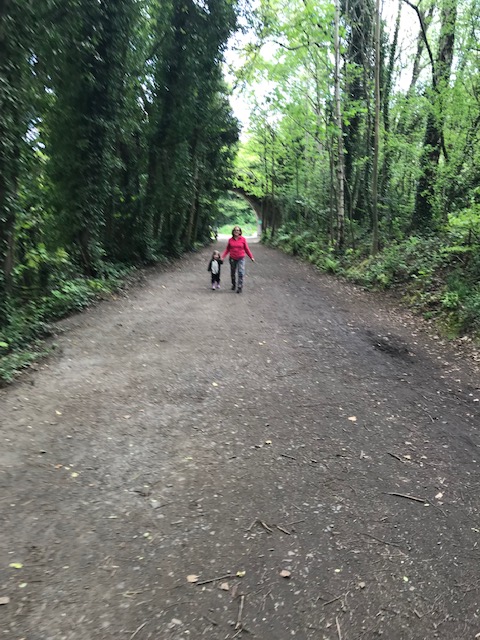
Today my son and his wife and daughters live in Colinton. Look who is coming along to meet Grandpa.

Sunday afternoon stroll in Colinton

Closely related in April

Brussels, 1 April 2022

I was born on the first of April. So I am an April Fool. Some of my fellow April fools may be ashamed of the day they were born, but it has always made me feel special. Every year on my birthday I am privileged to be on the receiving end of good wishes, birthday presents and practical jokes. Family and friends are in good form, and even people who don’t know me well and may forget other birthdays nevertheless remember mine.

When I was a child my mother used to come into my bedroom early on the morning of 1st April, pull back the curtains, and say “Oh look, is that snow on the ground? ” Snow on my birthday, hurrah, I must check this through the window: “April Fool !”

Continue reading “Closely related in April”

Dr Fay’s plays

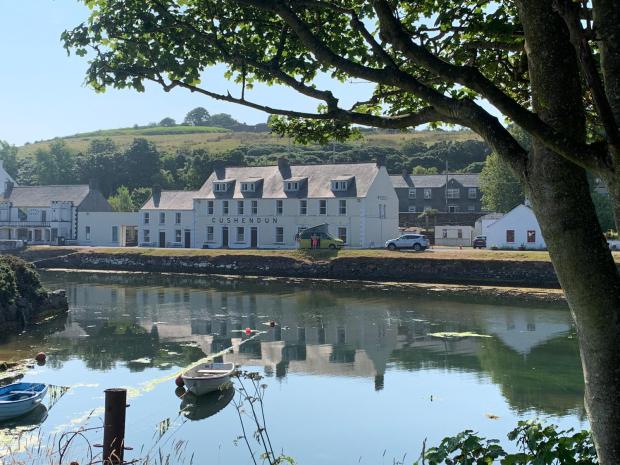
Cushendun, where we studied Antigone in 1970

Dr Fay assigned me to the chorus of one of his plays — Antigone — and so I can only make a minor contribution to their history in comparison with those, including the distinguished Irish cleric Rev John Faris, who played the main characters.

I became a classics scholar more by default than design. First form at Inst meant studying foreign languages — French and Latin — for the first time. Our new French teacher was perhaps a better coach of the 1st XV than of 11- year-olds struggling with avoir and être.

However our Latin teacher, Rev. McConnell Auld, was a decent chap, who tolerated our repeated mistakes without pulling our hair. He didn’t seem to notice that we decorated the covers of our New Latin Course textbooks, so that they became so many ‘Newts Eating Courses. The Auld sipped his chocolate, munched his biscuits and exhorted us to soldier on with porto, portas, portat as ‘the girl sits under the tree’ (puella sub
arbore sedet
) and as ‘the sailors launch their boats into the sea’,
(nautae scaphas etc). It was because of the more sympathetic teaching of a dead language than a living one that I chose to study Greek in 3rd form, rather than German like most of my friends.

Rothwell was another good chap, though quite eccentric. He seemed to be obsessed with pigs. I wonder if anyone remembers his brilliant Scottish Presbyterian minister’s sermon which included the phrase ‘Where the Wild Haggises Roam’. He was a distinguished classicist who instilled in us a love of the languages. With only five boys in my Greek class, my turn to answer the questions came round so often that learning inevitably took place. Rothers also introduced us to the classical theatre, taking us down to Dublin to see Medea performed at Trinity, and entertaining us to lunch in The Buttery.

So by the time we entered Charlie Fay’s class, we knew classics quite well, and were inoculated to some extent against his infamous wrath. We steered our way through his lessons more or less unscathed, and without being brought to ‘our knees’ too often. Dr Fay may have seemed a monster to pupils who struggled with classics, but he was kind to those who showed any enthusiasm for the subject. We were few and he needed every one of us to take part in his plays.

In my youth I suffered from stage fright. My first and only starring role at school, at the age of seven, was as one of the Pleiades. Fortunately Miss Strahan, the choreographer of this piece of stellar entertainment
for Inchmarlo parents, gave me no words to recite.

A couple of years later my one and only solo performance in the Windsor Church choir also turned out to be a silent one. I had learnt by heart the words of the second verse of The Holly and the Ivy (The Holly bears a berry as red as any blood) but when Alec Mc Neilly gave me my cue to perform in front of the congregation no words came out of my mouth, in spite the organ master’s smiling face, pleading with me to perform.

For a few years after that I succeeded in avoiding any solo stage appearances. When I learnt that my good run had come to an end, and there was no way to avoid conscription into one of Dr Fay’s plays, I was relieved to hide behind a mask, deep in the ranks of the chorus.

The choruses of Antigone were set to music by Geoffrey Trory, or Mr Trog as my Aunt Emily once addressed him, confidently, at a parents’ meeting. I can still remember the rising melody that Trory composed for the first chorus of Antigone:

‘Wonders are many on earth, and the greatest of these
Is Man, who rides the ocean and takes his way
Through the deeps, through wind-swept valleys of perilous sea
s

That surge and sway.’

Behind my mask I was at last able to perform in public. And I also sang in tune, which is more than can be said for some others, including Fay himself, who belted out the words from the wings when he thought the chorus was not getting its message across to the audience loudly enough.

Looking back today I admire the actors who played the leading roles In Antigone, learning swathes of Greek and English text, while all I had to memorize were a few chorus lines. As John Faris recalls, I also had sympathy for the parents who were condemned to sit through the play twice — first in Greek and then in English. Perhaps some of them sat in the Common Hall on a cold winter’s night, reflecting on ancient lessons about the laws of men and the laws of God. I suspect most were counting the minutes until the final curtain fell and they could drive their offspring safely home, through Belfast’s troubled City Centre streets, back to leafy Malone Road suburbs.

Recently I took my grandchildren to Cushendun and pointed out to them the house where, in 1970, we were summonsed by Charlie Fay to stay for a week with him and his wife and daughter, and study Antigone. That Easter I had been at my uncle’s farm in Loughgiel and had cycled over the mountains, past Slieve na Orra, where in 1583 Sorley Boy MacDonnell won a decisive victory against the MacQuillans, and down through beautiful Glendun to the village. It amazes me today that we were taught next to no Irish history at Inst, and certainly nothing about Sorley Boy MacDonnell, whereas we spent long hours translating Caeser’s Gallic wars and learning of battles between Athenians and Spartans.

At Cushendun Fay gave each of us household tasks. Mine was to sweep the kitchen floor each morning, since then a duty I have always taken seriously. We studied Greek all morning, translating the entire play, and were free after lunch. One afternoon one of the main actors in the play (was he Ismene?) was displaying his skills as a fly fisherman, casting into the river Dun, when a wind arose and he hooked his own ear. He was whisked off to the Cottage Hospital in Cushendall to get the hook removed. Comedy and tragedy are but a breath apart.

Today there is a little statue near the spot. It’s just below the bridge, near where Game of Thrones busses deposit sword-wielding tourists, who march solemnly round to the caves to take selfies, or enact battle scenes from the blood-curdling series, before having coffee at McBride’s. In fact the statue is not in honour of a Game of Thrones hero, Sir Jaime or Eurion, nor of Dr Fay, nor even of our unfortunate fisherman, but of a much-loved local goat, the last animal to be culled in the foot and mouth epidemic. Epi demos — from the Greek — a plague upon the people. We ignore the laws of God at our peril.

Thanks to our talented Classics teachers I did well in Greek and Latin ‘O’ levels. My last memory of Dr Fay is passing him in the N block stairwell, seeing him stop and turn round, with a look of regret. saying, “You should be studying Classics at ‘A’ level”. I did not want to disappoint him, but by that time I had found a good French teacher, outside Inst, and my eyes were fixed on Edinburgh and an M.A. course in Contemporary European Institutions.

Over the years I have sometimes pondered on the tale of tragic destiny that Sophocles presents to us in Antigone. I’ve thought of those old men in the chorus, who we first played when we were adolescents, coming on stage to declare, “Woe is me — the Gods are unhappy — this is not going to turn out well.” I sometimes felt my role as EU Ambassador in different countries, attempting to find common language among 28 national positions, was like leading a Greek chorus. Perhaps now that one of the most out-of-tune Member States has left the stage, the sound will be more EUphonious… perhaps not. As the chorus reminds us towards the end of Antigone “The future is not to be known; our present care is with the present; the rest is in other hands.”

Marking the page

The packers arrive tomorrow morning at 8 a.m. As I look down from our flat to the avenue below I see that the police have already reserved a place for the removal van. This is the 17th flit of our married life.

This evening, as the sun streams through our window, at the end of a beautiful Spring Sunday, we are making our final choices of what to bring to Edinburgh and what to leave in Brussels.

In the beginning we were going to move everything of value. However last week we learned that, as a result of Brexit, we will have to pay VAT, Customs Duties and a customs charge on all the goods we take to the UK. So we have decided to leave our most expensive belongings in Belgium for the time being.


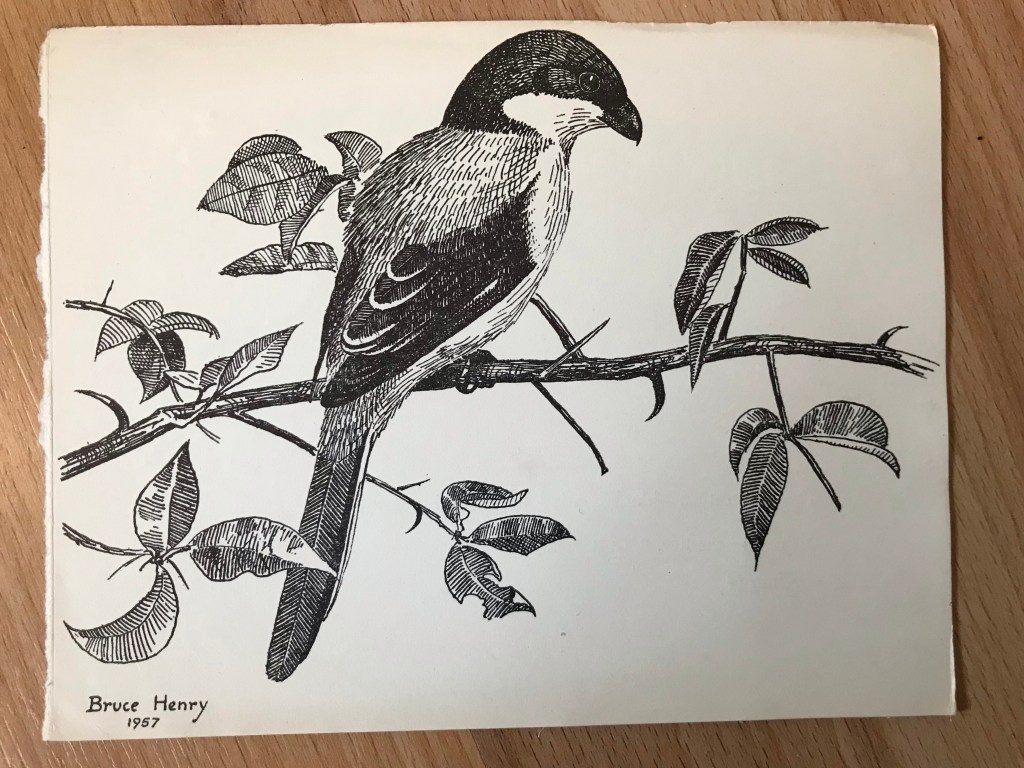
Among the books I found a copy of Kipling’s Jungle Books inscribed ‘Annie from R. October 3rd 1925’. Between pages 261 and 262 I found this picture, cut from a greetings card. On the back it says – ‘black headed shrike on bougainvillea. Drawing by the Rev B.C.R. Henry’

At the bottom corner you can see the year of the drawing is 1957. That is the year my Grandfather died. I have just read the first story entitled ‘Mowgli’s brothers’. We are introduced to Akela, Shere Khan, Baghera, Baloo – compelling stuff. I seem to recall that Gran read us these stories when we were young. Perhaps the marker shows that one of my grandparents was in the middle of reading the book when they died.


My grandsons Finn or Max are about the right age to appreciate these stories. I’ve just shown Finn the book on a phone call. As I thought he knows the film but doesn’t know the book. So this one is being added to the Edinburgh pile. I hope I’m not charged extra VAT because it is a first edition. I can’t wait to see my grandchildren again.


As a result of all our moves around the world we possess mountains of bits and pieces of things of little commercial value, but much sentimental value-added. Yet we have always found that the best moment in a move is when the packers have gone and the place is empty.

Eureka !

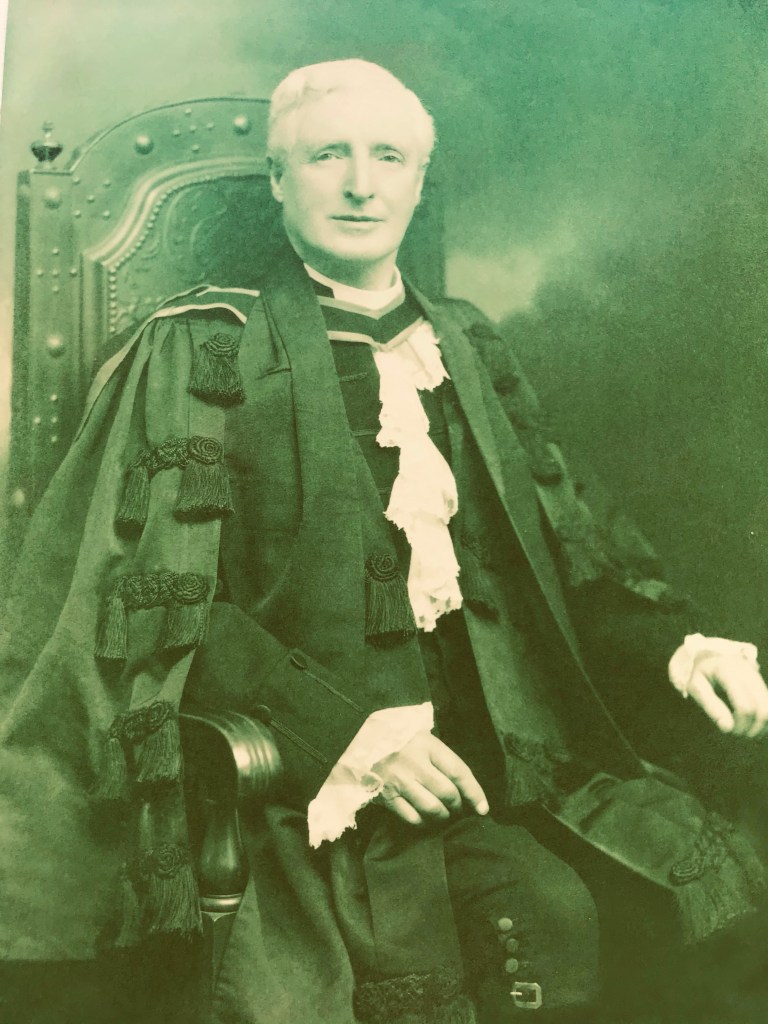
Yesterday I was clearing old photos and pictures, trying to decide what to take to Edinburgh and what to leave in Brussels. I found a Hanna family crest, and thought it would look well above the mantelpiece in my new house. However the frame was fairly battered, so I looked for another one to cannibalise. I found a suitably-sized framed photo of three grandsons at my daughter’s wedding. However much I love them all, it is not one of the most flattering images – one boy is crying, another looks bored, and the third is about to throw something at the camera. So I decided this particular moment in time could be conveniently forgotten, and the frame could instead reblazon the Hanna name. As I moved the boys out of the frame I had a sense of deja vu, and to my great joy, lying hidden underneath was a photo of my grandfather Robert Boyd.

Very Reverend R.H.Boyd, D.D. Moderator of the General Assembly of the Presbyterian Church in Ireland, 1947

I always intended to include this image of RHB in my book Voyages with my Grandfather, However when the time came for publication I searched high and low for the photo and could not find it. What finery ! Look at the lace, the degree hood, the tassels and even the buckle on the breeches – all the regalia of a Presbyterian moderator. RHB’s look is steadfast and confident. I’ll be packing this photo to show my grandchildren in Edinburgh. Boyd on one side of the mantelpiece, and Hanna on the other.