The Maria Raffo

Nonna Maria, centre right, with grand-daughter Paola, standing in front.

On one of my first visits to Italy, in the late 1970s, Paola introduced me to her grandmother. Nonna Maria spoke no English and I had learnt just a few phrases of Italian, but we smiled at each other and I learned afterwards that the matriarch had pronounced that I was a ‘ragazzo per bene’ – a suitable boy.

Nonna Maria died a few years later. Paola and I were married in 1978 and spent the following forty years living and working around the world. A couple of years after retiring we decided to look for somewhere warm to spend the winter months. We focussed on Liguria, the Italian riviera, which extends on either side of Genoa, from Ventimiglia at the French border, to Cinque Terre in the South. Paola’s brother and several cousins lived here, and her nonna Maria had originally come from Genoa, or so I thought.

In autumn 2022 we drove from Belgium through Switzerland to Italy and began our search for a suitable winter home. I had only one condition: that there should be a golf course nearby. I am addicted to the game, and sport is a great way to make friends in a new country. We found an excellent course in Garlenda, but it was not particularly welcoming. Golf is still an elite sport in Italy, with the associated golf snobbery. We travelled from the Ponente (sunset) side of Liguria to the Levante (sunrise) side and spent a week in Lerici, on the beautiful Bay of Poets, which Shelley and Byron visited in the 19th century. The sunsets were spectacular, but there was only a miniature golf course.

However we found a more promising 18 hole golf course in Rapallo, a town which was also once frequented by poets – W.B.Yeats and Ezra Pound held court there in the 1920s. I made up a three ball with two club members who had recently retired from Turin and Milan. These gentlemen were good company, not over fussy about the golf, but, like most Italians, obsessed with food. After the 14th hole they enquired if I was not hungry and suggested that we adjourn for lunch, as the kitchen was closing soon. Over a tasty dish of spaghetti, and a good bottle of wine, we chatted about the essential criteria for a winter home. They recommended that I avoid small touristy places which would be dead in December. Instead they suggested I should consider nearby Chiavari, a town with a large local population. Many people from Chiavari emigrated to South America, in the 19th and early 20th centuries, where they made their fortune. On their return to Chiavari, in the 1930s, they constructed palazzi on wide avenues with names such as Corso Buenos Aires or Corso Montevideo. In Chiavari I might find an apartment in one of the palazzi from that era to renovate.

When I told Paola about my conversation with the golfers, and suggested that we try Chiavari, she consulted her relatives. They pointed out that Chiavari was in fact Nonna Maria’s birthplace. She had lived in the city until, aged seventeen, she eloped with Paola’s grandfather. (He was already married, with several children, but that is another story.) So Paola was happy for us to explore Chiavari, where she had family roots.

We found a friendly B & B and liked the feel of the city. There was a marina,with sailing boats, and a wide seaside promenade which offered regular saffron sunsets. In the town ancient narrow streets, bordered by colonnades, were packed with little shops. Even in December Chiavari was full of people walking up and down the Carrugio, chatting in groups or having coffee.

We viewed a few apartments, but found nothing exceptional, until I came across an agency specializing in renovations. They took us to visit a palazzo built in the 1930s. Over the entrance was the figure of a sailing ship, cast in iron. We climbed up marble stairs to a third-floor apartment and were struck by the entrance hall with its Art Deco tiled floor. The house was owned by a family once famous for the manufacture of tiles, and in each room the floor had a different pattern. Part of the apartment was being used as offices and there was little furniture. The main room was bright, facing South. I looked out to palm trees and the marina, and beyond a myriad of little boats sailing on a shimmering blue sea. I could imagine us settling in this place, and so could Paola.

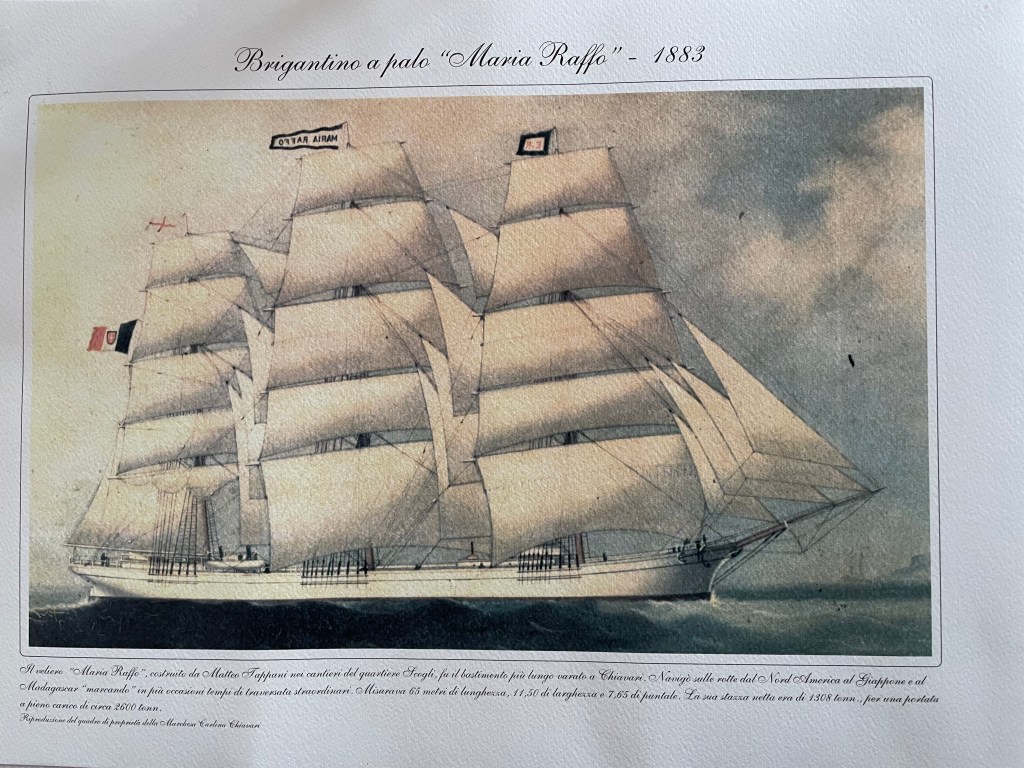
Turning away from the view, my eye was caught by a framed picture lying abandoned in the corner of the room on an old sideboard. I walked up to have a closer look. The picture was a drawing of a three-masted sailing boat, a Brigantine, and written in italics at the top was the boat’s name.

The boat was called the Maria Raffo, which is the full maiden name of Paola’s grandmother, nonna Maria Raffo.

This was a sign, a blessing from nonna Maria. We looked no further. We bought the flat, renovated it, and are living in it two years later.

At Christmas Paola gave me a copy of the Maria Raffo drawing which you can see below. The boat was built in Chiavari in 1883 for the shipowner Ernesto Raffo. It was remarkably fast and resistant in storms. For many years it carried goods across the Pacific Ocean, from the US to Japan, breaking records for speed. We have not yet discovered the link between Paola’s grandmother and the boat. Perhaps Ernesto Raffo named his boat after his wife. Was she a relative of Paola’s grandmother ? Whatever the precise history, these days Paola feels quite at home putting down new roots in Chiavari, the city of her grandmother, where everyday, as she goes to market and gets to know the inhabitants, she is no doubt meeting people to whom she is in some way related.
Exile in Paradise

Sandy Lane, Barbados

In 1685, during the reign of Charles II, the covenanter William Hanna of Wigtown in south west Scotland was banished to Barbados for his refusal to acknowledge the King’s religious authority. Britain had established an important colony on the tiny Caribbean island, with sugar plantations, worked first by indentured labour and later by African slaves. It is not known whether my namesake made it safely across the Atlantic to captivity in Barbados. Many ships were wrecked on the voyage there and he may have drowned on the way.

Three centuries later Barbados, with a population of 250,000, had become an independent country, the proud ‘craftsman of its fate’ and a growing tourist destination. It was a model democracy, with a long established Parliament. It still exported sugar and rum, and produced some of the finest cricketers in the world. Tourists thought of it as paradise.

Barbados was also the location for the Delegation of the European Commission to the Eastern Caribbean. A strange set of circumstances decreed that Barbados would be my first Delegation, and that I should enjoy a more fortunate exile than my courageous Scottish forefather.

Continue reading “Exile in Paradise”

Back to Inchmarlo: the Friendship Bench

at Inchmarlo

If you were out and about in South Belfast last week you might have noticed a pair of grey-haired men jogging up the Malone Road and down the Lisburn. Tony was in Northern Ireland for a wedding, and I was there for a funeral. We decided to meet up and revisit old haunts, including Inchmarlo, our preparatory school.

Tony, who is a ski instructor in his retirement, was always a natural sportsman, and still is a competitive runner, placed 150 somethingth in the world in his category. I run in no known categories, local or international, and was relieved that my wonky left knee held up for our 7km circuit, gaining me Strava kudos. 

Upon reaching Cranmore Park I found a pretext to halt a while. Where precisely had been the little woods where Miss Strahan led us on nature walks? There was once a pond, fringed with frogspawn, hidden under sycamores and horse chestnuts, giving masses of conkers in autumn. One day the woods were removed to make way for more rugby pitches. Inst’s insatiable quest to win the Schools’ Cup had triumphed over concern for conservation of the natural environment. Back then the ‘environment’ hadn’t yet been invented.

I showed Tony the place where, as I walked home from school at the end of term, along the chalk-flecked footpath, three or four great raindrops fell out of a clear sky onto the page of my report book, smudging the blue ink. I had opened the book to find out my marks and my place in class. We were not supposed to do this before our parents saw the book. My curiosity was now indelibly recorded for parents and teachers alike to see.

I wondered how reliable our memories would be the following day, when we were to tour the school, for the first time in 60 years. Tony pointed out that in my email to the Headteacher I had got our first year wrong: it was 1959 not 1958. But I recalled all the names of the teachers correctly. He was always good with numbers, and became a nuclear physicist. He also taught me my first words of French — which I won’t repeat here: I became a diplomat.

Next day we were warmly welcomed by the Headteacher and her deputy. But for me the school was still under the steely-eyed sway of our Headmaster, the ubiquitous Edgar Lockett. He was standing there, stiff and soldier-like, on the stairs above the Assembly; he was in shirt-sleeves in the covered way showing us how to play forward and backward defensive shots with the cricket bat; and he was smiling as he challenged us to spell Parliament and Government. A couple of lectures he gave me on the importance of hard work still ring in my ears.

I placed myself against the wall under where the clock used to be. This was where you were made to stand if you were sent out of the classroom for bad behaviour. Did this ever happen to me? It must have, for time now slowed down. I could hear the silence all through the building as I waited for the small impossibly suntanned Headmaster, to descend the creaking wooden stairs and quiz me about the nature of my misdemeanor.

Miss Kilpatrick’s class 1959/60 (thanks to Maurice Cassidy)

We adored Miss Kilpatrick, our first teacher, who one day placed fat black pencils in our hands and told us we could write with them. Unfortunately the blue cupboard with its panelled door in Miss Kilpatrick’s room was gone. But its contents were not forgotten. The headteacher still keeps a stash of sweeties as rewards. Miss Lamont mothered us and encouraged creative writing. I once wrote six pages for her about far off lands that I might travel to. But it is still Miss Strahan, striding the football pitch in her tweeds, with her shrill silver whistle, who is the most remembered teacher of those earliest years. She wrote that I must ‘hitch my wagon to a star’ and kept me in after class one day to write five lines: ‘I must not forget my handkerchief’. Tony remembered her pointing finger at lunchtime: ‘Eat that up ! ”

The floors were most familiar. The upstairs pine floor knotted and warped, the assembly hall criss-crossed by oak parquet, and the terrazzo in the cloakroom grey and white, precisely as I remembered it. We were small boys then, close to the ground.

The Ring, an oval-shaped path where we used to run, is still there. I showed Tony the final bend, where I was tripped up one day, and both my knees were sandpapered by the tarmacadam, turning rapidly from white to pink and then crimson. Ouch !

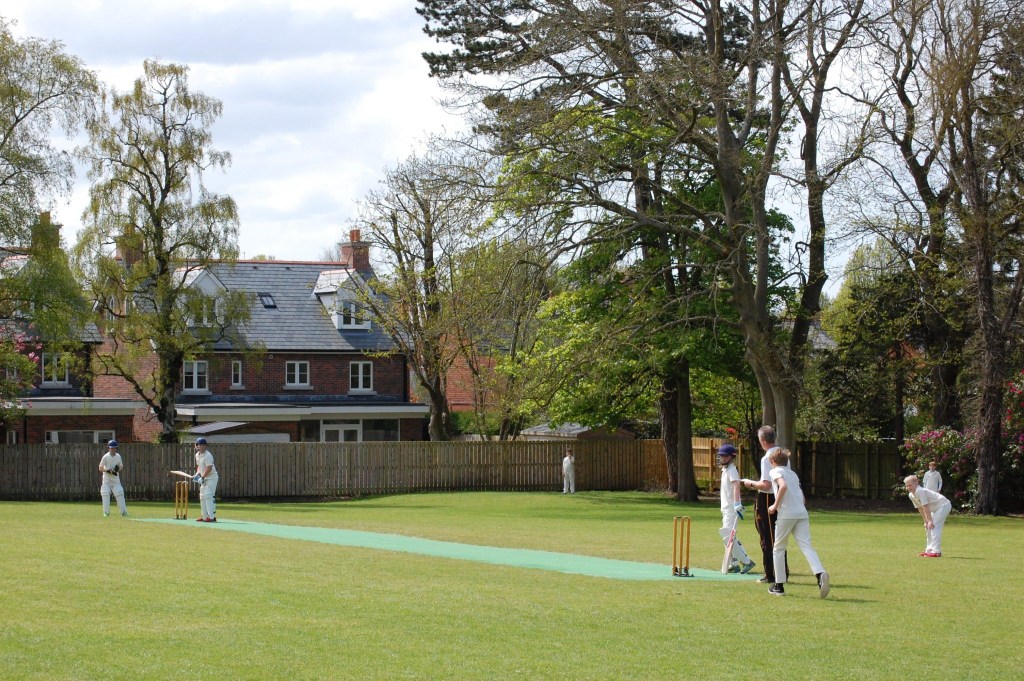
The rounders field now has an all-weather surface, but there is still real grass on the outfield of the main cricket ground. The Fathers v Sons match was due to be held the next day. In my mind Dad’s glorious cover drive rebounded against the red-brick wall. It didn’t matter that he was bowled out next ball. His four runs preserved my prestige.

Cricket at Inchmarlo, (image from school’s website)

Over in the dining hall Miss Weir, with her blue rinse hair, winged spectacles and handbag, was giving us elocution lessons, trying to wean us off Belfast vowels and consonants: “Cruella de Vil’s dinnah pahty took place in a black mahble room … and everything tasted of peppah.”

Next to the dining hall is the bicycle area where one day, when I was ten, I took a mental picture of me and my bike, and said to myself, “This exact moment in my life will never ever return”. I was right and wrong. It has returned many times in my memory, and it did so once more.

Tony and I had our picture taken at the friendship bench. The colourful wooden structure wasn’t there in the 60s, but we were then the best of friends, and remain so today, even though our paths diverged. Tony left when he was 8 years old. We both travelled far from Belfast and heard nothing of each other for over half a century. As I remember it, in our early years there were two gangs. Tony was the leader of one and I was his deputy. As Tony remembers it, he was often accused of being a swot, but I always had his back.

Inchmarlo remains a privileged place. The pupil numbers are small, and teachers have time for them, as well as for old boys. Edgar Lockett told us that the aim of education was to teach us how to think for ourselves. The school motto is Quaerere Verum — Seek the truth. Still a good guide after all these years.

Inchmarlo, Cranmore Park, Belfast (photo from school’s website)

Reflections on the Union Canal

Morning run by the Union Canal in Edinburgh

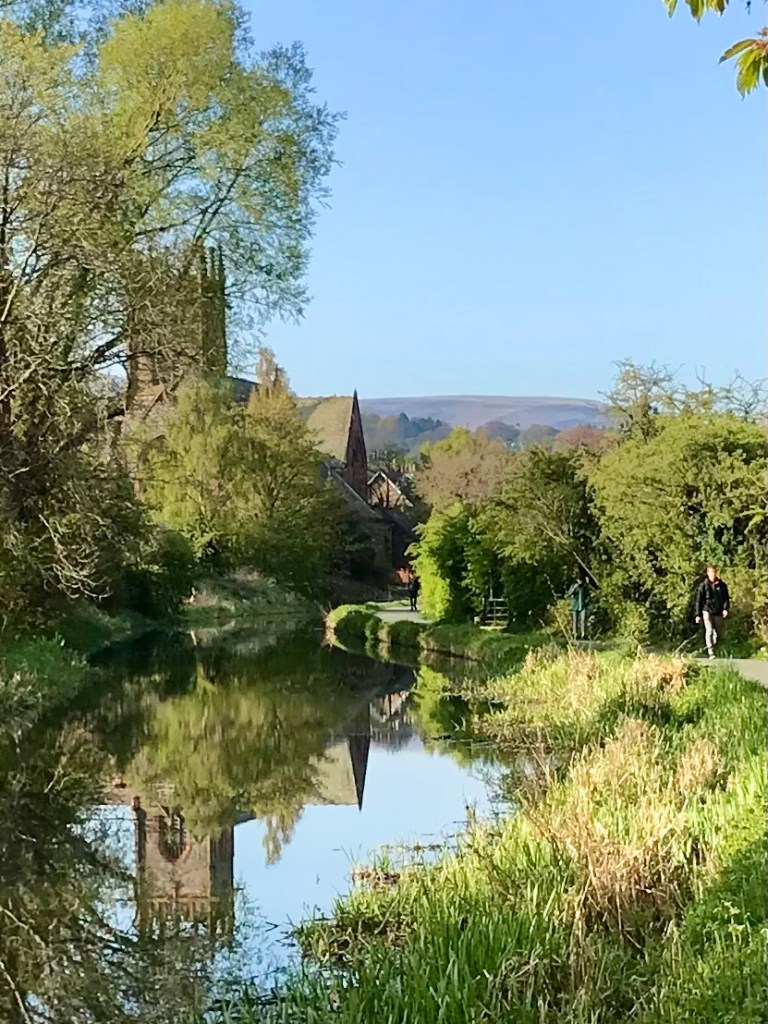
A few days ago I rose early to Ieave my car at a garage a couple of miles away beside the Union Canal. It was a beautiful blue-skied morning, such as Edinburgh occasionally bestows on its inhabitants, and I decided to run back home along the canal. The sun was shining brightly and the trees were just beginning to put on their new leaves. As I came to the stretch of the canal near the church at Polwarth I stopped and took a photo of the scene.

When I examined the photo later I was disappointed that the church tower was partly hidden by the leaves. Nevertheless I put the photo on Facebook where many people liked it. Looking more closely I could see that the tower is in fact fully visible in the reflection. You can see this even better if you turn the photo upside down.

My father might have crafted a sermon or a children’s address out of such a photograph. Perhaps his text would have been “for now we see through a glass darkly, but then face to face. Now I know in part; then I will know fully.”

A few days later, as I crossed the bridge over the canal, on my way to see a rugby match at Murrayfield, another beautiful sight greeted me.

Evening swim on the canal

There are also swans with their cygnets at the nearby Craiglockhart nature reserve. Each year the entire neighbourhood takes an interest in the birds’ nest and bets are placed on when the eggs will hatch. Ornithologists line up with their huge cameras to capture the moment of birth.

Yesterday afternoon I walked along the Union Canal, westwards this time to where it joins the Water of Leith, which winds its way down from the Pentland Hills.

The canal above Slateford

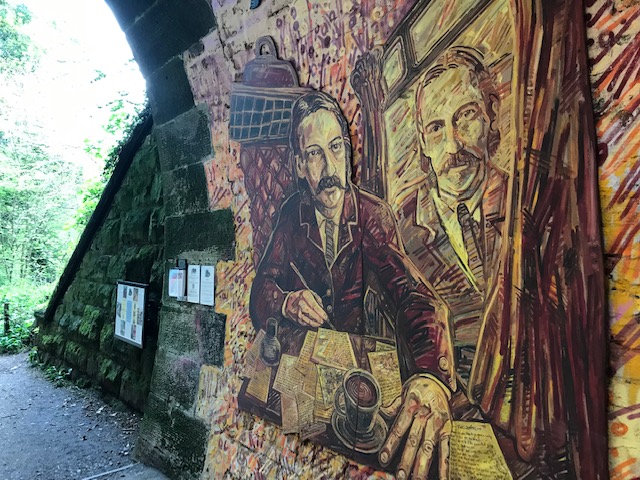
I followed the river up to the village of Colinton. This is territory Robert Louis Stevenson frequented as a boy. Stevenson, author of ‘Treasure Island’ and ‘Kidnapped’ was one of my grandparents’ favourite authors and I brought their copy of his book ‘Edinburgh’ with me when I first came to the University, many years ago. I remember reading it out loud to my future wife on the January night when we met.

Robert Louis Stevenson is celebrated in the mural at Colinton

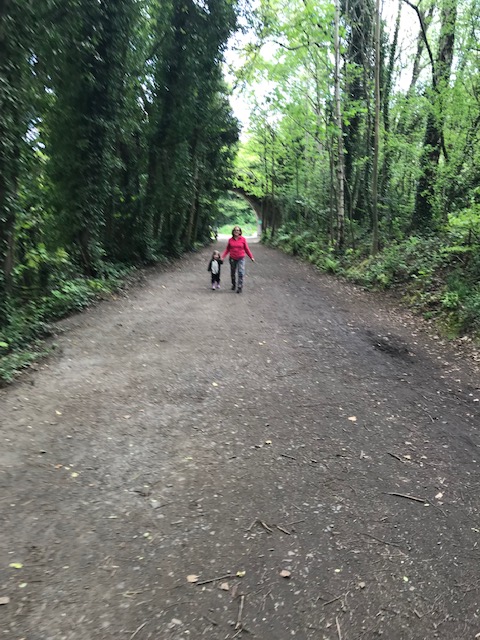
Today my son and his wife and daughters live in Colinton. Look who is coming along to meet Grandpa.

Sunday afternoon stroll in Colinton

Closely related in April

Brussels, 1 April 2022

I was born on the first of April. So I am an April Fool. Some of my fellow April fools may be ashamed of the day they were born, but it has always made me feel special. Every year on my birthday I am privileged to be on the receiving end of good wishes, birthday presents and practical jokes. Family and friends are in good form, and even people who don’t know me well and may forget other birthdays nevertheless remember mine.

When I was a child my mother used to come into my bedroom early on the morning of 1st April, pull back the curtains, and say “Oh look, is that snow on the ground? ” Snow on my birthday, hurrah, I must check this through the window: “April Fool !”

Continue reading “Closely related in April”