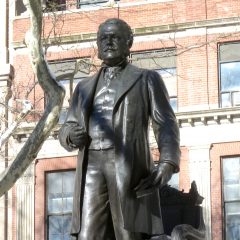
In defence of the 21st President of the United States of America

When I was a boy my father told me that our family was closely related to Chester Alan Arthur, the 21st President of the United States. Chester’s father, like mine, was a preacher who grew up on a small farm in North Antrim. 

Until recently I had met few people who had heard of Chester Alan Arthur, the Vice-President who took office in 1881 when President Garfield was assassinated. However, Chester’s obscurity did not prevent me from celebrating my relationship with the holder, from 1881-1885, of the most powerful office in the world.

In honour of my cousin, I named this blog “Closely related to Chester”. According to a recent biography entitled the “Unexpected President”, Chester Arthur turned out to be good at his job, rising above his  previous association with corrupt elements of the Republican party, and introducing an important reform of the civil service when he reached the White House. He was also an elegant man, “dignified, tall and handsome” who was known by his many admirers as the “dude President”.

Last week I learnt that NETFLIX had put out a new mini-series, “Death by Lightning”, about the assassination of US President Garfield. I wondered if Chester Arthur would feature in it and was eager to see how he would be portrayed.

A travesty ! Oh, how my eyes burned to see how the truth can be sacrificed on the binge altar, and how a good man’s reputation can be tarnished in the name of entertainment. What an injustice has been dealt out to my undeserving kinsman! 

Things start badly and then get worse. Chester is shown progressively as a thug, a drunkard, a lecher and a buffoon!  He was none of those things. The mini-series may be accurate in its portrayal of the physical assassination of President Garfield, but there is no historical evidence for the character assassination of his Vice-President.

The actor Matthew Macfadyen, of Succession fame, turns in a fine performance as the mad assassin, Guiteau, and many people will watch the show to see him. However, there is little to say about James Garfield, either before or after his three-month Presidency: not enough of a story here.

Question: How do you spin a one-off historical episode into a mini-series?

Answer: introduce a pantomime clown/villain. Boo! Hiss!

Poor cousin Chester, I sympathize with you. Unfortunately, when unscrupulous film producers decide to portray someone badly, viewers believe the images they see, however distorted and inaccurate. 

The reviewer in the Guardian fell for the trap, but I won’t repeat all the unfair words he used about “Stovepipe” Arthur.

It is some consolation to read a review of “Death by Lightning” by Destry Edwards who fact checks the string of falsehoods about Chester Arthur (viz: no clown, no drunkard, no thug and no lecher). I look forward to the film of Edwards’ true-life story of how Chester rose to the job of US President, not after a slap in the face by President Garfield’s wife, but after reading encouraging letters from one of his strongest supporters.

In the meantime, I proudly maintain the title of my blog, and refer readers to the chapter about Chester in my book “The Corncrake’s Welcome” in which I gave new meaning to the acronym MAGA – Make Arthur Great Again!

https://cei.org/opeds_articles/death-by-lightning-fact-vs-fiction/

https://troubador.co.uk/bookshop/autobiography/the-corncrakes-welcome

Bob Dylan at Bozar: no phones home

Palais des Beaux Arts, Brussels

The first time I saw Bob Dylan was in Belgium in the 1980s, at Anderlecht football ground. His band occupied a stage at one end of the pitch while we stood at the other. We could scarcely see him nor make out the songs he was singing, so distant was the band and so successfully did Dylan disguise his well-known words and tunes. 

The second time was at a concert was in Uruguay in 2006, at the Conrad Hotel in Punta del Este. The audience was made up of rich young Argentinians on holiday, calling their friends by mobile phone and then waving to one another across the stadium. I strained to listen Dylan singing “Like a Rolling Stone”, one of the anthems of my youth, but the Argentinians paid little attention. They were a different generation. For them it was all about being seen in the right place, and they spoiled my experience.

When I learnt that Dylan was playing once more in Brussels, this time in the intimate and beautiful Palais des Beaux Arts, I didn’t think twice. He is now 84 years old – no spring rooster crowing at the break of dawn. We bought tickets and travelled from Italy to Brussels for the concert.

What attracted me most to this concert was that it was without phones. Dylan had decided to disarm philistines and hangers-on, people addicted to capturing images that they will look at once and then discard. He seemed to be caring for genuine fans like me.  At last, I might hear the world’s finest song-writer close-up and without distractions. In his heyday Dylan was a mighty poet, not read in school-books but listened to on the radio, on TV, a troubadour singing for the poor and dispossessed, for freedom, for the whole world. There were other great singer song-writers – Leonard Cohen, Joni Mitchell and Van Morrison, but Dylan soared above them all.  And maybe, in 2025, with his new-found concern for the quality of the audience’s experience, he might even reward us with recognizable versions of his greatest hits.

We arrived at the Bozar an hour early, before the Art Deco entrance doors were unlocked. Our phones were locked away in pouches resembling church money collection bags, except that we allowed to carry them with us. We now had an hour to wait, time to sip a glass of wine and watch as people of all ages walked into the concert hall and stood around. Hundreds of people were happily talking to one other. No heads were buried, fixed on screens, communicating with people elsewhere. We were all together, fully present in the same public space.

With fifteen minutes to go, we took our seats in the “baignoires” – boxes like old-fashioned baths, just twenty yards from the stage. This was the closest I had ever been at a Dylan concert. The hall was packed, buzzing with anticipation, the bells ringing for ten minutes to go and then five, until, right on time, a group of ancient musicians, dressed in black, appeared on stage.  I was reminded of when we used to wait on the Lisburn Road in Belfast for the bands to arrive on 12th July: all of us looking down the road waiting and listening for the music to begin.

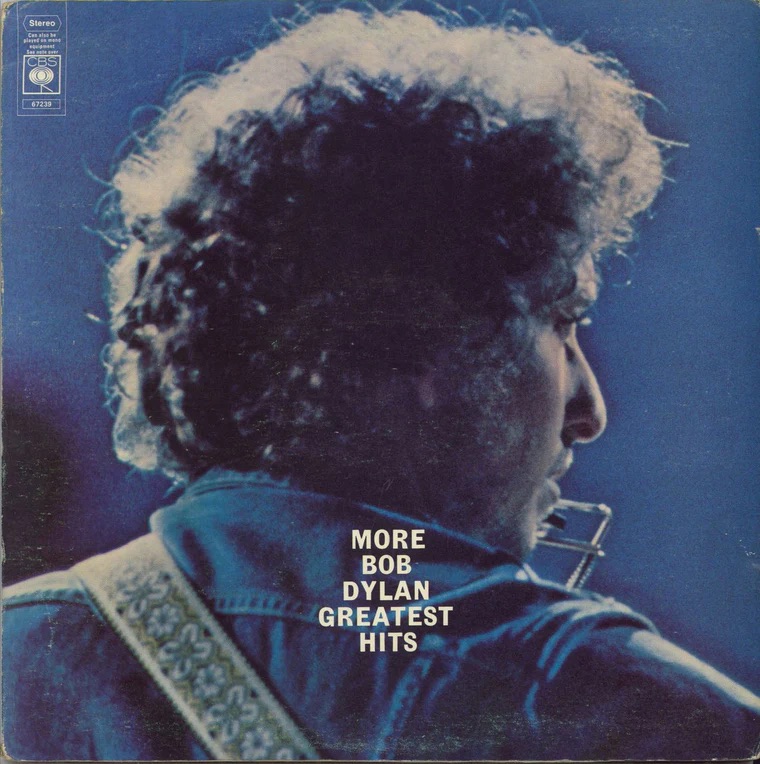
The lights were yellow and low. Dylan, surrounded tightly by his band, started with his back to the audience. The first song brought tears to my eyes. “I’ll be your baby tonight” was on the double LP Greatest Hits 2 which my brother John and I bought for Christmas in 1973. We listened and danced to this music in John’s room until the record player needle broke. It was harder to recognize “It ain’t me babe”, the only one of his early songs that Dylan played. A protest song of sorts, both a personal and public one. He was once more reminding us that he is only the poet, not the leader, not the messiah.

After that it got harder to make out the words in Dylan’s octogenarian guttural growl. I refused to believe Paola when she whispered to me he was singing “When I paint my masterpiece”, perhaps my favourite Dylan song. The tune was different, the rhythm was samba, but she was right. We made out the words “I left Rome and landed in Brussels” and a cheer broke out across the Belgian audience.

Most of the other songs were new – well, new to us. We have not kept up with the 50 plus albums Dylan has brought out in his lifetime. Dylan still seems to enjoy singing the songs he chooses on the night, not the songs the audience wants to hear. He and his band played without a break for eighty minutes. Chapeau ! From time to time he stood up for a few seconds and then sat down. He left the stage with no goodbye, thanks or encore, but we felt that he had given us good value.  

In 1964, at the height of his fame as a folk singer of protest songs, Dylan closed the album “The Times They Are A-Changin’” by taking “The Parting Glass”, a traditional song that he got from the Clancy brothers, and transforming it into “Restless Farewell”. It was a rebuke to critics of magazines like Newsweek who sought to tie him down, to know who had influenced him, and what cereal he ate for breakfast. The song ends with the lines: 

‘So I’ll make my stand

And remain as I am

And bid farewell and not give a damn’

Robert Zimmerman did not disappoint us this time. His idea to lock up our phones made all the difference. And I found it reassuring that he still presents his audiences with an enigma: A complete unknown/With no direction home/like a rolling stone.

Under observation by Jane Goodall

I once met Jane Goodall, the renowned environmentalist, who died last week. 

It was in 2003 and I was Head of Delegation and EU Ambassador to Tanzania. We had a massive programme of cooperation with the country, focusing on infrastructure and agriculture. We were also funding projects to protect the environment in many of Tanzania’s wildlife parks and reserves. These included the small park of Gombe, on the shores of Lake Tanganyika, where for many years Jane Goodall had been observing chimpanzees. There she made the astonishing discovery that our closest relatives in the animal world use tools, a skill that was previously thought to be reserved to our primate species. She also found out that, in certain circumstances, chimpanzees will kill one another and even wage war.

In Gombe, Jane’s organisation, Roots and Shoots, was involving local people in productive activities in order to protect the park, and the EU had funded some of this work. My environment expert in the Delegation briefed me that the funds had not always been used exactly for the intended activities.  He advised me to insist that all previous funds be properly accounted for before agreeing to advance any new money.

So when Jane Goodall arrived for our meeting at the new EU Delegation, I was in cautious mode, eager to listen to this famous person making her pitch for new funding, but also prepared to insist on proper accountability. 

However, instead of asking for new EU funding, Jane Goodall sat in a chair, not opposite but beside me, and said nothing. The slim woman, her blonde hair tied back in a bow, simply looked at me, smiling. This made me feel uneasy, and the more she saw this, the more she kept observing me. I found myself talking, not very coherently, about EU support for the environment. She just sat still without saying a word. It felt as though she were trying to assess what sort of an alpha male primate she was sitting beside. 

After a few minutes of this disturbing silence Jane took out of her handbag a fluffy toy baby chimpanzee and handed it to me.

What was I to do with a fluffy toy ? Of course I held it, but how should I hold it? On my lap? Against my heart? At arm’s length ? This was my first post as a Head of Delegation and EU Ambassador and I had a certain idea of the dignity of my position. There were a dozen people in the room, including my own staff, and it felt ridiculous to be holding a toy chimpanzee in front of them. 

When Jane Goodall finally spoke she said that she had placed the same chimpanzee in the hands of world leaders including Mikael Gorbatchev and Kofi Annan, and she found that the meetings with them had gone very well.

I don’t recall the rest of our meeting at the EU Delegation in Dar es salaam, but I know that from the beginning to the end Jane Goodall had me in the palm of her hand, and the EU did help fund later Roots and Shoots projects. 

As Jane Goodall left Umoja House we posed for a photo in front of the flags of the EU Member States which are flown inside EU Delegations the world over. Her wide green eyes fix the camera confidently, while I am still left holding the chimpanzee. Over the next twenty years she became one of the foremost spokespersons for nature, protecting the environment and combating climate change, someone who inspired millions of people, young and old, all over the world.

Through her many years of observing primates Jane Goodall discovered how closely we are connected to one another and to the natural world. She shared her unique understanding with us. She believed that ‘each of us makes a difference and that we have to decide what sort of difference we will make. She gave us all ‘reason for hope’.

Ancient and Modern in Greece 

 As I close one decade and enter a new one, I ask myself whether it is better to revisit familiar places or to explore new horizons. Is it more rewarding to travel back, and learn what has changed and what remains, or to set out on a fresh adventure and be surprised by the new? One way to enjoy both old and new worlds is to visit places you know about but have never properly visited. So I have come to Greece for my 70th birthday celebrations.

I find Greece a wonderfully hospitable country. Each of our friendly guides asks us the same three questions: What’s your name? Where do you come from? Have you been here before? Well, I have been here, but my previous visits have been two and far between: a stifling night in a hotel in Piraeus in 1978, returning from my wedding in Tanzania, and a week on the island of Corfu in the 1990s, when we exited the Club Med once for a half day tour. 

If academic studies were an accurate guide to destiny, I would have spent more time in Greece. Ancient Greek is my third foreign language, after French and Latin. My investment in the first two languages has already paid off well. I spent much of my working life in francophone countries, and now, in retirement, I’ve enjoyed almost six months in Italy, where they speak a modern version of Latin. So why haven’t I spent more time in Greece? 

Greece in early spring is as beautiful as it is supposed to be. The birds are singing, and wildflowers explode under the olive trees. The poppies are a deeper more blood-red colour than those showing their first growth in my Edinburgh garden. A few days ago, in the blue and white seaside village of Galaxidi, I listened to the water lapping on the shore and watched as “rosy-fingered dawn” appear over Mt. Parnassus. My thoughts turned to the Odyssey, taught to us by the late Michael Longley, to Odysseus and Telemachus, and then to my son David running at the same moment across England from West to East. We too also crossed mountains, the snow-covered Pindus range, not on foot but in a jeep. For a few hours, in that remote part of Greece, close to Albania, we were well away from the madding crowd of other tourists.

Before this visit I already knew much about this country’s history, culture, and religion. For two years in the mid-1960s I was one of a small band of pupils who chose to study Ancient Greek, and obtained two O-levels—one in the language and one in the Greek New Testament. The Good Book was first written in Greek, as I was reminded when we visited Corinth, and saw where St. Paul faced his accusers. When I was fifteen I was able to translate the entire Gospel according to St. Mark into English. It helped that I was well-versed in the English text.

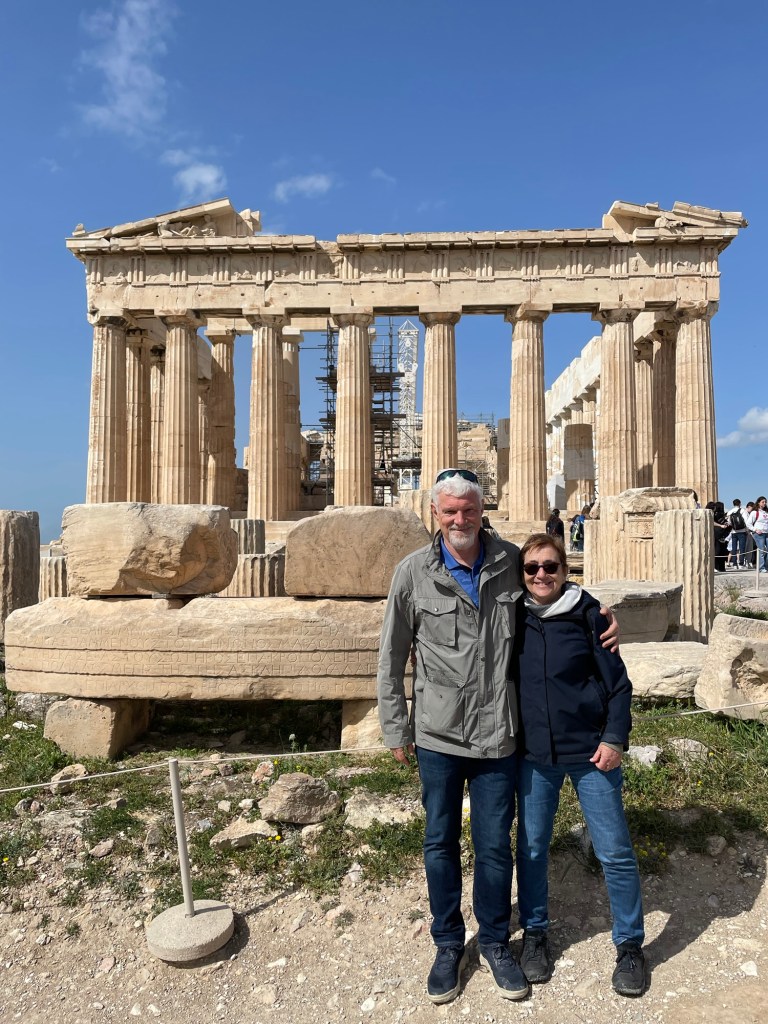
When we visited the Acropolis on my birthday, and posted a picture to prove it, one of my Facebook friends remarked that this was a ‘confluence of ancient ruins’. Ha ha, Dave. I had a similar thought, but kept it to myself. Good word ‘confluence’, but of Latin origin. I would prefer ‘synchronization’ from the Greek, meaning ‘in time with’.  

The Temple at Delphi

From that vantage point, high above the city of Athens, we looked down at the theatre where Sophocles’ tragedy Antigone was first performed. I thought of our teachers, Old Rothers and Charlie Fay. It is the only play I have ever performed in —in both Greek and English—hiding my nerves behind a giant mask of the Chorus.  

The Agora and temple of Hephaestus

Of course, today there is the slight problem of updating my knowledge of Ancient Greek to Modern Greek. Judging by their puzzled reactions, today’s Greeks have difficulty understanding their own archaic tongue, particularly when spoken with a Belfast accent. Over the last two millennia some vowels have shifted, and some consonants have clustered in confusing ways. 

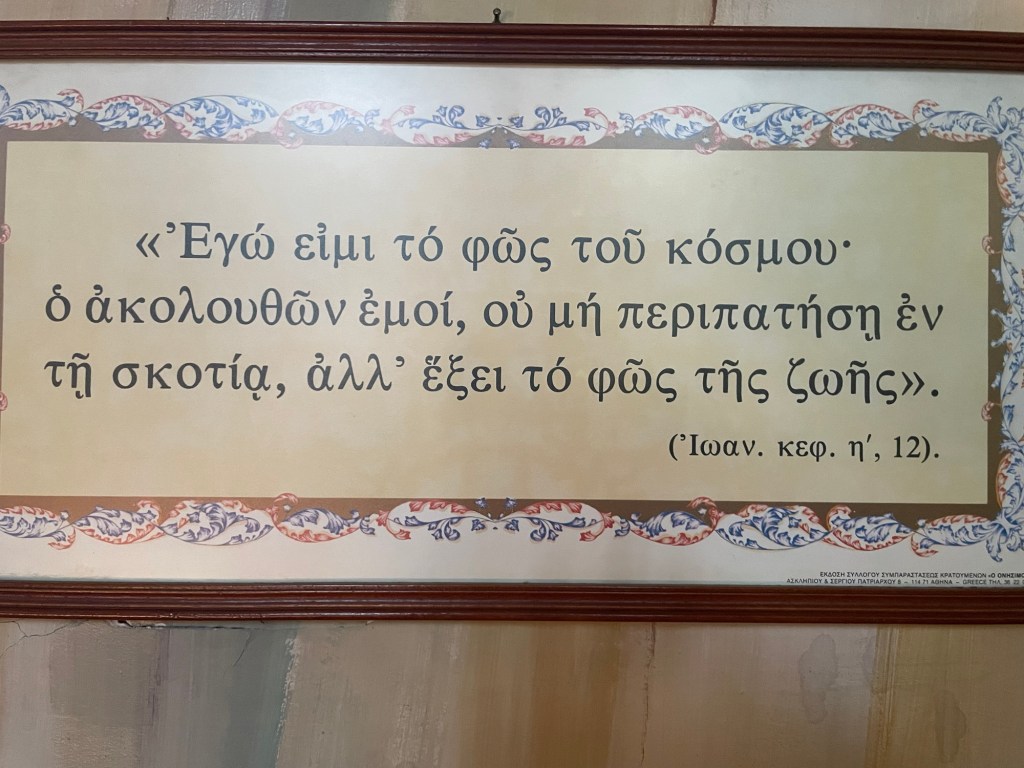
Notwithstanding these impediments, as I travel through this country I feel that the Greek language insurance policy I took out fifty years ago has finally matured. It is satisfying to be able to decipher and make sense of the characters of the 24-letter Greek alphabet. In a restaurant, this reveals the simplest words for potatoes and tomatoes. Along the highway, I discovered the place name Thermopylae, just in time to ask the driver to stop at the battlefield where the ancient Spartans made their last stand. And in the amazing monasteries of Meteora I was able to decipher the biblical texts on the walls. Each small success — with menus, the names of streets, or scripture— gives me the simple joy of connecting with ancient and modern people through a shared language.

‘I am the light of the World.’ St John’s gospel

Michael Longley

The poet Michael Longley, previously mentioned in this blog, died last week at the age of 85. I had the good fortune to have Michael Longley as my English teacher at Inst from 1967 to 1969. He was an inspirational young schoolmaster, introducing  us to Homer, to Stravinsky, and, in person, to his friend Seamus Heaney, who read some of his first poems to us. Fifty years later I had the privilege to meet Michael again, when I interviewed him, during lockdown, for the Wigtown Book Festival.

With no experience of this sort of interview, I was a wee bit nervous at first, but Michael soon put me at ease, and I greatly enjoyed our conversation. I asked him about the different themes of his poetry and he read some of his favourite pieces. Towards the end of the interview, in answer to questions from viewers, he gave some fascinating insights into the art of writing poetry.

Over the years I carried the slim volumes of Michael Longley’s poetry with me all over the world. I recall asking his permission to read ‘Ceasefire’ at BRAC University in Bangladesh. Michael kindly allowed me to quote from two of his poems as epigraphs in my books of memoirs. My favourite poem of his used to be ‘Detour’, in which he imagines his own funeral meandering along the main street of an Irish market town, never reaching a conclusion. No doubt it will be read this week. I now think that my favourite poem is ‘Laertes’ which he chose, explained and read at the Wigtown Festival. Here is the link to the U tube video of our interview, called the Candlelight Master. The conversation starts at minute 6.20.

The Best of Irish Presbyterianism

One of the joys of writing is learning the response of readers. Strangers tell you that they have enjoyed your story. Old friends get back in touch, and you learn more about one another. And sometimes people whom you did not know well show that they have understood you through your writing: they “really get you”.

Neil Faris was one such understanding reader. I had known Neil since I was a child, but I am closer in age to his younger brothers, Paul and John. I started school, at the age 4, in the same class as Paul, and I was best man at his wedding. John, who became a clergyman, kindly took the service at my brother’s funeral in 2017.

Neil followed this blog. He enjoyed my first book of memoirs Voyages with my Grandfather and encouraged me to write the seque The Corncrake’s Welcome. I sent some chapters to him and he offered meticulous and pertinent observations.

When I learnt that Neil was suffering from a severe form of cancer, I made a point of meeting up with him in Belfast. He was undergoing treatment and was not well, but we enjoyed coffee and scones at a cafe on the Lisburn Road, on a chilly October day. Six months later, he invited me for tea at his flat on the Malone Road, on a bright May morning. We chatted about our families, who have known each other for three generations, and we found that we viewed the world from similar standpoints. He was the grandson of a Presbyterian Minister, and I was a son of the Manse. We both attended Belfast Inst and both went on to study law. Neil’s years at Trinity College and mine at the Department of Foreign Affairs in Dublin broadened our Northern Irish perspective. I felt both enriched and stimulated after our conversations.

Neil died last month. Tributes from friends and colleagues appeared in The Newsletter and the Belfast Telegraph. Neil had been a leading Northern Irish lawyer who fought for justice, human rights, and the environment, and had made a difference in all these fields. He kept going right to the end.

After his death I realised that Neil left me a gift, in the form of a review of The Corncrake’s Welcome which he wrote earlier this year. He thought that it needed polishing, and wanted to discuss it with me, but we were not given the opportunity to do so. Here it is, unedited, and sorry I am to lose an old/new/good friend and a valued reader.

Review of The Corncrake’s Welcome  – William D Hanna, Troubador Publishing Limited, Market Harborough

William Hanna was  a son of Windsor Presbyterian Church Manse on the Lisburn Road in Belfast, becoming, in a diplomatic career,  an ambassador of the European Union. The Corncrake’s Welcome is his engaging memoir of his and his family’s  life and times in the Belfast of the 1960s and 1970s.  

First of all, William Hanna marries very well elements of  his family history. He was able to persuade his father, Rev William Hanna, to write reminiscences of his childhood in Loughgiel, County Antrim. Rev Mr Hanna records a deep love for the County Antrim countryside, evoking the call of the corncrakes, then common enough in the fields around Loughgiel. The community there was ‘mixed’ between Protestant and Catholic and Rev Mr Hanna developed a lasting friendship with a fellow cleric – who became Cardinal Cathal B Daly and who introduced Rev Mr Hanna to Pope John Paul II on the famous papal visit to Ireland in September 1979.

William Hanna records well how both Rev Mr Hanna and Cardinal Daly were, throughout their years of service in their respective churches, true men of peace in  the long weary decades of sectarian violence that afflicted Northern Ireland (and the island of Ireland and Britain generally). But there is much else of interest in the reminiscences of Rev Mr Hanna: including his origins in the covenanting tradition of the Reformed Presbyterian Church – a tradition that perhaps may be novel to many protestants.

But William Hanna by no means forgets his mother, Honor Hanna. He includes very interesting extracts of 1942 from her World War 2 diary, when as Honor Boyd, she was a nurse in Belfast. As well as recounting the travails of that life and times she records the deep trauma of the loss on active service in Burma of her brother Jack. Truly, as William Hanna writes, 1942 was a fateful year for the family.

The second half of the book is then the  personal story of William Hanna (both growing up in Belfast  & at the start of his career in the Irish Diplomatic Service in Dublin).

Now, the ‘Windsor’ area of South Belfast was by no means immune from the sectarian violence  which intensified across Northern Ireland in the 1960s and 1970s, even though, of course, many other areas suffered far worse. William Hanna  recounts episodes where his father as presbyterian minister stood firm against sectarianism and for peace.

Just one example of this.  Not in any way an incidental point, but William Hanna records a  dreadful sectarian murder at Moore & Oliver’s garage then on the Lisburn Road and almost opposite the presbyterian church. Surely, Rev Mr Hanna was a genuine peacemaker being able to bring not just some comfort to the bereaved family and also, as William Hanna was told,  years later at his father’s  funeral, how in calling on and praying with the bereaved family Rev Mr Hanna had  ‘taken the hate away’. Truly an act of enduring grace.

In summary, there is so much in the book that captures the best of Irish Presbyterianism that it should be appreciated by all those who are presbyterian adherents and also by those who value the contribution that Presbyterianism has made and can make on the island of Ireland and wider afield.

Neil Faris

Dreaming about Bangladesh

Last Sunday night I dreamt about Bangladesh, where I served as EU Ambassador from 2010 to 2014. In my dream I was organizing a diplomatic event, when the Prime Minister, Sheikh Hasina suddenly appeared in the room, totally alone. I had not expected her to attend in person, and I rushed around trying to find a chair for her to sit on, but each one I looked at was broken. Since I was unable to find a suitable chair the PM lay down on the floor. When I awoke I told my wife about the dream. An hour later I learnt on BBC radio news that Sheikh Hasina, who had been in power since 2010, had fled the country, leaving by helicopter before students ransacked her palace.

Although it is ten years since I lived in Bangladesh I still have great affection for the country. People often ask me which of my diplomatic postings I enjoyed the most. I reply that it was Bangladesh. It’s not that the capital, Dhaka, was a comfortable place to live. Far from it: Dhaka usually features as one of the most unlivable capital cities in the world. But the people of Bangladesh captivated me: their language and culture, their courage, resilience and determination to succeed in the face of adversity impressed me profoundly and have stayed with me.

In my book Voyages with my Grandfather ( https://troubador.co.uk/bookshop/travel/voyages-with-my-grandfather) I told the story of my first official meeting with Sheikh Hasina, the then Prime Minister. Soon after my arrival in Bangladesh I learnt of the work of Rabindranath Tagore, the finest poet in Bangla, composer of the national anthems of India and Bangladesh, and winner of the Nobel Prize. I discovered both an Irish and Scottish connection. The Irish connection is W. B. Yeats, who was one of the first westerners to appreciate Tagore’s work. The Scottish connection is Robert Burns. Tagore adapted the words and music of one of Burns’ most beautiful songs to the Bangla language and topography. He transposed ‘Ye Banks and Braes’ into ‘Phule Phule’ which is today one of the most popular folk songs in Bangladesh.

img_1588-1
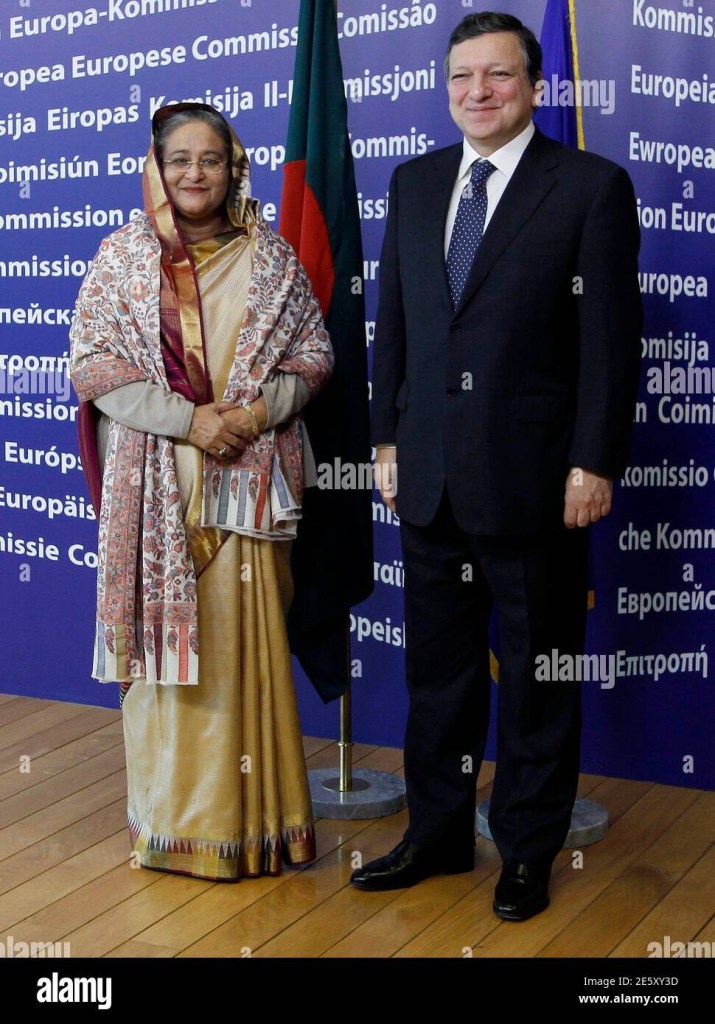
Bangladesh PM meeting EU Commission President Barroso in 2010

On the day appointed for my first meeting with Sheikh Hasina I was sitting in a large room in her palace, talking nervously to her diplomatic adviser. I told him about Tagore and Burns and started humming the tune of Phule Phule. At that moment the Prime Minister entered the room and sat down on an embroidered settee. Her adviser began the introductions by informing the PM that the new European Ambassador had a song for her. This was not a moment to be bashful. So I started singing ‘Phule Phule, dhole dhole’. And then, for a few moments, Sheikh Hasina joined in and sang the song with me, in a soft and tuneful voice.

I did not mention in my book that I rather spoiled this harmonious start to my new assignment by asking the PM how certain minorities in the country, such as the Rohingya, were being treated. My mandate was to improve relations between the EU and Bangladesh. We promoted trade and business and provided a lot of aid. But our main purpose – the main objective of EU Foreign Policy was, and remains, to strengthen fundamental values such as democracy, the rule of law and human rights. At times this led to a difficult dialogue, particularly in 2014 when we decided not to observe the elections because of the undemocratic actions of the government. This decision displeased the PM. Although I saw the President before I left the country, the PM was unavailable to meet me for a farewell courtesy call.

Over the years since then Sheikh Hasina’s rule became increasingly authoritarian, and student protests grew. I have now retired, and have not been following the events in Bangladesh closely. Last week I had no conscious idea that the protesters were so near to ousting the PM. I suppose my dream must have been a case of my unconscious mind drawing some conclusions.

Speaking to the Press in Bangladesh, 2014

One person who was always prepared to see me, not only when I first arrived in Dhaka, but also when I said farewell, was Nobel prize winner and founder of the Grameen Bank, Muhammad Yunus. I recall his sense of despair ten years ago at the authoritarian direction the country was already taking. Today he has been appointed head of an interim government. I am convinced that Yunus, who is 84, has no political ambitions. He simply wishes to serve his country. He has made some hopeful statements. For my many friends in Bangladesh, and for its millions of people, I sincerely hope that he will be able to ensure an orderly and peaceful transition towards a democratically elected government, in full respect of human rights and democratic principles.

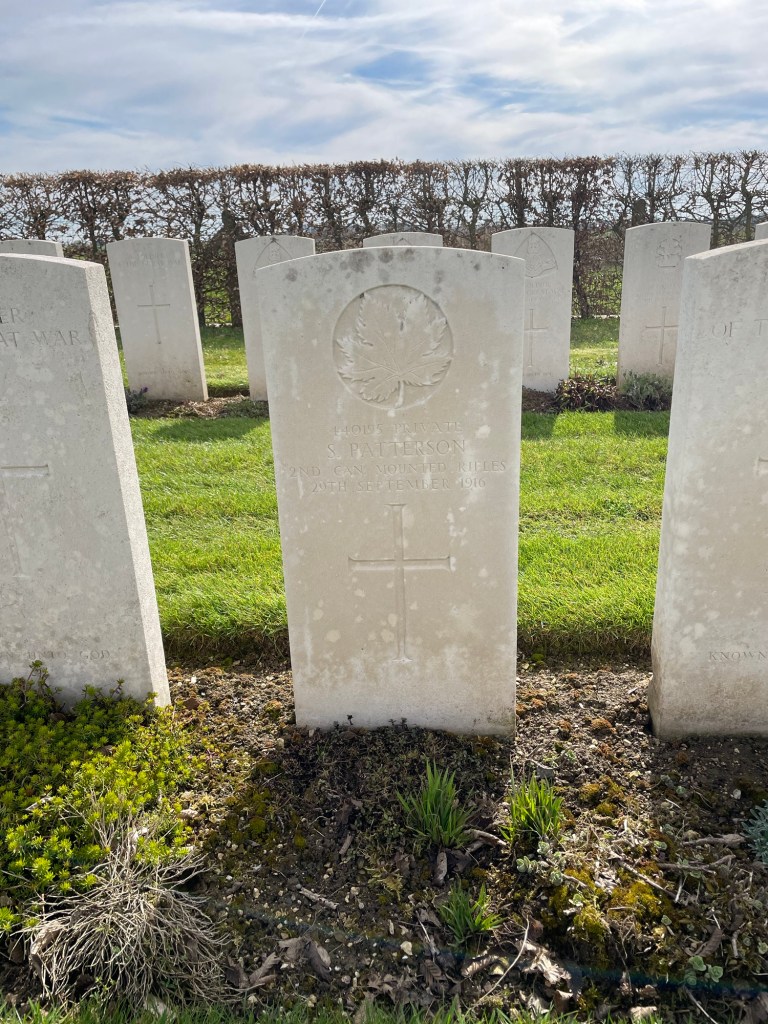
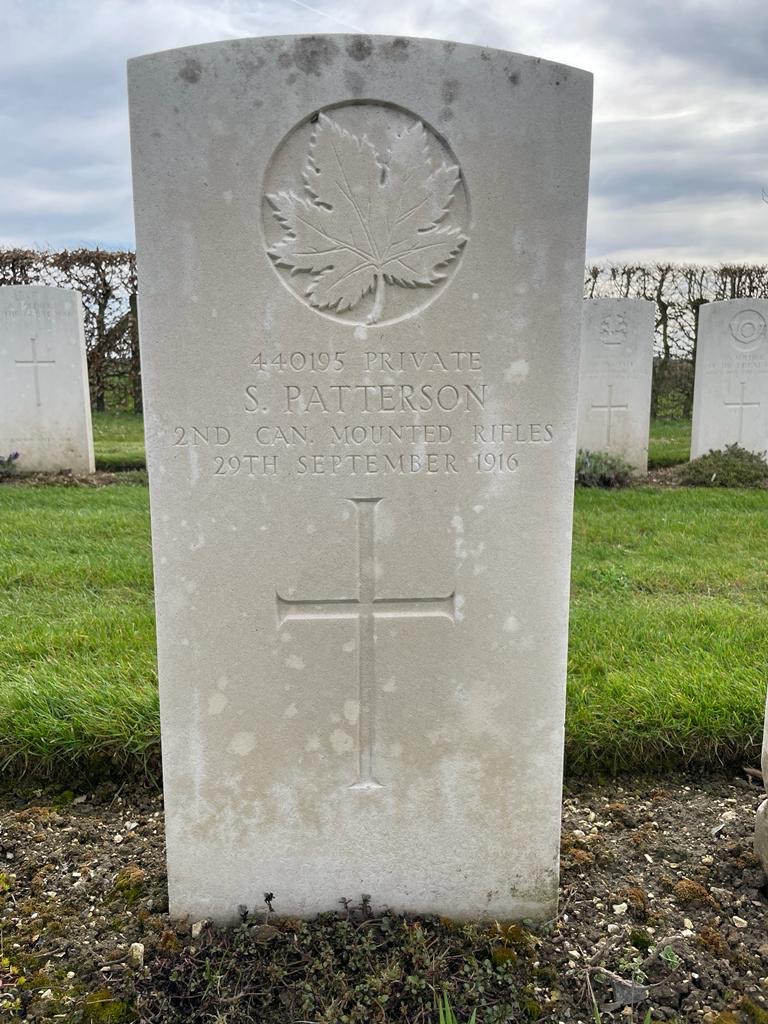
Samuel Patterson, Villers Bretonneux, 29 September 1916

My first visit to Belgium was in 1977 to study at the College of Europe in Bruges. The College arranged a visit for all the students to the First World War cemeteries in nearby Ypres and Passendaele. We walked beside the graves of so many young men who had come from all over the world to die in Flanders. There were many Irish soldiers, from North and South, and many Scots. I remember being struck by the numbers of young Australians and Canadians and thinking that they had died far from home. We visited the German war graves as well as those of the allied forces. We were impressed by the stillness and beauty of the surroundings, in contrast with the horror of life and death in the muddy trenches. For students of European integration – French, Germans, British and all the other nationalities – our visit was a powerful lesson about the origin and purpose of European unity.

Over the years since then my work as a European diplomat took me to similar cemeteries around the world. I’ve attended Remembrance Day services in Tanzania, Uruguay, Bangladesh and Ghana. In 2013 I visited the cemetery outside Rangoon in Burma/Myanmar where my Uncle Jack’s name is carved on the wall listing the fallen in the Second World War. I wrote about Uncle Jack and my visit to Burma in ‘Voyages with my Grandfather’.

When I was researching for my second book, ‘The Corncrake’s Welcome’, I became aware that one of my father’s uncles had fought and died in the First World War. My second cousin James Patterson got in touch and was able to tell me where our great-uncle Samuel Patterson’s grave lies.

Visiting Villers-Bretonneux

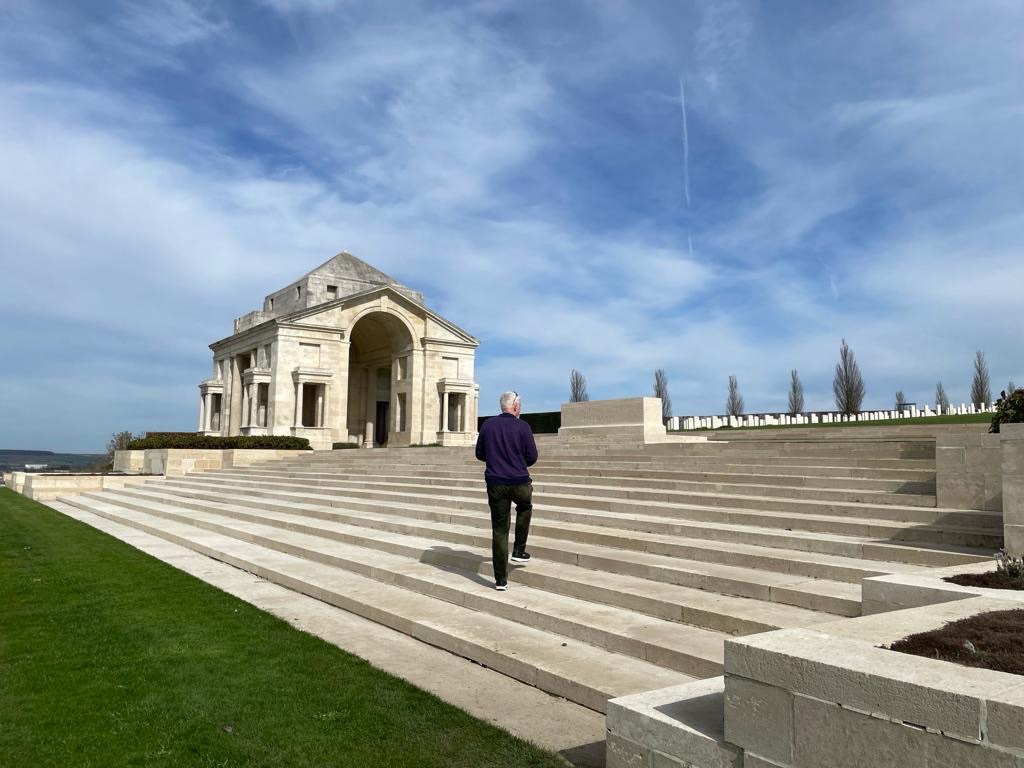
And so one of my final acts, before leaving Belgium at the end of this month, was to pay a visit to the First World War cemetery at Villers Bretonneux in Northern France. It took just two hours to travel from Brussels, passing Waterloo on the outskirts of the city, and then taking the autoroute into France as far as the valley of the Somme.

The cemetery lies a mile outside the village, on a ridge from where you can see for many miles in all directions. In April 1916 the German forces attacked the Allied lines and advanced some 70 kilometers. Beginning on 1 July 1916 the Allied Forces counter-attacked. On that day there were five thousand casualties in the Ulster Division alone, at Thiepval, further along the line. However Samuel Patterson was not one of those who went over the top with the Ulster Division. A few years before the War he and a brother had emigrated to Canada to make a new life for themselves. It was in Canada that he signed up to serve in the Imperial Forces who crossed the Atlantic to join the fight in Europe.

In the cemetery at Villers Bretonneux lie mainly Australian soldiers, but also some Canadians who were part of the Allied counter attack at the end of September 1916. I found Samuel’s grave stone in Row XVI A E5. Beside him, to his right and his left, are the graves of two soldiers ‘Known unto God’. Of course this is a euphemism: their bodies must have been so blown to pieces that it was not possible to identify them. At the entrance to the cemetery are carved the familiar words I saw in Rangoon ‘Their name liveth for Evermore’. More fine words perhaps, but at least the sacrifice of these young men is still faithfully recorded over a century after their death.

The day was bright and small birds were singing. Flowers adorned the graves which were carefully kept, as are the millions of other graves in similar resting-places all over the world. I shared the scene by phone with my cousin James in Scotland. I’m glad to have honoured my grandmother Jeannie Patterson’s brother. I don’t know if any family member has ever visited the grave before now.

In the Corncrake’s Welcome my father describes how the Patterson family was denounced from the pulpit of Kilraughts Reformed Presbyterian Church for allowing their sons to fight in the First World War, and how his grandfather, Samuel Patterson’s father, turned his back on that church as a consequence. How dreadful for a father to have lost a son in the War and then to be condemned and shamed because of it.

After the Second World War Europeans decided to create new institutions that would so bind them together that war between the countries would no longer be thinkable.There has been peace in Europe for most of my lifetime. However today Putin’s Russia has called this into question by fostering disunity in Europe and by attacking our Eastern flank in Ukraine. Our future and that of our children and grandchildren today depend on Ukrainian soldiers who are paying the ultimate price for freedom, and on our European determination to work together and do whatever it takes to support them.

On the radio

Next Sunday morning, 18 February 2024, I will be talking about my new book, “The Corncrake’s Welcome” in the programme Sunday Sequence on BBC Radio Ulster. The interview will go out as a podcast soon after.

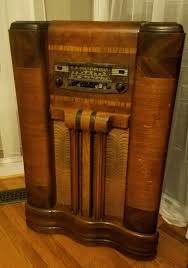
The Corncrake’s Welcome is both a personal and family memoir, set in Northern Ireland. Early in the book my father recounts the magical day, some ninety years ago, when their farmhouse was connected to the outside world through the airwaves.

Wireless

It was a Saturday in late winter in the early 1930s. A kinsman had taken the day off to supervise the operation. First he erected a pole, roof high alongside our dwelling. He bored a hole through the timber of a window, produced a wire to be attached to the pole, threaded it through the windows, and finally secured it a strange looking contraption with lots of knobs and dials. And we now owned our first wireless. This was no crystal set but the real thing. It was mid-afternoon and the voice of the rugby commentator from Cardiff was saying, ‘Ross has crossed the Welsh line for his second score. The conversion is now being attempted. Square two.’ A reference to the diagram of the field was then provided for listeners. The player was William McC Ross. His performance that day has been equalled by few Irishmen.

At school some companions talked about ‘the flicks’. But we lived miles away from the nearest picture house. We didn’t have the money or transport, nor would there have been much encouragement from our parents for such waste of time on a Friday evening or a Saturday afternoon matinee. After all, the outside world came right to our own fireside through the wireless.

At first, we listened to music broadcast from England: Jack Payne and his band, Henry Hall and his Orchestra, and Reginald Dixon at the organ of the Blackpool Tower Ballroom.

Religion too had a place on the air. One young Scottish preacher from Govan Old Parish Church, George McCleod, was compelling. This man could talk and what he had to say was important. There was a Thursday evening short service from St Michael’s, Chester Square in London. And also from St Martin in the Fields. We loved the Irish witticisms of Reverend Pat McCormack and later the passionate pleading of his successor, Reverend Dick Sheppard.

Jamie McAleese was the local carpenter and very competent. Our family would call him in to build an extension to the kitchen or to erect a new barn. His wife was a teacher, and their home was a delight to visit. It was so neat and tidy and ordered. To boys accustomed to the daily disarray of a busy farmhouse, this home looked different. Different too was the choice of wireless programmes that always caught the ear on entering. Tuned in twice daily to London, we were used to solid and substantial fare, whereas the McAleese apparatus always seemed to carry the sounds of a Ceilidh. We soon learned to tune in to Radio Athlone. There was always gaiety about the daily output on the Southern waves. When John McCormack was not singing the evocative melodies of Thomas Moore, a Ceilidh band set our feet tapping. To add to the novelty there was a generous quota of programmes in the Gaelic tongue.

Around eleven o’clock each evening, the lady announcer from Athlone signed off in English and in Gaelic with ‘and that Ladies and gentleman is the end of broadcasting for today’. I heard this so often I leant it by heart: ‘agus sin deireadh’. I have often spoken this one phrase in Irish, and it has served me well as a useful variant for the more traditional ‘Goodbye’.

***

Dad became a clergyman and served from 1941-1981 as minister to congregations in Randalstown, Belfast and Co. Donegal. All his life he remained passionate about rugby. He was the founder of the rugby club at Randalstown. In 1967 he took me to Dublin to see my first international match, Ireland v Wales. He died in 1983.

Last year, when I came to write about Dad in my memoirs, I wanted to give an idea of what it was like to listen to him preaching in the pulpit.

I had been struggling with my chapter for a while, just as Dad had often struggled with his sermons. But boy could the old man tell a story. We especially enjoyed his children’s addresses. How could I recapture today the impression Dad’s storytelling made and the lessons he taught us?

It occurred to me that I still had old cassette tapes of Dad’s preaching from services broadcast on the radio. I hadn’t listened to them this century and no longer even owned a tape recorder. I ordered a Walkman-like device, which Amazon delivered the next day, and sat down to listen to a service first broadcast on RTE radio from St Johnston in Donegal on Sunday 24 February 1980.

The cassette had been stopped in the middle of the service. I didn’t press rewind, in case the new machine would eat up the old brown tape. I just pressed Play, and the congregation sprang to life, singing a Psalm. Donegal voices in harmony. Winnie McCracken at the organ. I wondered how many of that congregation are alive today.

A woman read a lesson from the New Testament with great gusto and in a lovely accent — a Laggan lilt. It was the story of the man who built his house on stone and the one who built his house on sand.

The voice that followed was even clearer, and still holds power over me, whether I hear it on tape, or in my head. Dad had an engaging speaking voice, with an unmistakable North Antrim accent and intonation. He pronounced ‘not’ as ‘nought’ an indicator of his origin in the Route district. He also rolled his Rs, a trick he may have acquired from listening to Scots pulpit orators like George McCleod and D.P. Thompson.

He began the Children’s Address, pausing between each phrase;

‘What an exciting picture Jesus gives us in those verses. Two men in two houses and then the rain, floods and gales. One house stands up to it, and the other one comes down with a great crash.

GiRRls and boys, let’s hope the weather is ‘nought’ like that when you go to school tomorrow.

Do you know that in some parts of Scotland when it’s raining hard, and the children cannot get out to play, they sing this little rhyme:

‘Rainy rainy, rattle and stainy

Don’t rain on me,

Rain on John O’Groat’s house,

Far ayont the sea.’

Now that’s funny, because John O’Groats’house is not far beyond the sea. It’s in the north of Scotland, in Caithness, almost in the sea. Maybe you will go there one day and see it for yourselves.

I smiled to myself, as I listened to the radio broadcast. How did you know, Dad, that I’ve recently visited Caithness for the first time?

But who was this man John O’Groats? We are told that many years ago, in the reign of James IV, there came to Scotland a Dutch man called Jan de Groot. He had eight sons, and by and by they all married and had homes of their own, but once a year, on a certain date, they all came back to see their father and to celebrate the day when he arrived in Scotland.

On one of those yearly visits, unfortunately, these eight sons started quarreling among themselves as to which one should be the boss and sit at the top of the table. Not so nice for the old man, was it? Well, they all turned to him to decide and settle the dispute. And all he said was ‘All right, all right, come back all of you next year and I’ll tell you.

The next year, when they all came back for the anniversary dinner, they found that their father had built a room with eight sides to it, and on each side a door, and in the centre of the room a table with eight sides. So, there was nothing to quarrel over. Each son could walk in by a different door and sit at a different side of the table. All eight of them were equal.

Clever old man, John O’Groats. Mind you, we are not told if that ended the quarrel among the brothers. I do hope so. But d’you know, our Lord Jesus had the same trouble with his twelve disciples. One day he found that several of them had started to quarrel because each wanted to be head disciple. And our Lord was much cleverer and wiser than old John O’Groats. This is what he said to them.

‘Whoever wants to be greatest among you must be your servant.’

And to show them what he meant, Jesus took a basin of water and a towel and stood down and washed the sand from his disciples’ feet.

***

I’ve just realized that next Sunday 18 February be the anniversary of Dad’s death. I have a notion that he’ll be listening to the BBC Ulster radio broadcast up in heaven.

(Ireland next play Wales at Lansdowne Road on 24 February).

https://emea01.safelinks.protection.outlook.com/?url=https%3A%2F%2Fwww.troubador.co.uk%2Fbookshop%2Fautobiography%2Fthe-corncrakes-welcome&data=05%7C02%7C%7Cba48d417c0854ca7484808dbfb3230f1%7C84df9e7fe9f640afb435aaaaaaaaaaaa%7C1%7C0%7C638379966747866045%7CUnknown%7CTWFpbGZsb3d8eyJWIjoiMC4wLjAwMDAiLCJQIjoiV2luMzIiLCJBTiI6Ik1haWwiLCJXVCI6Mn0%3D%7C3000%7C%7C%7C&sdata=sdP7XxzZzaCs8KH0w0MCsS3FAc8vWQ6FjXYkUAMk7hk%3D&reserved=0


Still Life

Last year I wrote about returning to Inst for a school reunion, fifty years on. John Faris, who was a couple of years ahead of me at Inst, and who reads this blog, contacted the editor of the Instonians Old Boys magazine, Seahorse, to propose that the piece be included in their Winter 2023 edition.

A fellow called Stephen read the article and noticed the reference to my brother John, who died in 2017. Stephen had been in charge of the sheltered accommodation on the Lisburn Road where John lived for many years.

Last week Stephen sent me an e mail and told me he had something of John’s which he wanted to give me. For the life of me I couldn’t think what it was, but I gave Stephen my number and he phoned me later the same day.

Stephen reminded me that after John died his flat was cleared and there were some personal belongings to be disposed of. At the time I had said that the only item which interested me was a picture that had been my mother’s and had been given to John in 2010 after she died.

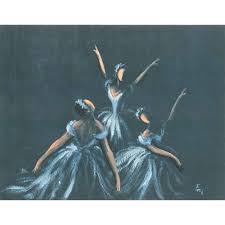
John attached little or no importance to material things and did not hang the picture on his wall. He was also embarrassed to display the painting because its subject was a group of ballerinas. So they lay neglected in a corner of his bed-sit, the glass got broken, and the picture was forgotten until now.

We’ve arranged to have the painting delivered to relatives in Belfast who remember it well. It hung for many years in the drawing room in Windsor Manse, and it was precious to my mother, because it was painted by a woman whom she admired, perhaps more than anyone else in the world, for her incredible courage.

Elizabeth Twistington Higgins and her sister Janet were close friends of my mother when she nursed in London after the War. Elizabeth made my mother’s wedding dress, and sewed part of the hem with my mother’s golden hair. She was a ballet dancer and my mother took her then fiancé, my father, to see Elizabeth dance in a West End show. But Elizabeth contracted polio and had to give up dancing. She was paralyzed from the neck down, and had to spent much of the rest of her life in an iron lung.

However Elizabeth did not give up living. Although she could only move a few muscles she taught ballet and took up painting. Her paintings were often used in Christmas cards. The subjects were flowers or fruit or ballet dancers. She gave my mother two of these paintings, one of daffodils, which my mother may have passed on to a niece, and the one of the three ballerinas which will soon be returned to me.

Elizabeth appeared in ‘This is Your Life’ with Eamonn Andrews. My mother used to tell her story to Presbyterian Women’s Groups, showing as visual aids the wedding dress, also worn by my sister Anne Louise at her wedding, some Christmas cards, the picture of the ballerinas, and Elizabeth’s autobiography.

The title of Elizabeth Twistington Higgins’ autobiography may have been chosen before by other writers, but none could have given it more meaning : Still Life.

The picture of the ballerinas will remind me of family members who are departed from this world, but are still alive in my mind. I tell more stories about them in The Corncrake’s Welcome. https://www.troubador.co.uk/bookshop/autobiography/the-corncrakes-welcome