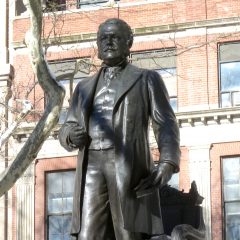

I travelled back to Belfast last month to attend a school reunion at Inst. It was fifty years since I left the school, and I had never before been minded to attend such an event.
A few hundred old boys turned up, in dinner jackets and bow ties, with heads greyer or more bald towards the front tables of the Common Hall, where once ‘eager and joyous in youth’ we donned uniform black and yellow RBAI blazers and school ties.
As Michael Longley pointed out in a video a few years ago, Inst was founded by William Drennan, also founding member of the Society of United Irishmen, and coiner of the phrase ‘The Emerald Isle’, as a place of education for all, with no religious connotations. Indeed until the Education Act of 1947 there were no prayers at Assembly.
That had changed by my time, and when we attended Morning Assembly in 1966 we had to remember to bring red hymn books with us.
In our first years at Inst there was revolution in the air, at least among the bigger boys. I don’t recall that it was about the impending sectarian conflict in our city. It was more triggered by civil rights marches in the US, and student protest in Paris. Having discovered the similarity between our hymn books and Chairman Mao’s little red book, we waved our books in the air, like so many followers of the revolution. Some books were even thrown and trampled on the ground and burned near the tuck shop.
For this irresponsible and irreligious act a few radical pupils were punished. A gust of protest arose. Word went round that we would not sing the hymn the next day at Assembly. But the Principal somehow got wind of our proposed hymn boycott. At 9 a.m. we all stood to attention, as we were expected to, when Mr Peskett entered the Common Hall. But when he arrived on the stage, and took off his mortar board, instead of announcing the morning’s hymn he curtly told us all to ‘please sit’. He announced no hymn. Radical protestant movement in the centre of Belfast had once more been nipped in the bud.
Last month no hymns were sung at our Old Boys dinner, but a prayer was said, and we drank a loyal toast to the King. And, with the words printed on sheets to remind us, we all sang the school song in unison and with gusto.
The words of Inst ! Inst ! Ancient and Royal are stirring, but the music is borrowed from an old German drinking song, of the oompah oompah variety, and it was hard to tell if the old boys were taking the words seriously enough. A finer Inst school song was written in the 1930s by some of our uncles, but it did not catch on, and they may have taken it with them to their graves.
Ten old boys from my year turned up. That’s about 10% of the final year pupils. Half had stayed in Northern Ireland and half had left. Belfast wasn’t such a great place to hang around in in ‘73. It’s much improved today.
Some of us recalled our first English teacher, an Irish hockey international from Cork, who introduced us to Yeats, and got himself into deep water by an impressive but inaccurate throw of a duster across the classroom. It had been the boy behind who was talking, not the innocent chap who still bears the scar on his head.
Michael Longley, our second year English teacher one day brought a pal to his classroom to read his new poetry to us – poems with titles such as ‘Digging’ ‘Blackberrying’ and ‘Follower’ which were later to earn their author ~ Seamus Heaney ~ the Nobel Prize. We recalled how Longley once played a piece of classical music on his record player and asked us to write down the thoughts that came into our heads as we listened. We learnt afterwards that the piece was Stravinsky’s Rite of Spring. Apparently one cultured fellow knew the title of the work.
I was delighted when the President of the Old Boys Association remembered our 1973 Ulster Schools Cup Rugby Final, even though we lost to Ballyclare, and when one old boy remembered playing rugby with my late brother John. There was a moment’s silence for absent friends.
What had happened to us all in the fifty years since we left Inst ? Some joined the family firm, and a pair of good mathematicians entered the insurance profession. A talented scrum-half became an architect; a fine artist chose to teach English ; a clever fellow turned into an Oxford don; and one boy – perhaps our highest flyer – became a pilot in the Canadian Air Force.
It was he who asked me how I became a diplomat, but, just as I was about to answer we were asked to stand to sing that old school song, and we did as we were told.
After that there were good speeches, and plenty of red wine, and I never did get round to explaining how a son of the Manse and old Instonian, brought up in such a British tradition, later became an Irish and European diplomat.
If you are interested to know more you may read my story, and that of my family, and how we responded to the Troubles, in ‘The Corncrake’s Welcome’ , just published by Troubador, available in paperback and soon in e book. https://www.troubador.co.uk/bookshop/autobiography/the-corncrakes-welcome
P.S. I apologize for any inaccuracies that may have occurred in this post. The school’s motto is Quaerere Verum – Seek the Truth, and my memories may not all be accurate or reliable. I welcome observations or corrections.





 Closely Related to Chester
You must be logged in to post a comment.