Bob Dylan at Bozar: no phones home

Palais des Beaux Arts, Brussels

The first time I saw Bob Dylan was in Belgium in the 1980s, at Anderlecht football ground. His band occupied a stage at one end of the pitch while we stood at the other. We could scarcely see him nor make out the songs he was singing, so distant was the band and so successfully did Dylan disguise his well-known words and tunes. 

The second time was at a concert was in Uruguay in 2006, at the Conrad Hotel in Punta del Este. The audience was made up of rich young Argentinians on holiday, calling their friends by mobile phone and then waving to one another across the stadium. I strained to listen Dylan singing “Like a Rolling Stone”, one of the anthems of my youth, but the Argentinians paid little attention. They were a different generation. For them it was all about being seen in the right place, and they spoiled my experience.

When I learnt that Dylan was playing once more in Brussels, this time in the intimate and beautiful Palais des Beaux Arts, I didn’t think twice. He is now 84 years old – no spring rooster crowing at the break of dawn. We bought tickets and travelled from Italy to Brussels for the concert.

What attracted me most to this concert was that it was without phones. Dylan had decided to disarm philistines and hangers-on, people addicted to capturing images that they will look at once and then discard. He seemed to be caring for genuine fans like me.  At last, I might hear the world’s finest song-writer close-up and without distractions. In his heyday Dylan was a mighty poet, not read in school-books but listened to on the radio, on TV, a troubadour singing for the poor and dispossessed, for freedom, for the whole world. There were other great singer song-writers – Leonard Cohen, Joni Mitchell and Van Morrison, but Dylan soared above them all.  And maybe, in 2025, with his new-found concern for the quality of the audience’s experience, he might even reward us with recognizable versions of his greatest hits.

We arrived at the Bozar an hour early, before the Art Deco entrance doors were unlocked. Our phones were locked away in pouches resembling church money collection bags, except that we allowed to carry them with us. We now had an hour to wait, time to sip a glass of wine and watch as people of all ages walked into the concert hall and stood around. Hundreds of people were happily talking to one other. No heads were buried, fixed on screens, communicating with people elsewhere. We were all together, fully present in the same public space.

With fifteen minutes to go, we took our seats in the “baignoires” – boxes like old-fashioned baths, just twenty yards from the stage. This was the closest I had ever been at a Dylan concert. The hall was packed, buzzing with anticipation, the bells ringing for ten minutes to go and then five, until, right on time, a group of ancient musicians, dressed in black, appeared on stage.  I was reminded of when we used to wait on the Lisburn Road in Belfast for the bands to arrive on 12th July: all of us looking down the road waiting and listening for the music to begin.

The lights were yellow and low. Dylan, surrounded tightly by his band, started with his back to the audience. The first song brought tears to my eyes. “I’ll be your baby tonight” was on the double LP Greatest Hits 2 which my brother John and I bought for Christmas in 1973. We listened and danced to this music in John’s room until the record player needle broke. It was harder to recognize “It ain’t me babe”, the only one of his early songs that Dylan played. A protest song of sorts, both a personal and public one. He was once more reminding us that he is only the poet, not the leader, not the messiah.
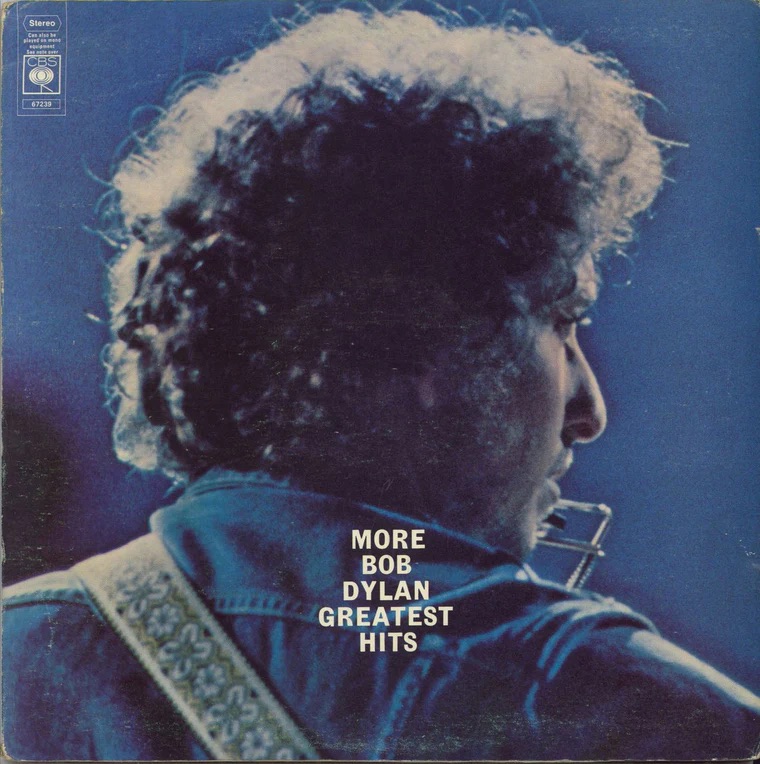
After that it got harder to make out the words in Dylan’s octogenarian guttural growl. I refused to believe Paola when she whispered to me he was singing “When I paint my masterpiece”, perhaps my favourite Dylan song. The tune was different, the rhythm was samba, but she was right. We made out the words “I left Rome and landed in Brussels” and a cheer broke out across the Belgian audience.

Most of the other songs were new – well, new to us. We have not kept up with the 50 plus albums Dylan has brought out in his lifetime. Dylan still seems to enjoy singing the songs he chooses on the night, not the songs the audience wants to hear. He and his band played without a break for eighty minutes. Chapeau ! From time to time he stood up for a few seconds and then sat down. He left the stage with no goodbye, thanks or encore, but we felt that he had given us good value.  

In 1964, at the height of his fame as a folk singer of protest songs, Dylan closed the album “The Times They Are A-Changin’” by taking “The Parting Glass”, a traditional song that he got from the Clancy brothers, and transforming it into “Restless Farewell”. It was a rebuke to critics of magazines like Newsweek who sought to tie him down, to know who had influenced him, and what cereal he ate for breakfast. The song ends with the lines: 

‘So I’ll make my stand

And remain as I am

And bid farewell and not give a damn’

Robert Zimmerman did not disappoint us this time. His idea to lock up our phones made all the difference. And I found it reassuring that he still presents his audiences with an enigma: A complete unknown/With no direction home/like a rolling stone.

Ancient and Modern in Greece 

 As I close one decade and enter a new one, I ask myself whether it is better to revisit familiar places or to explore new horizons. Is it more rewarding to travel back, and learn what has changed and what remains, or to set out on a fresh adventure and be surprised by the new? One way to enjoy both old and new worlds is to visit places you know about but have never properly visited. So I have come to Greece for my 70th birthday celebrations.

I find Greece a wonderfully hospitable country. Each of our friendly guides asks us the same three questions: What’s your name? Where do you come from? Have you been here before? Well, I have been here, but my previous visits have been two and far between: a stifling night in a hotel in Piraeus in 1978, returning from my wedding in Tanzania, and a week on the island of Corfu in the 1990s, when we exited the Club Med once for a half day tour. 

If academic studies were an accurate guide to destiny, I would have spent more time in Greece. Ancient Greek is my third foreign language, after French and Latin. My investment in the first two languages has already paid off well. I spent much of my working life in francophone countries, and now, in retirement, I’ve enjoyed almost six months in Italy, where they speak a modern version of Latin. So why haven’t I spent more time in Greece? 

Greece in early spring is as beautiful as it is supposed to be. The birds are singing, and wildflowers explode under the olive trees. The poppies are a deeper more blood-red colour than those showing their first growth in my Edinburgh garden. A few days ago, in the blue and white seaside village of Galaxidi, I listened to the water lapping on the shore and watched as “rosy-fingered dawn” appear over Mt. Parnassus. My thoughts turned to the Odyssey, taught to us by the late Michael Longley, to Odysseus and Telemachus, and then to my son David running at the same moment across England from West to East. We too also crossed mountains, the snow-covered Pindus range, not on foot but in a jeep. For a few hours, in that remote part of Greece, close to Albania, we were well away from the madding crowd of other tourists.

Before this visit I already knew much about this country’s history, culture, and religion. For two years in the mid-1960s I was one of a small band of pupils who chose to study Ancient Greek, and obtained two O-levels—one in the language and one in the Greek New Testament. The Good Book was first written in Greek, as I was reminded when we visited Corinth, and saw where St. Paul faced his accusers. When I was fifteen I was able to translate the entire Gospel according to St. Mark into English. It helped that I was well-versed in the English text.

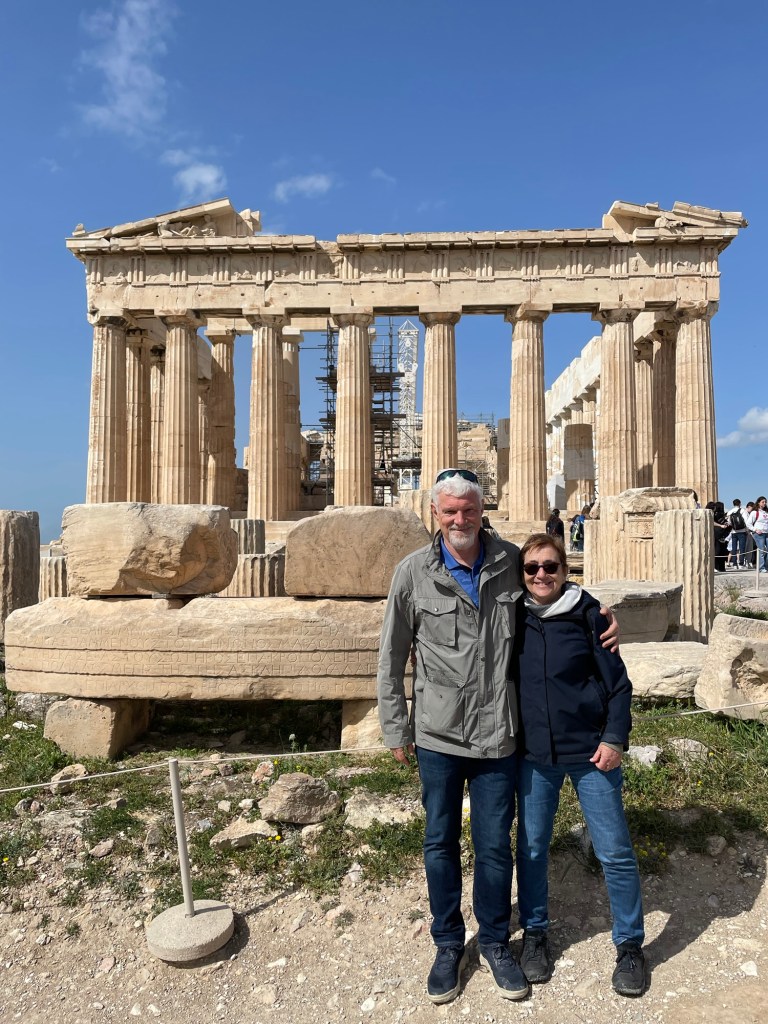
When we visited the Acropolis on my birthday, and posted a picture to prove it, one of my Facebook friends remarked that this was a ‘confluence of ancient ruins’. Ha ha, Dave. I had a similar thought, but kept it to myself. Good word ‘confluence’, but of Latin origin. I would prefer ‘synchronization’ from the Greek, meaning ‘in time with’.  

The Temple at Delphi

From that vantage point, high above the city of Athens, we looked down at the theatre where Sophocles’ tragedy Antigone was first performed. I thought of our teachers, Old Rothers and Charlie Fay. It is the only play I have ever performed in —in both Greek and English—hiding my nerves behind a giant mask of the Chorus.  

The Agora and temple of Hephaestus

Of course, today there is the slight problem of updating my knowledge of Ancient Greek to Modern Greek. Judging by their puzzled reactions, today’s Greeks have difficulty understanding their own archaic tongue, particularly when spoken with a Belfast accent. Over the last two millennia some vowels have shifted, and some consonants have clustered in confusing ways. 

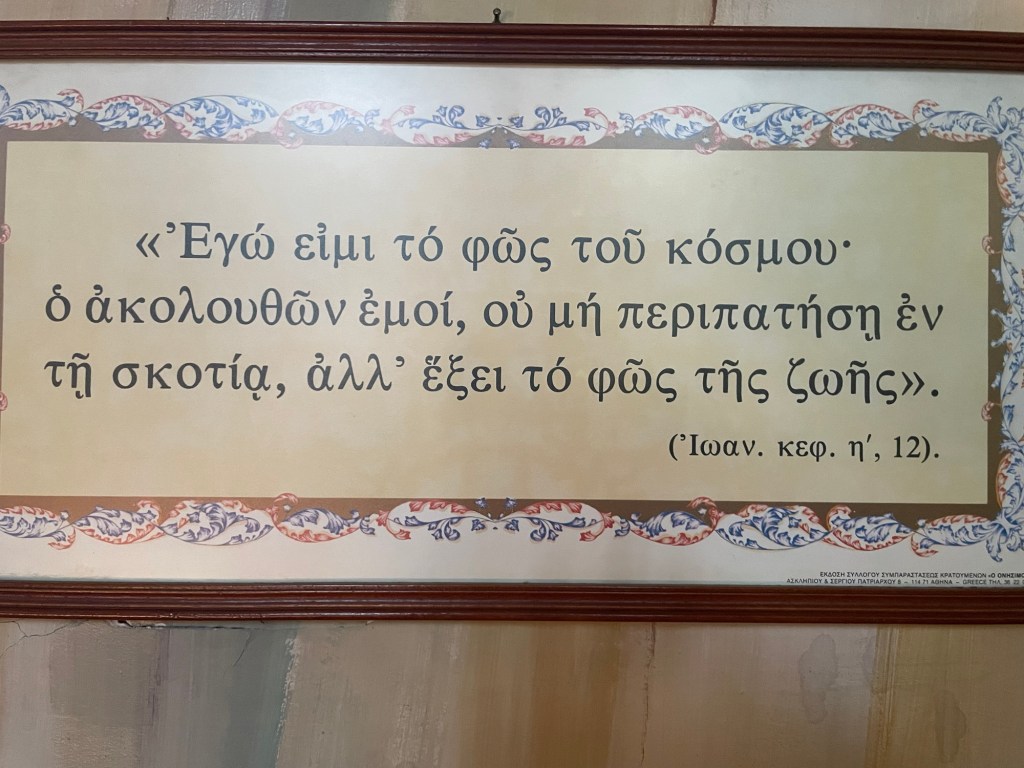
Notwithstanding these impediments, as I travel through this country I feel that the Greek language insurance policy I took out fifty years ago has finally matured. It is satisfying to be able to decipher and make sense of the characters of the 24-letter Greek alphabet. In a restaurant, this reveals the simplest words for potatoes and tomatoes. Along the highway, I discovered the place name Thermopylae, just in time to ask the driver to stop at the battlefield where the ancient Spartans made their last stand. And in the amazing monasteries of Meteora I was able to decipher the biblical texts on the walls. Each small success — with menus, the names of streets, or scripture— gives me the simple joy of connecting with ancient and modern people through a shared language.

‘I am the light of the World.’ St John’s gospel

Michael Longley

The poet Michael Longley, previously mentioned in this blog, died last week at the age of 85. I had the good fortune to have Michael Longley as my English teacher at Inst from 1967 to 1969. He was an inspirational young schoolmaster, introducing  us to Homer, to Stravinsky, and, in person, to his friend Seamus Heaney, who read some of his first poems to us. Fifty years later I had the privilege to meet Michael again, when I interviewed him, during lockdown, for the Wigtown Book Festival.

With no experience of this sort of interview, I was a wee bit nervous at first, but Michael soon put me at ease, and I greatly enjoyed our conversation. I asked him about the different themes of his poetry and he read some of his favourite pieces. Towards the end of the interview, in answer to questions from viewers, he gave some fascinating insights into the art of writing poetry.

Over the years I carried the slim volumes of Michael Longley’s poetry with me all over the world. I recall asking his permission to read ‘Ceasefire’ at BRAC University in Bangladesh. Michael kindly allowed me to quote from two of his poems as epigraphs in my books of memoirs. My favourite poem of his used to be ‘Detour’, in which he imagines his own funeral meandering along the main street of an Irish market town, never reaching a conclusion. No doubt it will be read this week. I now think that my favourite poem is ‘Laertes’ which he chose, explained and read at the Wigtown Festival. Here is the link to the U tube video of our interview, called the Candlelight Master. The conversation starts at minute 6.20.

The Best of Irish Presbyterianism

One of the joys of writing is learning the response of readers. Strangers tell you that they have enjoyed your story. Old friends get back in touch, and you learn more about one another. And sometimes people whom you did not know well show that they have understood you through your writing: they “really get you”.

Neil Faris was one such understanding reader. I had known Neil since I was a child, but I am closer in age to his younger brothers, Paul and John. I started school, at the age 4, in the same class as Paul, and I was best man at his wedding. John, who became a clergyman, kindly took the service at my brother’s funeral in 2017.

Neil followed this blog. He enjoyed my first book of memoirs Voyages with my Grandfather and encouraged me to write the seque The Corncrake’s Welcome. I sent some chapters to him and he offered meticulous and pertinent observations.

When I learnt that Neil was suffering from a severe form of cancer, I made a point of meeting up with him in Belfast. He was undergoing treatment and was not well, but we enjoyed coffee and scones at a cafe on the Lisburn Road, on a chilly October day. Six months later, he invited me for tea at his flat on the Malone Road, on a bright May morning. We chatted about our families, who have known each other for three generations, and we found that we viewed the world from similar standpoints. He was the grandson of a Presbyterian Minister, and I was a son of the Manse. We both attended Belfast Inst and both went on to study law. Neil’s years at Trinity College and mine at the Department of Foreign Affairs in Dublin broadened our Northern Irish perspective. I felt both enriched and stimulated after our conversations.

Neil died last month. Tributes from friends and colleagues appeared in The Newsletter and the Belfast Telegraph. Neil had been a leading Northern Irish lawyer who fought for justice, human rights, and the environment, and had made a difference in all these fields. He kept going right to the end.

After his death I realised that Neil left me a gift, in the form of a review of The Corncrake’s Welcome which he wrote earlier this year. He thought that it needed polishing, and wanted to discuss it with me, but we were not given the opportunity to do so. Here it is, unedited, and sorry I am to lose an old/new/good friend and a valued reader.

Review of The Corncrake’s Welcome  – William D Hanna, Troubador Publishing Limited, Market Harborough

William Hanna was  a son of Windsor Presbyterian Church Manse on the Lisburn Road in Belfast, becoming, in a diplomatic career,  an ambassador of the European Union. The Corncrake’s Welcome is his engaging memoir of his and his family’s  life and times in the Belfast of the 1960s and 1970s.  

First of all, William Hanna marries very well elements of  his family history. He was able to persuade his father, Rev William Hanna, to write reminiscences of his childhood in Loughgiel, County Antrim. Rev Mr Hanna records a deep love for the County Antrim countryside, evoking the call of the corncrakes, then common enough in the fields around Loughgiel. The community there was ‘mixed’ between Protestant and Catholic and Rev Mr Hanna developed a lasting friendship with a fellow cleric – who became Cardinal Cathal B Daly and who introduced Rev Mr Hanna to Pope John Paul II on the famous papal visit to Ireland in September 1979.

William Hanna records well how both Rev Mr Hanna and Cardinal Daly were, throughout their years of service in their respective churches, true men of peace in  the long weary decades of sectarian violence that afflicted Northern Ireland (and the island of Ireland and Britain generally). But there is much else of interest in the reminiscences of Rev Mr Hanna: including his origins in the covenanting tradition of the Reformed Presbyterian Church – a tradition that perhaps may be novel to many protestants.

But William Hanna by no means forgets his mother, Honor Hanna. He includes very interesting extracts of 1942 from her World War 2 diary, when as Honor Boyd, she was a nurse in Belfast. As well as recounting the travails of that life and times she records the deep trauma of the loss on active service in Burma of her brother Jack. Truly, as William Hanna writes, 1942 was a fateful year for the family.

The second half of the book is then the  personal story of William Hanna (both growing up in Belfast  & at the start of his career in the Irish Diplomatic Service in Dublin).

Now, the ‘Windsor’ area of South Belfast was by no means immune from the sectarian violence  which intensified across Northern Ireland in the 1960s and 1970s, even though, of course, many other areas suffered far worse. William Hanna  recounts episodes where his father as presbyterian minister stood firm against sectarianism and for peace.

Just one example of this.  Not in any way an incidental point, but William Hanna records a  dreadful sectarian murder at Moore & Oliver’s garage then on the Lisburn Road and almost opposite the presbyterian church. Surely, Rev Mr Hanna was a genuine peacemaker being able to bring not just some comfort to the bereaved family and also, as William Hanna was told,  years later at his father’s  funeral, how in calling on and praying with the bereaved family Rev Mr Hanna had  ‘taken the hate away’. Truly an act of enduring grace.

In summary, there is so much in the book that captures the best of Irish Presbyterianism that it should be appreciated by all those who are presbyterian adherents and also by those who value the contribution that Presbyterianism has made and can make on the island of Ireland and wider afield.

Neil Faris

Back to Inst: Quaerere Verum

Royal Belfast Academical Institution

I travelled back to Belfast last month to attend a school reunion at Inst. It was fifty years since I left the school, and I had never before been minded to attend such an event.

A few hundred old boys turned up, in dinner jackets and bow ties, with heads greyer or more bald towards the front tables of the Common Hall, where once ‘eager and joyous in youth’ we donned uniform black and yellow RBAI blazers and school ties.

As Michael Longley pointed out in a video a few years ago, Inst was founded by William Drennan, also founding member of the Society of United Irishmen, and coiner of the phrase ‘The Emerald Isle’, as a place of education for all, with no religious connotations. Indeed until the Education Act of 1947 there were no prayers at Assembly.

That had changed by my time, and when we attended Morning Assembly in 1966 we had to remember to bring red hymn books with us.

In our first years at Inst there was revolution in the air, at least among the bigger boys. I don’t recall that it was about the impending sectarian conflict in our city. It was more triggered by civil rights marches in the US, and student protest in Paris. Having discovered the similarity between our hymn books and Chairman Mao’s little red book, we waved our books in the air, like so many followers of the revolution. Some books were even thrown and trampled on the ground and burned near the tuck shop.

For this irresponsible and irreligious act a few radical pupils were punished. A gust of protest arose. Word went round that we would not sing the hymn the next day at Assembly. But the Principal somehow got wind of our proposed hymn boycott. At 9 a.m. we all stood to attention, as we were expected to, when Mr Peskett entered the Common Hall. But when he arrived on the stage, and took off his mortar board, instead of announcing the morning’s hymn he curtly told us all to ‘please sit’. He announced no hymn. Radical protestant movement in the centre of Belfast had once more been nipped in the bud.

Last month no hymns were sung at our Old Boys dinner, but a prayer was said, and we drank a loyal toast to the King. And, with the words printed on sheets to remind us, we all sang the school song in unison and with gusto.

The words of Inst ! Inst ! Ancient and Royal are stirring, but the music is borrowed from an old German drinking song, of the oompah oompah variety, and it was hard to tell if the old boys were taking the words seriously enough. A finer Inst school song was written in the 1930s by some of our uncles, but it did not catch on, and they may have taken it with them to their graves.

Ten old boys from my year turned up. That’s about 10% of the final year pupils. Half had stayed in Northern Ireland and half had left. Belfast wasn’t such a great place to hang around in in ‘73. It’s much improved today.

Some of us recalled our first English teacher, an Irish hockey international from Cork, who introduced us to Yeats, and got himself into deep water by an impressive but inaccurate throw of a duster across the classroom. It had been the boy behind who was talking, not the innocent chap who still bears the scar on his head.

Michael Longley, our second year English teacher one day brought a pal to his classroom to read his new poetry to us – poems with titles such as ‘Digging’ ‘Blackberrying’ and ‘Follower’ which were later to earn their author ~ Seamus Heaney ~ the Nobel Prize. We recalled how Longley once played a piece of classical music on his record player and asked us to write down the thoughts that came into our heads as we listened. We learnt afterwards that the piece was Stravinsky’s Rite of Spring. Apparently one cultured fellow knew the title of the work.

I was delighted when the President of the Old Boys Association remembered our 1973 Ulster Schools Cup Rugby Final, even though we lost to Ballyclare, and when one old boy remembered playing rugby with my late brother John. There was a moment’s silence for absent friends.

What had happened to us all in the fifty years since we left Inst ? Some joined the family firm, and a pair of good mathematicians entered the insurance profession. A talented scrum-half became an architect; a fine artist chose to teach English ; a clever fellow turned into an Oxford don; and one boy – perhaps our highest flyer – became a pilot in the Canadian Air Force.

It was he who asked me how I became a diplomat, but, just as I was about to answer we were asked to stand to sing that old school song, and we did as we were told.

After that there were good speeches, and plenty of red wine, and I never did get round to explaining how a son of the Manse and old Instonian, brought up in such a British tradition, later became an Irish and European diplomat.

If you are interested to know more you may read my story, and that of my family, and how we responded to the Troubles, in ‘The Corncrake’s Welcome’ , just published by Troubador, available in paperback and soon in e book. https://www.troubador.co.uk/bookshop/autobiography/the-corncrakes-welcome

P.S. I apologize for any inaccuracies that may have occurred in this post. The school’s motto is Quaerere Verum – Seek the Truth, and my memories may not all be accurate or reliable. I welcome observations or corrections.

What-you-may-call-it

Yesterday I finished writing my second book. It’s a sequel to Voyages with my Grandfather. It starts with my parents’ stories and moves on to how I grew up in Belfast in the 1960s. It also takes me to Scotland, Donegal, France, Dublin, and Belgium.

I’m still looking for a title. The working title has always been, like this blog, Closely related to Chester. I have reworked some of the pieces published here over the last two years, including my tribute to old Chester, the little known 21st President of the United States. But perhaps this title is too obscure, or too presumptuous.

Continue reading “What-you-may-call-it”

Back to Inchmarlo: the Friendship Bench

at Inchmarlo

If you were out and about in South Belfast last week you might have noticed a pair of grey-haired men jogging up the Malone Road and down the Lisburn. Tony was in Northern Ireland for a wedding, and I was there for a funeral. We decided to meet up and revisit old haunts, including Inchmarlo, our preparatory school.

Tony, who is a ski instructor in his retirement, was always a natural sportsman, and still is a competitive runner, placed 150 somethingth in the world in his category. I run in no known categories, local or international, and was relieved that my wonky left knee held up for our 7km circuit, gaining me Strava kudos. 

Upon reaching Cranmore Park I found a pretext to halt a while. Where precisely had been the little woods where Miss Strahan led us on nature walks? There was once a pond, fringed with frogspawn, hidden under sycamores and horse chestnuts, giving masses of conkers in autumn. One day the woods were removed to make way for more rugby pitches. Inst’s insatiable quest to win the Schools’ Cup had triumphed over concern for conservation of the natural environment. Back then the ‘environment’ hadn’t yet been invented.

I showed Tony the place where, as I walked home from school at the end of term, along the chalk-flecked footpath, three or four great raindrops fell out of a clear sky onto the page of my report book, smudging the blue ink. I had opened the book to find out my marks and my place in class. We were not supposed to do this before our parents saw the book. My curiosity was now indelibly recorded for parents and teachers alike to see.

I wondered how reliable our memories would be the following day, when we were to tour the school, for the first time in 60 years. Tony pointed out that in my email to the Headteacher I had got our first year wrong: it was 1959 not 1958. But I recalled all the names of the teachers correctly. He was always good with numbers, and became a nuclear physicist. He also taught me my first words of French — which I won’t repeat here: I became a diplomat.

Next day we were warmly welcomed by the Headteacher and her deputy. But for me the school was still under the steely-eyed sway of our Headmaster, the ubiquitous Edgar Lockett. He was standing there, stiff and soldier-like, on the stairs above the Assembly; he was in shirt-sleeves in the covered way showing us how to play forward and backward defensive shots with the cricket bat; and he was smiling as he challenged us to spell Parliament and Government. A couple of lectures he gave me on the importance of hard work still ring in my ears.

I placed myself against the wall under where the clock used to be. This was where you were made to stand if you were sent out of the classroom for bad behaviour. Did this ever happen to me? It must have, for time now slowed down. I could hear the silence all through the building as I waited for the small impossibly suntanned Headmaster, to descend the creaking wooden stairs and quiz me about the nature of my misdemeanor.

Miss Kilpatrick’s class 1959/60 (thanks to Maurice Cassidy)

We adored Miss Kilpatrick, our first teacher, who one day placed fat black pencils in our hands and told us we could write with them. Unfortunately the blue cupboard with its panelled door in Miss Kilpatrick’s room was gone. But its contents were not forgotten. The headteacher still keeps a stash of sweeties as rewards. Miss Lamont mothered us and encouraged creative writing. I once wrote six pages for her about far off lands that I might travel to. But it is still Miss Strahan, striding the football pitch in her tweeds, with her shrill silver whistle, who is the most remembered teacher of those earliest years. She wrote that I must ‘hitch my wagon to a star’ and kept me in after class one day to write five lines: ‘I must not forget my handkerchief’. Tony remembered her pointing finger at lunchtime: ‘Eat that up ! ”

The floors were most familiar. The upstairs pine floor knotted and warped, the assembly hall criss-crossed by oak parquet, and the terrazzo in the cloakroom grey and white, precisely as I remembered it. We were small boys then, close to the ground.

The Ring, an oval-shaped path where we used to run, is still there. I showed Tony the final bend, where I was tripped up one day, and both my knees were sandpapered by the tarmacadam, turning rapidly from white to pink and then crimson. Ouch !

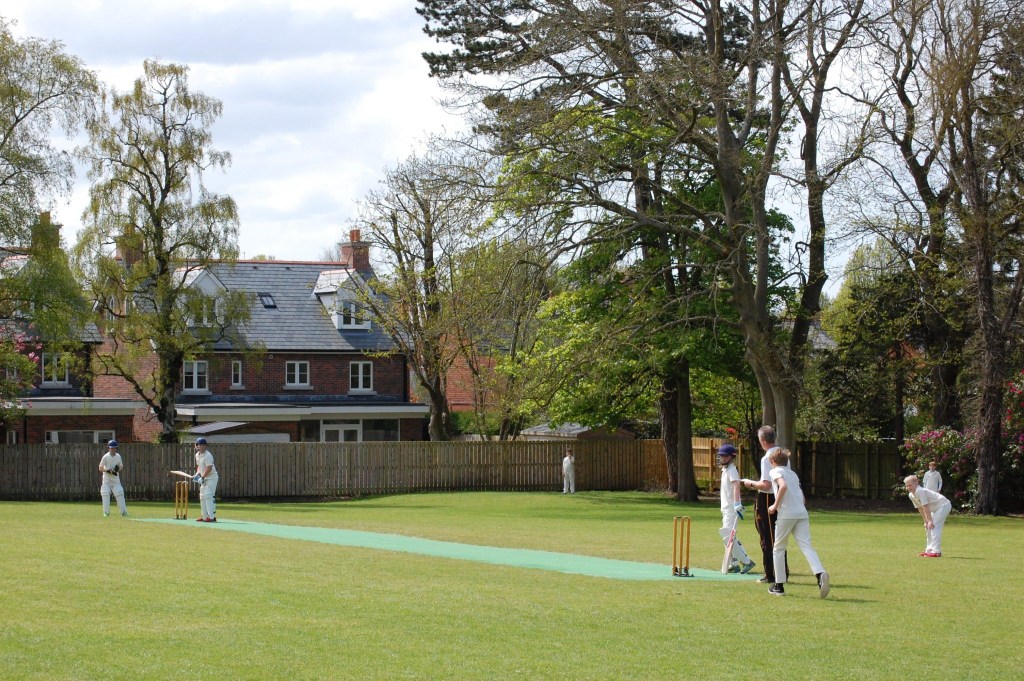
The rounders field now has an all-weather surface, but there is still real grass on the outfield of the main cricket ground. The Fathers v Sons match was due to be held the next day. In my mind Dad’s glorious cover drive rebounded against the red-brick wall. It didn’t matter that he was bowled out next ball. His four runs preserved my prestige.

Cricket at Inchmarlo, (image from school’s website)

Over in the dining hall Miss Weir, with her blue rinse hair, winged spectacles and handbag, was giving us elocution lessons, trying to wean us off Belfast vowels and consonants: “Cruella de Vil’s dinnah pahty took place in a black mahble room … and everything tasted of peppah.”

Next to the dining hall is the bicycle area where one day, when I was ten, I took a mental picture of me and my bike, and said to myself, “This exact moment in my life will never ever return”. I was right and wrong. It has returned many times in my memory, and it did so once more.

Tony and I had our picture taken at the friendship bench. The colourful wooden structure wasn’t there in the 60s, but we were then the best of friends, and remain so today, even though our paths diverged. Tony left when he was 8 years old. We both travelled far from Belfast and heard nothing of each other for over half a century. As I remember it, in our early years there were two gangs. Tony was the leader of one and I was his deputy. As Tony remembers it, he was often accused of being a swot, but I always had his back.

Inchmarlo remains a privileged place. The pupil numbers are small, and teachers have time for them, as well as for old boys. Edgar Lockett told us that the aim of education was to teach us how to think for ourselves. The school motto is Quaerere Verum — Seek the truth. Still a good guide after all these years.

Inchmarlo, Cranmore Park, Belfast (photo from school’s website)

Closely related in April

Brussels, 1 April 2022

I was born on the first of April. So I am an April Fool. Some of my fellow April fools may be ashamed of the day they were born, but it has always made me feel special. Every year on my birthday I am privileged to be on the receiving end of good wishes, birthday presents and practical jokes. Family and friends are in good form, and even people who don’t know me well and may forget other birthdays nevertheless remember mine.

When I was a child my mother used to come into my bedroom early on the morning of 1st April, pull back the curtains, and say “Oh look, is that snow on the ground? ” Snow on my birthday, hurrah, I must check this through the window: “April Fool !”

Continue reading “Closely related in April”