The poet Michael Longley, previously mentioned in this blog, died last week at the age of 85. I had the good fortune to have Michael Longley as my English teacher at Inst from 1967 to 1969. He was an inspirational young schoolmaster, introducing us to Homer, to Stravinsky, and, in person, to his friend Seamus Heaney, who read some of his first poems to us. Fifty years later I had the privilege to meet Michael again, when I interviewed him, during lockdown, for the Wigtown Book Festival.
With no experience of this sort of interview, I was a wee bit nervous at first, but Michael soon put me at ease, and I greatly enjoyed our conversation. I asked him about the different themes of his poetry and he read some of his favourite pieces. Towards the end of the interview, in answer to questions from viewers, he gave some fascinating insights into the art of writing poetry.
Over the years I carried the slim volumes of Michael Longley’s poetry with me all over the world. I recall asking his permission to read ‘Ceasefire’ at BRAC University in Bangladesh. Michael kindly allowed me to quote from two of his poems as epigraphs in my books of memoirs. My favourite poem of his used to be ‘Detour’, in which he imagines his own funeral meandering along the main street of an Irish market town, never reaching a conclusion. No doubt it will be read this week. I now think that my favourite poem is ‘Laertes’ which he chose, explained and read at the Wigtown Festival. Here is the link to the U tube video of our interview, called the Candlelight Master. The conversation starts at minute 6.20.
One of the joys of writing is learning the response of readers. Strangers tell you that they have enjoyed your story. Old friends get back in touch, and you learn more about one another. And sometimes people whom you did not know well show that they have understood you through your writing: they “really get you”.
Neil Faris was one such understanding reader. I had known Neil since I was a child, but I am closer in age to his younger brothers, Paul and John. I started school, at the age 4, in the same class as Paul, and I was best man at his wedding. John, who became a clergyman, kindly took the service at my brother’s funeral in 2017.
Neil followed this blog. He enjoyed my first book of memoirs Voyages with my Grandfather and encouraged me to write the seque The Corncrake’s Welcome. I sent some chapters to him and he offered meticulous and pertinent observations.
When I learnt that Neil was suffering from a severe form of cancer, I made a point of meeting up with him in Belfast. He was undergoing treatment and was not well, but we enjoyed coffee and scones at a cafe on the Lisburn Road, on a chilly October day. Six months later, he invited me for tea at his flat on the Malone Road, on a bright May morning. We chatted about our families, who have known each other for three generations, and we found that we viewed the world from similar standpoints. He was the grandson of a Presbyterian Minister, and I was a son of the Manse. We both attended Belfast Inst and both went on to study law. Neil’s years at Trinity College and mine at the Department of Foreign Affairs in Dublin broadened our Northern Irish perspective. I felt both enriched and stimulated after our conversations.
Neil died last month. Tributes from friends and colleagues appeared in The Newsletter and the Belfast Telegraph. Neil had been a leading Northern Irish lawyer who fought for justice, human rights, and the environment, and had made a difference in all these fields. He kept going right to the end.
After his death I realised that Neil left me a gift, in the form of a review of The Corncrake’s Welcome which he wrote earlier this year. He thought that it needed polishing, and wanted to discuss it with me, but we were not given the opportunity to do so. Here it is, unedited, and sorry I am to lose an old/new/good friend and a valued reader.
Review of The Corncrake’s Welcome – William D Hanna, Troubador Publishing Limited, Market Harborough
William Hanna was a son of Windsor Presbyterian Church Manse on the Lisburn Road in Belfast, becoming, in a diplomatic career, an ambassador of the European Union. The Corncrake’s Welcome is his engaging memoir of his and his family’s life and times in the Belfast of the 1960s and 1970s.
First of all, William Hanna marries very well elements of his family history. He was able to persuade his father, Rev William Hanna, to write reminiscences of his childhood in Loughgiel, County Antrim. Rev Mr Hanna records a deep love for the County Antrim countryside, evoking the call of the corncrakes, then common enough in the fields around Loughgiel. The community there was ‘mixed’ between Protestant and Catholic and Rev Mr Hanna developed a lasting friendship with a fellow cleric – who became Cardinal Cathal B Daly and who introduced Rev Mr Hanna to Pope John Paul II on the famous papal visit to Ireland in September 1979.
William Hanna records well how both Rev Mr Hanna and Cardinal Daly were, throughout their years of service in their respective churches, true men of peace in the long weary decades of sectarian violence that afflicted Northern Ireland (and the island of Ireland and Britain generally). But there is much else of interest in the reminiscences of Rev Mr Hanna: including his origins in the covenanting tradition of the Reformed Presbyterian Church – a tradition that perhaps may be novel to many protestants.
But William Hanna by no means forgets his mother, Honor Hanna. He includes very interesting extracts of 1942 from her World War 2 diary, when as Honor Boyd, she was a nurse in Belfast. As well as recounting the travails of that life and times she records the deep trauma of the loss on active service in Burma of her brother Jack. Truly, as William Hanna writes, 1942 was a fateful year for the family.
The second half of the book is then the personal story of William Hanna (both growing up in Belfast & at the start of his career in the Irish Diplomatic Service in Dublin).
Now, the ‘Windsor’ area of South Belfast was by no means immune from the sectarian violence which intensified across Northern Ireland in the 1960s and 1970s, even though, of course, many other areas suffered far worse. William Hanna recounts episodes where his father as presbyterian minister stood firm against sectarianism and for peace.
Just one example of this. Not in any way an incidental point, but William Hanna records a dreadful sectarian murder at Moore & Oliver’s garage then on the Lisburn Road and almost opposite the presbyterian church. Surely, Rev Mr Hanna was a genuine peacemaker being able to bring not just some comfort to the bereaved family and also, as William Hanna was told, years later at his father’s funeral, how in calling on and praying with the bereaved family Rev Mr Hanna had ‘taken the hate away’. Truly an act of enduring grace.
In summary, there is so much in the book that captures the best of Irish Presbyterianism that it should be appreciated by all those who are presbyterian adherents and also by those who value the contribution that Presbyterianism has made and can make on the island of Ireland and wider afield.
If you were out and about in South Belfast last week you might have noticed a pair of grey-haired men jogging up the Malone Road and down the Lisburn. Tony was in Northern Ireland for a wedding, and I was there for a funeral. We decided to meet up and revisit old haunts, including Inchmarlo, our preparatory school.
Tony, who is a ski instructor in his retirement, was always a natural sportsman, and still is a competitive runner, placed 150 somethingth in the world in his category. I run in no known categories, local or international, and was relieved that my wonky left knee held up for our 7km circuit, gaining me Strava kudos.
Upon reaching Cranmore Park I found a pretext to halt a while. Where precisely had been the little woods where Miss Strahan led us on nature walks? There was once a pond, fringed with frogspawn, hidden under sycamores and horse chestnuts, giving masses of conkers in autumn. One day the woods were removed to make way for more rugby pitches. Inst’s insatiable quest to win the Schools’ Cup had triumphed over concern for conservation of the natural environment. Back then the ‘environment’ hadn’t yet been invented.
I showed Tony the place where, as I walked home from school at the end of term, along the chalk-flecked footpath, three or four great raindrops fell out of a clear sky onto the page of my report book, smudging the blue ink. I had opened the book to find out my marks and my place in class. We were not supposed to do this before our parents saw the book. My curiosity was now indelibly recorded for parents and teachers alike to see.
I wondered how reliable our memories would be the following day, when we were to tour the school, for the first time in 60 years. Tony pointed out that in my email to the Headteacher I had got our first year wrong: it was 1959 not 1958. But I recalled all the names of the teachers correctly. He was always good with numbers, and became a nuclear physicist. He also taught me my first words of French — which I won’t repeat here: I became a diplomat.
Next day we were warmly welcomed by the Headteacher and her deputy. But for me the school was still under the steely-eyed sway of our Headmaster, the ubiquitous Edgar Lockett. He was standing there, stiff and soldier-like, on the stairs above the Assembly; he was in shirt-sleeves in the covered way showing us how to play forward and backward defensive shots with the cricket bat; and he was smiling as he challenged us to spell Parliament and Government. A couple of lectures he gave me on the importance of hard work still ring in my ears.
I placed myself against the wall under where the clock used to be. This was where you were made to stand if you were sent out of the classroom for bad behaviour. Did this ever happen to me? It must have, for time now slowed down. I could hear the silence all through the building as I waited for the small impossibly suntanned Headmaster, to descend the creaking wooden stairs and quiz me about the nature of my misdemeanor.
Miss Kilpatrick’s class 1959/60 (thanks to Maurice Cassidy)
We adored Miss Kilpatrick, our first teacher, who one day placed fat black pencils in our hands and told us we could write with them. Unfortunately the blue cupboard with its panelled door in Miss Kilpatrick’s room was gone. But its contents were not forgotten. The headteacher still keeps a stash of sweeties as rewards. Miss Lamont mothered us and encouraged creative writing. I once wrote six pages for her about far off lands that I might travel to. But it is still Miss Strahan, striding the football pitch in her tweeds, with her shrill silver whistle, who is the most remembered teacher of those earliest years. She wrote that I must ‘hitch my wagon to a star’ and kept me in after class one day to write five lines: ‘I must not forget my handkerchief’. Tony remembered her pointing finger at lunchtime: ‘Eat that up ! ”
The floors were most familiar. The upstairs pine floor knotted and warped, the assembly hall criss-crossed by oak parquet, and the terrazzo in the cloakroom grey and white, precisely as I remembered it. We were small boys then, close to the ground.
The Ring, an oval-shaped path where we used to run, is still there. I showed Tony the final bend, where I was tripped up one day, and both my knees were sandpapered by the tarmacadam, turning rapidly from white to pink and then crimson. Ouch !
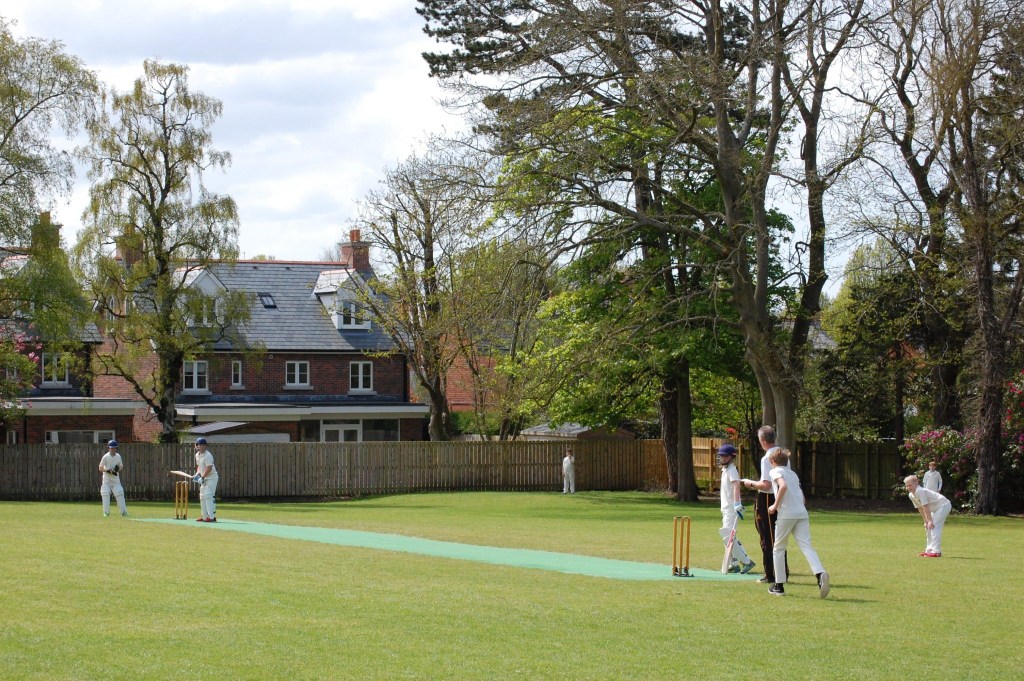
The rounders field now has an all-weather surface, but there is still real grass on the outfield of the main cricket ground. The Fathers v Sons match was due to be held the next day. In my mind Dad’s glorious cover drive rebounded against the red-brick wall. It didn’t matter that he was bowled out next ball. His four runs preserved my prestige.
Cricket at Inchmarlo, (image from school’s website)
Over in the dining hall Miss Weir, with her blue rinse hair, winged spectacles and handbag, was giving us elocution lessons, trying to wean us off Belfast vowels and consonants: “Cruella de Vil’s dinnah pahty took place in a black mahble room … and everything tasted of peppah.”
Next to the dining hall is the bicycle area where one day, when I was ten, I took a mental picture of me and my bike, and said to myself, “This exact moment in my life will never ever return”. I was right and wrong. It has returned many times in my memory, and it did so once more.
Tony and I had our picture taken at the friendship bench. The colourful wooden structure wasn’t there in the 60s, but we were then the best of friends, and remain so today, even though our paths diverged. Tony left when he was 8 years old. We both travelled far from Belfast and heard nothing of each other for over half a century. As I remember it, in our early years there were two gangs. Tony was the leader of one and I was his deputy. As Tony remembers it, he was often accused of being a swot, but I always had his back.
Inchmarlo remains a privileged place. The pupil numbers are small, and teachers have time for them, as well as for old boys. Edgar Lockett told us that the aim of education was to teach us how to think for ourselves. The school motto is Quaerere Verum — Seek the truth. Still a good guide after all these years.
Inchmarlo, Cranmore Park, Belfast (photo from school’s website)



 Closely Related to Chester
You must be logged in to post a comment.