The Maria Raffo

Nonna Maria, centre right, with grand-daughter Paola, standing in front.

On one of my first visits to Italy, in the late 1970s, Paola introduced me to her grandmother. Nonna Maria spoke no English and I had learnt just a few phrases of Italian, but we smiled at each other and I learned afterwards that the matriarch had pronounced that I was a ‘ragazzo per bene’ – a suitable boy.

Nonna Maria died a few years later. Paola and I were married in 1978 and spent the following forty years living and working around the world. A couple of years after retiring we decided to look for somewhere warm to spend the winter months. We focussed on Liguria, the Italian riviera, which extends on either side of Genoa, from Ventimiglia at the French border, to Cinque Terre in the South. Paola’s brother and several cousins lived here, and her nonna Maria had originally come from Genoa, or so I thought.

In autumn 2022 we drove from Belgium through Switzerland to Italy and began our search for a suitable winter home. I had only one condition: that there should be a golf course nearby. I am addicted to the game, and sport is a great way to make friends in a new country. We found an excellent course in Garlenda, but it was not particularly welcoming. Golf is still an elite sport in Italy, with the associated golf snobbery. We travelled from the Ponente (sunset) side of Liguria to the Levante (sunrise) side and spent a week in Lerici, on the beautiful Bay of Poets, which Shelley and Byron visited in the 19th century. The sunsets were spectacular, but there was only a miniature golf course.

However we found a more promising 18 hole golf course in Rapallo, a town which was also once frequented by poets – W.B.Yeats and Ezra Pound held court there in the 1920s. I made up a three ball with two club members who had recently retired from Turin and Milan. These gentlemen were good company, not over fussy about the golf, but, like most Italians, obsessed with food. After the 14th hole they enquired if I was not hungry and suggested that we adjourn for lunch, as the kitchen was closing soon. Over a tasty dish of spaghetti, and a good bottle of wine, we chatted about the essential criteria for a winter home. They recommended that I avoid small touristy places which would be dead in December. Instead they suggested I should consider nearby Chiavari, a town with a large local population. Many people from Chiavari emigrated to South America, in the 19th and early 20th centuries, where they made their fortune. On their return to Chiavari, in the 1930s, they constructed palazzi on wide avenues with names such as Corso Buenos Aires or Corso Montevideo. In Chiavari I might find an apartment in one of the palazzi from that era to renovate.

When I told Paola about my conversation with the golfers, and suggested that we try Chiavari, she consulted her relatives. They pointed out that Chiavari was in fact Nonna Maria’s birthplace. She had lived in the city until, aged seventeen, she eloped with Paola’s grandfather. (He was already married, with several children, but that is another story.) So Paola was happy for us to explore Chiavari, where she had family roots.

We found a friendly B & B and liked the feel of the city. There was a marina,with sailing boats, and a wide seaside promenade which offered regular saffron sunsets. In the town ancient narrow streets, bordered by colonnades, were packed with little shops. Even in December Chiavari was full of people walking up and down the Carrugio, chatting in groups or having coffee.

We viewed a few apartments, but found nothing exceptional, until I came across an agency specializing in renovations. They took us to visit a palazzo built in the 1930s. Over the entrance was the figure of a sailing ship, cast in iron. We climbed up marble stairs to a third-floor apartment and were struck by the entrance hall with its Art Deco tiled floor. The house was owned by a family once famous for the manufacture of tiles, and in each room the floor had a different pattern. Part of the apartment was being used as offices and there was little furniture. The main room was bright, facing South. I looked out to palm trees and the marina, and beyond a myriad of little boats sailing on a shimmering blue sea. I could imagine us settling in this place, and so could Paola.

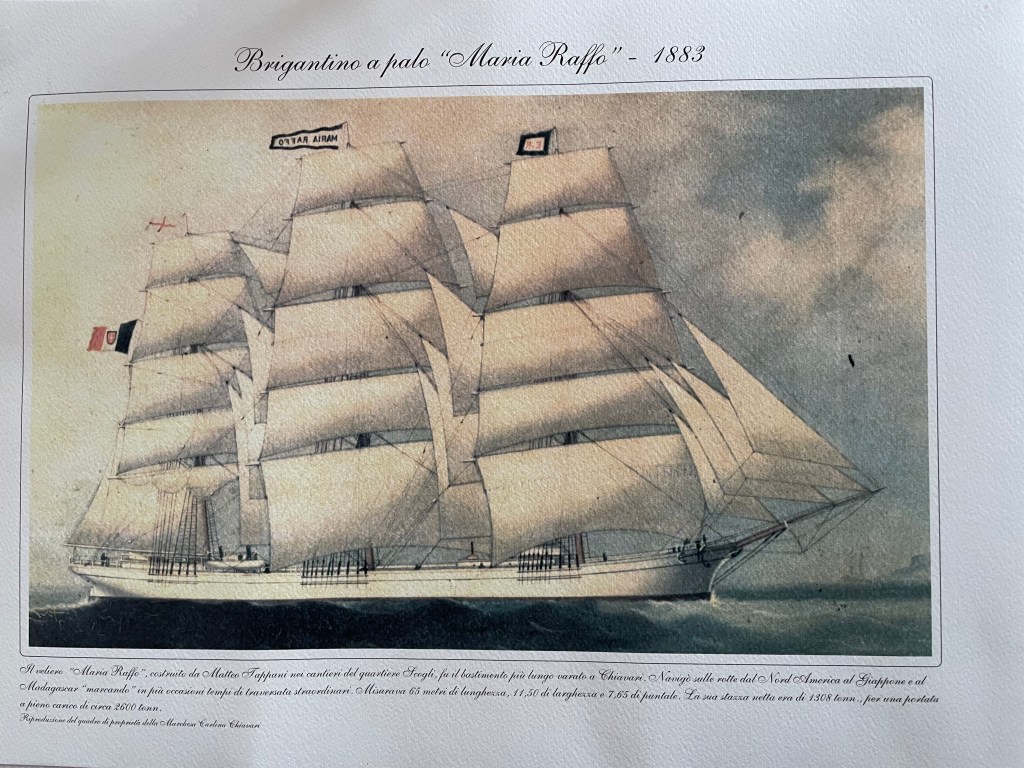
Turning away from the view, my eye was caught by a framed picture lying abandoned in the corner of the room on an old sideboard. I walked up to have a closer look. The picture was a drawing of a three-masted sailing boat, a Brigantine, and written in italics at the top was the boat’s name.

The boat was called the Maria Raffo, which is the full maiden name of Paola’s grandmother, nonna Maria Raffo.

This was a sign, a blessing from nonna Maria. We looked no further. We bought the flat, renovated it, and are living in it two years later.

At Christmas Paola gave me a copy of the Maria Raffo drawing which you can see below. The boat was built in Chiavari in 1883 for the shipowner Ernesto Raffo. It was remarkably fast and resistant in storms. For many years it carried goods across the Pacific Ocean, from the US to Japan, breaking records for speed. We have not yet discovered the link between Paola’s grandmother and the boat. Perhaps Ernesto Raffo named his boat after his wife. Was she a relative of Paola’s grandmother ? Whatever the precise history, these days Paola feels quite at home putting down new roots in Chiavari, the city of her grandmother, where everyday, as she goes to market and gets to know the inhabitants, she is no doubt meeting people to whom she is in some way related.
Exile in Paradise

Sandy Lane, Barbados

In 1685, during the reign of Charles II, the covenanter William Hanna of Wigtown in south west Scotland was banished to Barbados for his refusal to acknowledge the King’s religious authority. Britain had established an important colony on the tiny Caribbean island, with sugar plantations, worked first by indentured labour and later by African slaves. It is not known whether my namesake made it safely across the Atlantic to captivity in Barbados. Many ships were wrecked on the voyage there and he may have drowned on the way.

Three centuries later Barbados, with a population of 250,000, had become an independent country, the proud ‘craftsman of its fate’ and a growing tourist destination. It was a model democracy, with a long established Parliament. It still exported sugar and rum, and produced some of the finest cricketers in the world. Tourists thought of it as paradise.

Barbados was also the location for the Delegation of the European Commission to the Eastern Caribbean. A strange set of circumstances decreed that Barbados would be my first Delegation, and that I should enjoy a more fortunate exile than my courageous Scottish forefather.

Continue reading “Exile in Paradise”

The Best of Irish Presbyterianism

One of the joys of writing is learning the response of readers. Strangers tell you that they have enjoyed your story. Old friends get back in touch, and you learn more about one another. And sometimes people whom you did not know well show that they have understood you through your writing: they “really get you”.

Neil Faris was one such understanding reader. I had known Neil since I was a child, but I am closer in age to his younger brothers, Paul and John. I started school, at the age 4, in the same class as Paul, and I was best man at his wedding. John, who became a clergyman, kindly took the service at my brother’s funeral in 2017.

Neil followed this blog. He enjoyed my first book of memoirs Voyages with my Grandfather and encouraged me to write the seque The Corncrake’s Welcome. I sent some chapters to him and he offered meticulous and pertinent observations.

When I learnt that Neil was suffering from a severe form of cancer, I made a point of meeting up with him in Belfast. He was undergoing treatment and was not well, but we enjoyed coffee and scones at a cafe on the Lisburn Road, on a chilly October day. Six months later, he invited me for tea at his flat on the Malone Road, on a bright May morning. We chatted about our families, who have known each other for three generations, and we found that we viewed the world from similar standpoints. He was the grandson of a Presbyterian Minister, and I was a son of the Manse. We both attended Belfast Inst and both went on to study law. Neil’s years at Trinity College and mine at the Department of Foreign Affairs in Dublin broadened our Northern Irish perspective. I felt both enriched and stimulated after our conversations.

Neil died last month. Tributes from friends and colleagues appeared in The Newsletter and the Belfast Telegraph. Neil had been a leading Northern Irish lawyer who fought for justice, human rights, and the environment, and had made a difference in all these fields. He kept going right to the end.

After his death I realised that Neil left me a gift, in the form of a review of The Corncrake’s Welcome which he wrote earlier this year. He thought that it needed polishing, and wanted to discuss it with me, but we were not given the opportunity to do so. Here it is, unedited, and sorry I am to lose an old/new/good friend and a valued reader.

Review of The Corncrake’s Welcome  – William D Hanna, Troubador Publishing Limited, Market Harborough

William Hanna was  a son of Windsor Presbyterian Church Manse on the Lisburn Road in Belfast, becoming, in a diplomatic career,  an ambassador of the European Union. The Corncrake’s Welcome is his engaging memoir of his and his family’s  life and times in the Belfast of the 1960s and 1970s.  

First of all, William Hanna marries very well elements of  his family history. He was able to persuade his father, Rev William Hanna, to write reminiscences of his childhood in Loughgiel, County Antrim. Rev Mr Hanna records a deep love for the County Antrim countryside, evoking the call of the corncrakes, then common enough in the fields around Loughgiel. The community there was ‘mixed’ between Protestant and Catholic and Rev Mr Hanna developed a lasting friendship with a fellow cleric – who became Cardinal Cathal B Daly and who introduced Rev Mr Hanna to Pope John Paul II on the famous papal visit to Ireland in September 1979.

William Hanna records well how both Rev Mr Hanna and Cardinal Daly were, throughout their years of service in their respective churches, true men of peace in  the long weary decades of sectarian violence that afflicted Northern Ireland (and the island of Ireland and Britain generally). But there is much else of interest in the reminiscences of Rev Mr Hanna: including his origins in the covenanting tradition of the Reformed Presbyterian Church – a tradition that perhaps may be novel to many protestants.

But William Hanna by no means forgets his mother, Honor Hanna. He includes very interesting extracts of 1942 from her World War 2 diary, when as Honor Boyd, she was a nurse in Belfast. As well as recounting the travails of that life and times she records the deep trauma of the loss on active service in Burma of her brother Jack. Truly, as William Hanna writes, 1942 was a fateful year for the family.

The second half of the book is then the  personal story of William Hanna (both growing up in Belfast  & at the start of his career in the Irish Diplomatic Service in Dublin).

Now, the ‘Windsor’ area of South Belfast was by no means immune from the sectarian violence  which intensified across Northern Ireland in the 1960s and 1970s, even though, of course, many other areas suffered far worse. William Hanna  recounts episodes where his father as presbyterian minister stood firm against sectarianism and for peace.

Just one example of this.  Not in any way an incidental point, but William Hanna records a  dreadful sectarian murder at Moore & Oliver’s garage then on the Lisburn Road and almost opposite the presbyterian church. Surely, Rev Mr Hanna was a genuine peacemaker being able to bring not just some comfort to the bereaved family and also, as William Hanna was told,  years later at his father’s  funeral, how in calling on and praying with the bereaved family Rev Mr Hanna had  ‘taken the hate away’. Truly an act of enduring grace.

In summary, there is so much in the book that captures the best of Irish Presbyterianism that it should be appreciated by all those who are presbyterian adherents and also by those who value the contribution that Presbyterianism has made and can make on the island of Ireland and wider afield.

Neil Faris