Last Sunday night I dreamt about Bangladesh, where I served as EU Ambassador from 2010 to 2014. In my dream I was organizing a diplomatic event, when the Prime Minister, Sheikh Hasina suddenly appeared in the room, totally alone. I had not expected her to attend in person, and I rushed around trying to find a chair for her to sit on, but each one I looked at was broken. Since I was unable to find a suitable chair the PM lay down on the floor. When I awoke I told my wife about the dream. An hour later I learnt on BBC radio news that Sheikh Hasina, who had been in power since 2010, had fled the country, leaving by helicopter before students ransacked her palace.
Although it is ten years since I lived in Bangladesh I still have great affection for the country. People often ask me which of my diplomatic postings I enjoyed the most. I reply that it was Bangladesh. It’s not that the capital, Dhaka, was a comfortable place to live. Far from it: Dhaka usually features as one of the most unlivable capital cities in the world. But the people of Bangladesh captivated me: their language and culture, their courage, resilience and determination to succeed in the face of adversity impressed me profoundly and have stayed with me.
In my book Voyages with my Grandfather ( https://troubador.co.uk/bookshop/travel/voyages-with-my-grandfather) I told the story of my first official meeting with Sheikh Hasina, the then Prime Minister. Soon after my arrival in Bangladesh I learnt of the work of Rabindranath Tagore, the finest poet in Bangla, composer of the national anthems of India and Bangladesh, and winner of the Nobel Prize. I discovered both an Irish and Scottish connection. The Irish connection is W. B. Yeats, who was one of the first westerners to appreciate Tagore’s work. The Scottish connection is Robert Burns. Tagore adapted the words and music of one of Burns’ most beautiful songs to the Bangla language and topography. He transposed ‘Ye Banks and Braes’ into ‘Phule Phule’ which is today one of the most popular folk songs in Bangladesh.
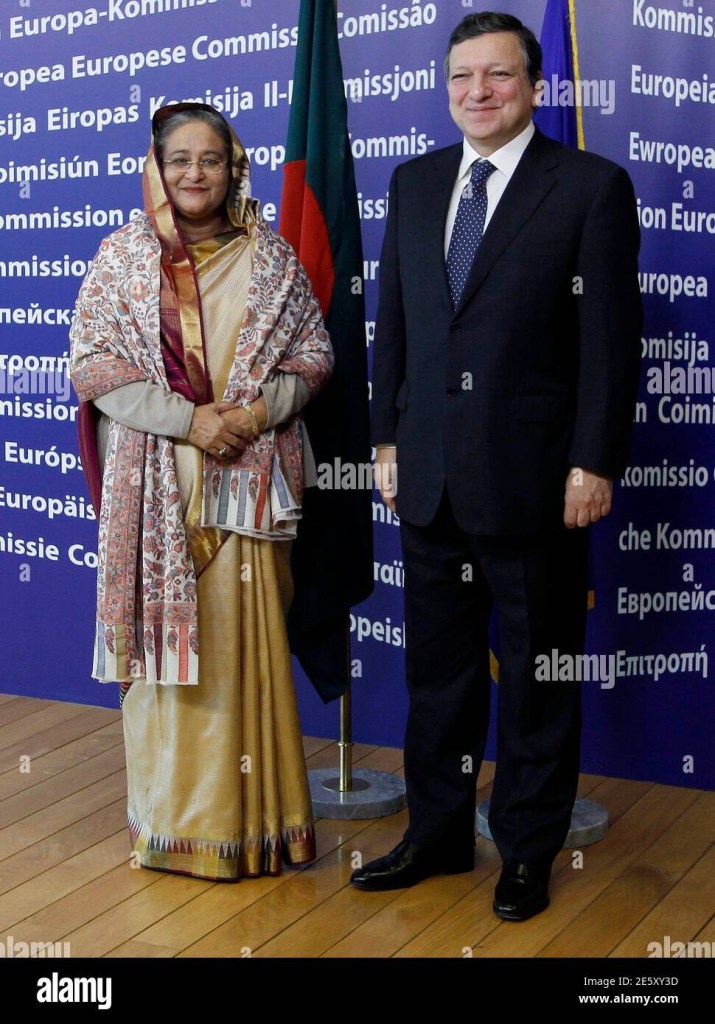
On the day appointed for my first meeting with Sheikh Hasina I was sitting in a large room in her palace, talking nervously to her diplomatic adviser. I told him about Tagore and Burns and started humming the tune of Phule Phule. At that moment the Prime Minister entered the room and sat down on an embroidered settee. Her adviser began the introductions by informing the PM that the new European Ambassador had a song for her. This was not a moment to be bashful. So I started singing ‘Phule Phule, dhole dhole’. And then, for a few moments, Sheikh Hasina joined in and sang the song with me, in a soft and tuneful voice.
I did not mention in my book that I rather spoiled this harmonious start to my new assignment by asking the PM how certain minorities in the country, such as the Rohingya, were being treated. My mandate was to improve relations between the EU and Bangladesh. We promoted trade and business and provided a lot of aid. But our main purpose – the main objective of EU Foreign Policy was, and remains, to strengthen fundamental values such as democracy, the rule of law and human rights. At times this led to a difficult dialogue, particularly in 2014 when we decided not to observe the elections because of the undemocratic actions of the government. This decision displeased the PM. Although I saw the President before I left the country, the PM was unavailable to meet me for a farewell courtesy call.
Over the years since then Sheikh Hasina’s rule became increasingly authoritarian, and student protests grew. I have now retired, and have not been following the events in Bangladesh closely. Last week I had no conscious idea that the protesters were so near to ousting the PM. I suppose my dream must have been a case of my unconscious mind drawing some conclusions.

One person who was always prepared to see me, not only when I first arrived in Dhaka, but also when I said farewell, was Nobel prize winner and founder of the Grameen Bank, Muhammad Yunus. I recall his sense of despair ten years ago at the authoritarian direction the country was already taking. Today he has been appointed head of an interim government. I am convinced that Yunus, who is 84, has no political ambitions. He simply wishes to serve his country. He has made some hopeful statements. For my many friends in Bangladesh, and for its millions of people, I sincerely hope that he will be able to ensure an orderly and peaceful transition towards a democratically elected government, in full respect of human rights and democratic principles.

 Closely Related to Chester
Very interesting Willie
There’s certainly a lot more going on in realms we can’t explain or understand.
Let’s hope things settle down there with recent developments.
LikeLiked by 1 person